
How co-owners hold title in California and the disputes that arise between them, from joint tenancy and possession to inheritance, breakups, and uncooperative co-owners. Every Talkov Law guide on co-ownership, organized by topic.

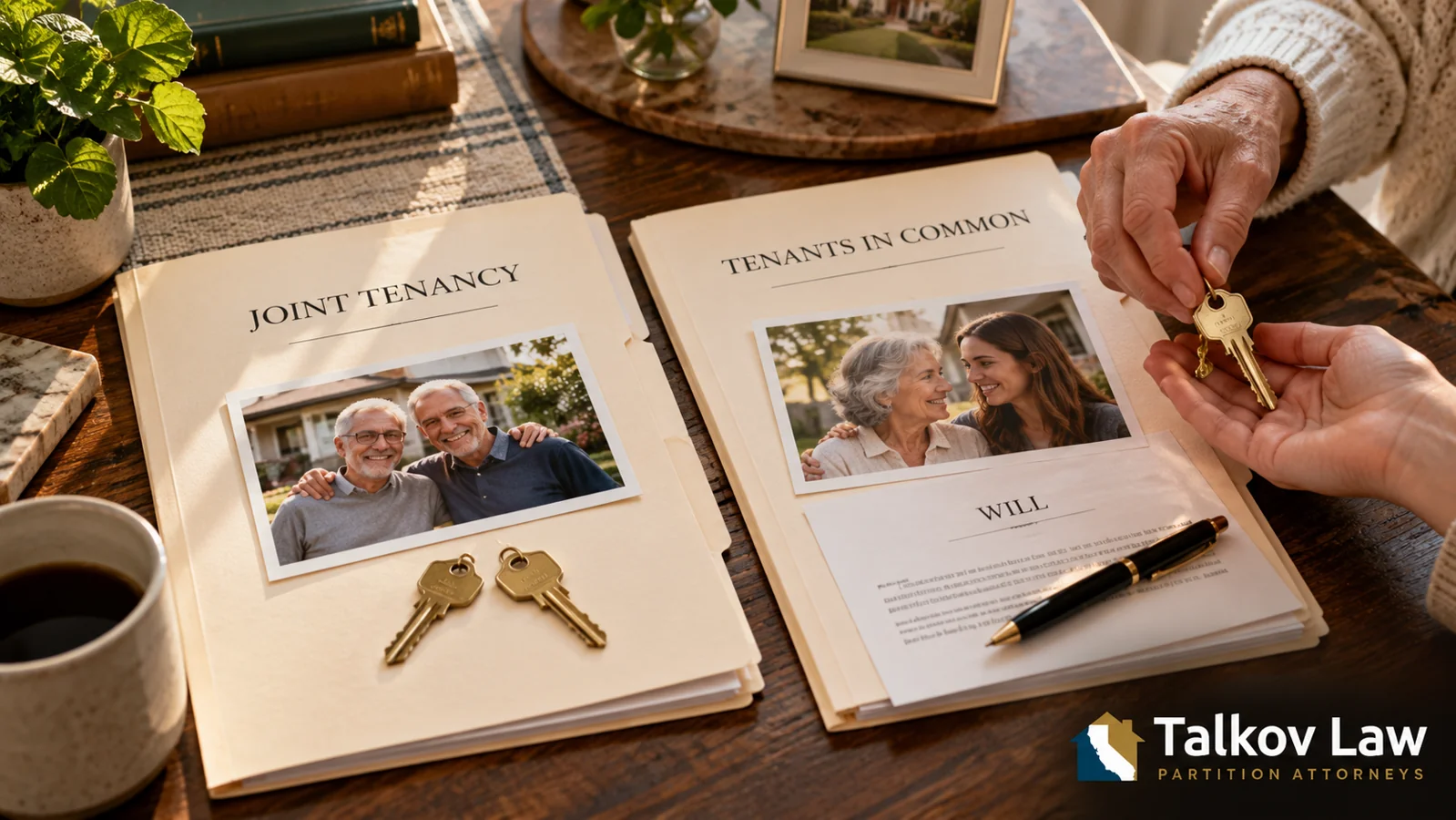
Co-owners of California real estate usually hold title as joint tenants or as tenants in common. How title is held decides what each owner’s share is, what happens when an owner dies, and which rules apply when the owners disagree.
This page collects every Talkov Law guide, form, and case summary on co-ownership, organized by topic. When co-owners cannot agree, the remedy is a partition action.
Four questions co-owners ask
- How do we hold title?Joint tenancy, tenancy in common, and what each means for your share.
- Who owns what share?Deeds, contributions, and how a court decides disputed ownership.
- Who gets to live there?Each co-owner’s right to possession, ouster, and rental value.
- What if my co-owner won’t cooperate?Co-owners who will not talk, sell, or leave, and how to break the deadlock.
Essential co-ownership guides
 Start hereJoint tenants vs. tenants in commonThe two main ways co-owners hold title, and what the difference means.
- Joint tenancyJoint tenancy in CaliforniaEqual shares and the right of survivorship.
- Tenancy in commonWhat is tenancy in common?The default form of co-ownership in California.
- Your shareHow to calculate your shareOwnership percentages, credits, and what each owner receives.
- PossessionWhat is ouster?When one co-owner wrongfully excludes another from the property.
- TitleRemoving a co-owner from titleHow a co-owner comes off the deed, by agreement or through the court.
- MortgageWhen a co-owner stops paying the mortgageYour options when you are covering more than your share.
- Inherited propertyForcing the sale of an inherited houseWhat heirs can do when they cannot agree on selling.
- Uncooperative co-ownerWhen the co-owner living there refuses to sellWhy living in the home usually does not stop a partition.
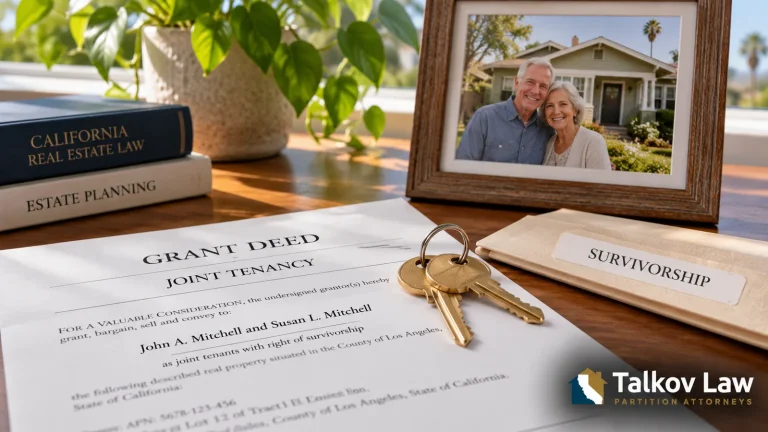


Latest co-ownership articles
- Lindsay-Field v. Friendly: One Co-Owner Can’t Sign Away Your Share
- Swartzbaugh v. Sampson: A Co-Owner’s Lease Binds Only Their Own Share

- How Do I Transfer My Share of a Co-Owned Property in California?
- Does Paying Someone Else’s Property Taxes Give You Ownership in California?

- Adams v. Hopkins: Why Time Never Bars a Partition Between Co-Owners
- Gerontopoulos v. Gerontopoulos: Little Credit for Repairs by the Co-Owner Living in the House

- Forrest v. Elam: When a Life Tenant Forces a Partition Sale
- Cosler v. Norwood: Joint Tenants Can Own Unequal Shares in a Partition
- Estate of Hughes: When Claiming the Whole House Is an Ouster
- Riddle v. Harmon: A Joint Tenant Can Sever by Deeding to Herself
Browse by topic
1.Joint tenancy
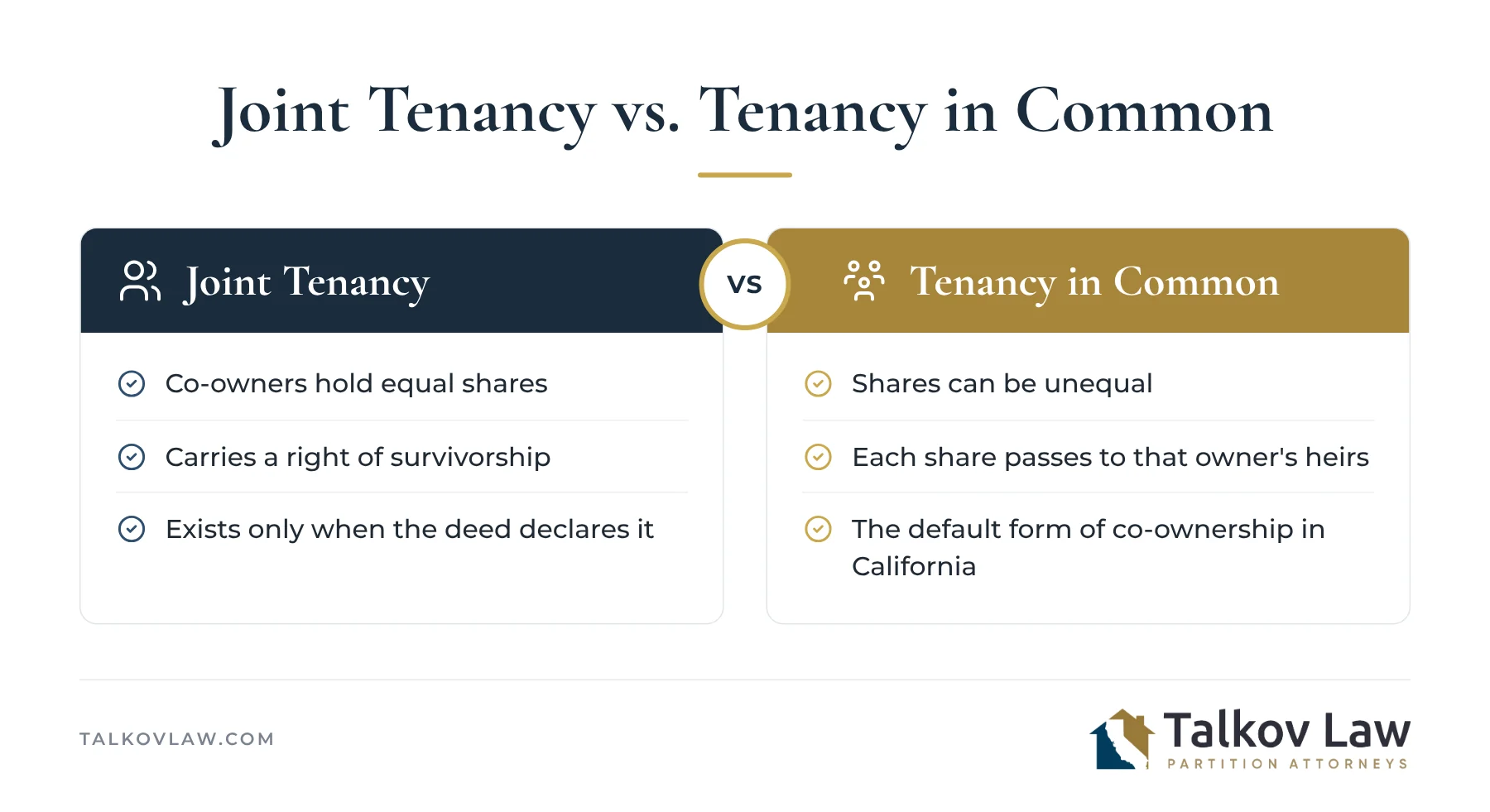
Joint tenancy is co-ownership in equal shares with a right of survivorship. It exists only when the deed expressly declares a joint tenancy.
These guides cover how joint tenancy works in California, the right of survivorship, severing a joint tenancy, and how joint tenants’ shares are decided in a partition.
- Civil Code 683How a joint tenancy is created
2.Tenants in common
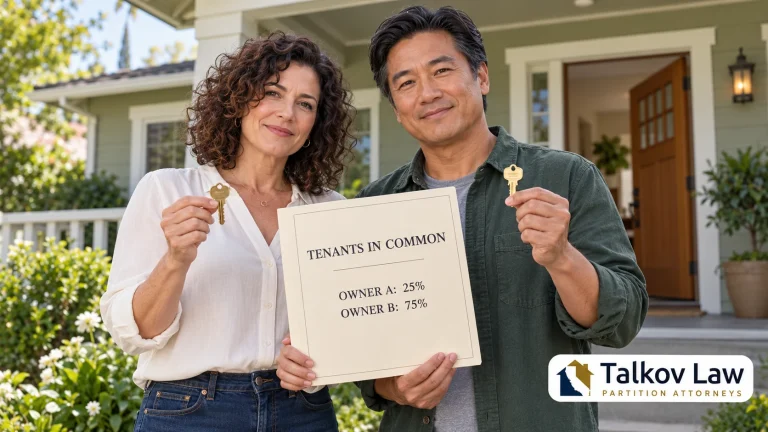
Tenancy in common is the default form of co-ownership in California. Shares can be unequal, and each owner’s share passes to their own heirs.
These guides cover tenancy in common, tenancy-in-common (TIC) agreements, and how tenants in common divide property in a partition.
- Civil Code 686Tenancy in common as the default form of co-ownership
4.Transfer and title
Co-owners change who is on title with a deed. A deed changes who owns the property. It does not change who owes the mortgage.
These guides cover grant and quitclaim deeds, selling or transferring a fractional share, unrecorded deeds, and title insurance.
5.Possession and ouster
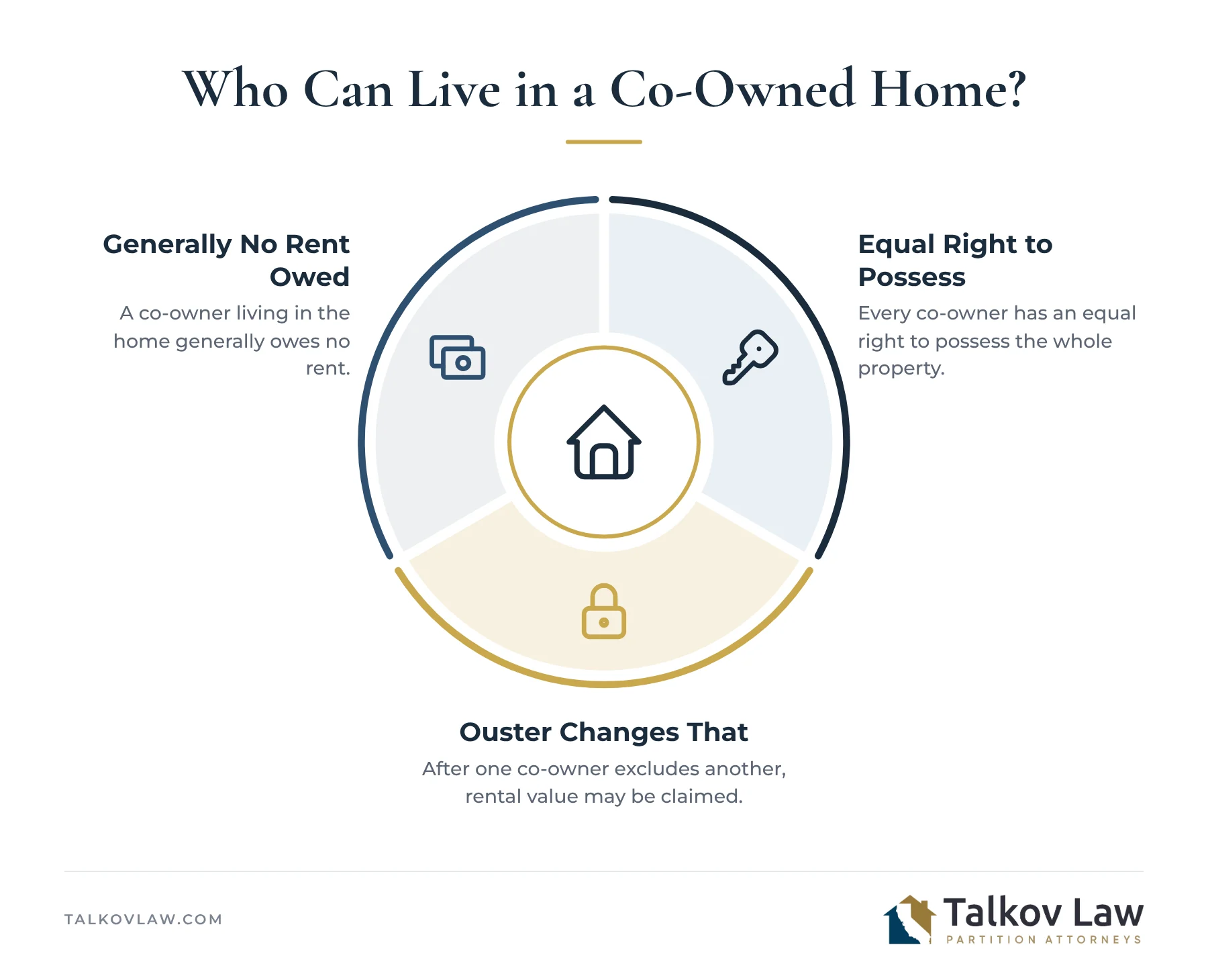
Every co-owner has an equal right to possess the whole property, so a co-owner living in the home generally owes no rent to the others. That changes after an ouster, when one co-owner excludes another.
These guides cover each co-owner’s right to occupy the property, when exclusion becomes ouster, claims for rental value, and co-owners who change the locks or refuse to leave.
- Civil Code 843How an excluded co-owner establishes an ouster
6.Mortgage liability
Signing a deed does not take a co-owner off the loan. A co-owner stays liable on the mortgage until it is refinanced, paid off, or the lender releases them.
These guides cover removing your name from the loan, refinancing, loan assumptions, and buyouts when you are on the mortgage.
7.Inheritance, trusts, and probate
Heirs who inherit a house together often hold it as tenants in common, and inherited property is the most common setting for partition. A co-owner generally may seek partition without every sibling or other heir agreeing to a sale.
These guides cover heirs who disagree, partitions involving trustees and executors, and the Uniform Partition of Heirs Property Act.
8.Former partners and spouses
Unmarried couples who bought a home together can end the co-ownership through a partition action. Community property between spouses is divided in the family court instead.
These guides cover community property versus partition, divorce-related orders, and breakup issues such as engagement rings.
9.Uncooperative co-owners
A co-owner’s objection to a sale is generally not a defense to partition. Refusing to sell, living in the home, or going silent usually does not stop the case.
These guides cover co-owners who will not talk, sell, cooperate, or leave, and how a partition action breaks the deadlock.
- CCP 872.710Partition as of right, unless a valid waiver bars it
10.Deceased, missing, and unreachable co-owners
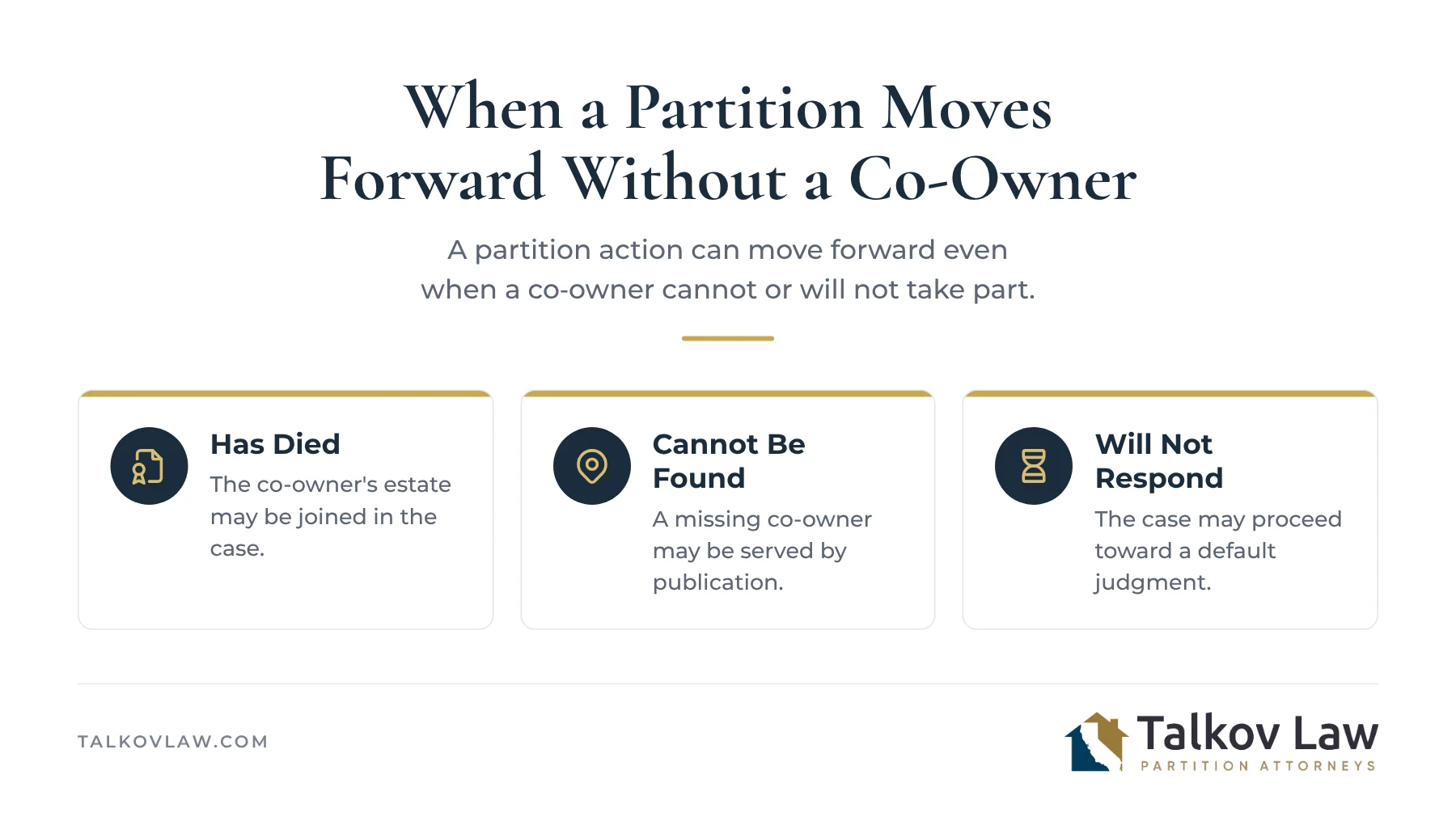
A partition action can move forward even when a co-owner has died, cannot be found, or will not respond. California’s partition statutes provide a process for serving a missing co-owner, including service by publication.
These guides cover joining an estate, unknown heirs, service by publication, and default judgments.
See every Deceased, Missing & Unreachable Co-Owners article →

Scott Talkov
Founder & Managing Partner, Talkov Law
Scott Talkov founded Talkov Law and leads its partition practice, representing co-owners across California in disputes over title, possession, inherited property, and the sale or buyout of co-owned real estate.
Read Scott’s bio →





