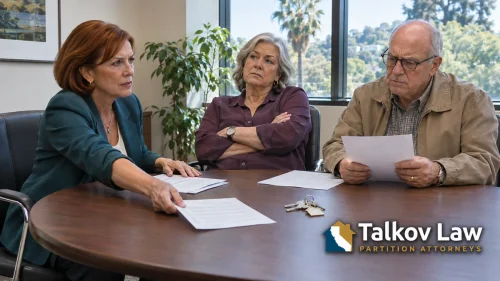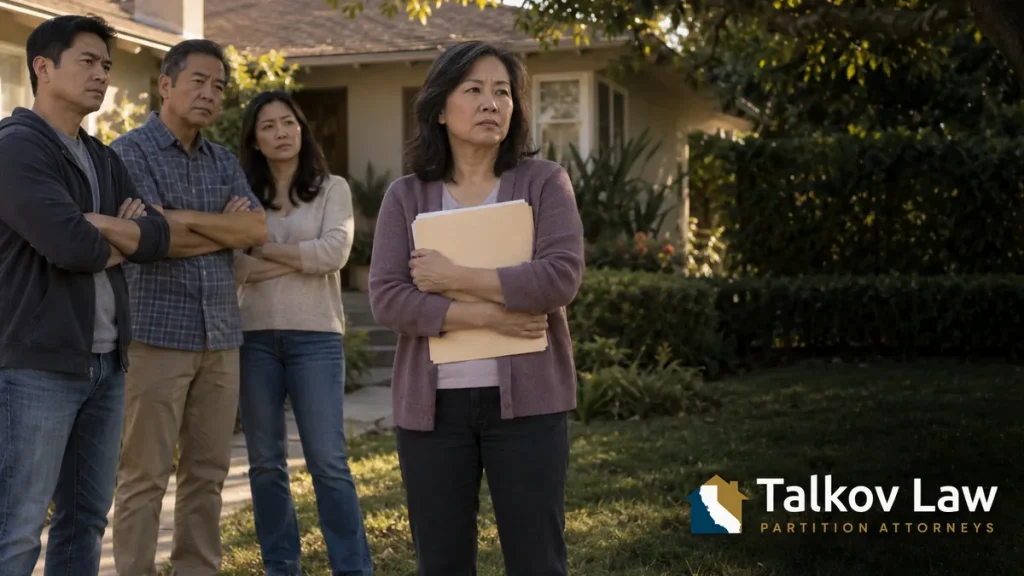
A co-owner who games a partition can be stuck paying all of their own attorney’s fees. In Lin v. Jeng (2012) 203 Cal.App.4th 1008, 1025–1026, the Court of Appeal upheld an order denying a sister any share of her more than $100,000 in fees after she claimed 85 percent of the family home while knowing her siblings owned most of it. The court held that judges have broad power to divide partition fees based on fairness, not just ownership percentages.
That makes the case the key authority for anyone asking whether a difficult co-owner can be made to bear more of the cost of a partition. Our guide to who pays for a partition action explains the general rules.
Why Lin v. Jeng Matters
Partition fees spent for the common benefit of all owners are costs of partition under California Code of Civil Procedure section 874.010. California Code of Civil Procedure section 874.040 then directs the court to divide them “among the parties in proportion to their interests or make such other apportionment as may be equitable.” (Lin v. Jeng, at p. 1022.)
Before this case, an earlier decision had read that second option very narrowly, as allowing an unequal split in only two technical situations. (Finney v. Gomez (2003) 111 Cal.App.4th 527, 545–547.) Lin v. Jeng, at pages 1022–1025, rejected that reading. Now a court can look at how each co-owner behaved and shift fees accordingly:
- Fees still start out split by ownership.
- A co-owner who overreaches or drags out the case can be made to pay more, or all, of their own fees.
- The court must have a reason in the record, and appellate courts will defer to it.
The Facts: A Sister Who Claimed 85 Percent
Seven adult siblings’ parents lived in a house in Alhambra, in Los Angeles County. The deed put 85 percent in the name of Shwu-Jen Lin, a real estate agent who arranged the purchase, and her husband, and 15 percent in the name of her brother, Ing-Jieh Jeng. Most of the down payment came from their mother, and several brothers sent money each month to help cover the mortgage. (Lin v. Jeng, at pp. 1012–1016.)
Lin and her husband filed a partition action against Jeng alone, claiming 85 percent and asking for a partition by sale. She did not name her other siblings, so the five of them had to file their own complaint to join the case, claiming that all seven siblings shared ownership. (Lin v. Jeng, at p. 1010.)
The siblings won. The trial court looked past the deed, found that the people on title held the house in trust for the family members who had paid for it, and gave Lin a 15.45 percent share. That ruling was affirmed in an earlier appeal, and the house was sold. (Lin v. Jeng, at pp. 1019–1020.) Then came the fight over fees.
The Trial Court Made Lin Pay Her Own Fees
Both sides asked to share their fees with everyone. The siblings sought $79,626, and Lin and her husband sought $106,768.85. The trial court divided the siblings’ fees among all owners by percentage, so Lin paid her 15.45 percent share. It denied Lin’s request entirely. (Lin v. Jeng, at pp. 1020–1021.)
The judge found that the equities favoring the siblings “far outweighed any equity whatsoever for the plaintiff[s],” and that Lin “manipulated this thing … in her favor and not in favor of all the siblings.” (Lin v. Jeng, at p. 1021.) Lin appealed, arguing that because her lawsuit ended up dividing the house among everyone, her fees benefited everyone and had to be shared.
How the Court of Appeal Reached Its Decision
The Statute Gives Courts Broad Power
Lin relied on the earlier decision limiting unequal splits to two narrow situations. The Court of Appeal found that decision “inconsistent with the current statutory language.” (Lin v. Jeng, at p. 1022.) The older partition law had required fees to be shared by ownership with only narrow exceptions. When the Legislature replaced it in 1976 with California Code of Civil Procedure section 874.040, it gave courts a general power to divide fees however equity requires. (Lin v. Jeng, at pp. 1023–1025.) The court concluded:
“There is no ambiguity in the language of section 874.040. It simply states that the trial court must apportion the costs incurred in a partition action based upon either the parties’ interests in the property, or equitable considerations. The statute’s broad language does not limit the trial court’s equitable discretion, and we decline to follow Finney by doing so.”
Lin v. Jeng, at p. 1025
Lin’s Conduct Justified the Split
Because the ruling rested on fairness, the trial court’s decision would stand unless it “exceeded the bounds of reason.” It did not. The trial court had found that Lin used her real estate experience to control title and keep her siblings from their interests, despite their mother’s wish that all of the children share. Lin knew she was not entitled to 85 percent. And even though she knew her siblings owned shares, she left them out of her complaint and forced them to file their own. (Lin v. Jeng, at pp. 1025–1026.)
On those facts, the court could fairly put all of Lin’s fees on Lin. Her lawsuit did end with the house being sold and divided, but the trial court found she had pursued it for her own benefit, not for the benefit of all of the owners.
The Result: Lin Paid Every Dollar of Her Own Fees
The Court of Appeal affirmed. Lin and her husband bore all $106,768.85 of their own fees, paid their percentage share of the siblings’ fees, and were ordered to pay the siblings’ costs on appeal. (Lin v. Jeng, at pp. 1020–1021, 1028.)
What Lin v. Jeng Means for California Co-Owners
- Partition fees start out split by ownership, but the court can shift them when one co-owner’s conduct makes that unfair.
- The same power works against a co-owner who stalls, hides information, or refuses to cooperate with a sale. See recovering partition attorney’s fees against an uncooperative co-owner.
- Claim only the share you can prove, and name every co-owner you know about. Overreaching cost the plaintiff here.
- A settlement offer under Code of Civil Procedure section 998 can add more pressure on a co-owner who refuses a fair deal.
For the full picture on fees, see attorney’s fees in a California partition action.
Make a Difficult Co-Owner Bear the Cost
Courts reward the co-owner who plays it straight. If you share a family home with a sibling who is inflating their share or blocking a sale, a partition action can divide the property by each owner’s true share, and the record of their conduct can shift the cost of the fight onto them. When you are ready, you can file a partition lawsuit.
Talkov Law can help. With 12 full-time partition attorneys and experience in over 650 partition actions throughout California, our team handles every step of the process, from proving each owner’s share through the referee’s sale and the final division of proceeds and fees. Call (877) PARTITION (727-8484) today or contact us online to get started.