

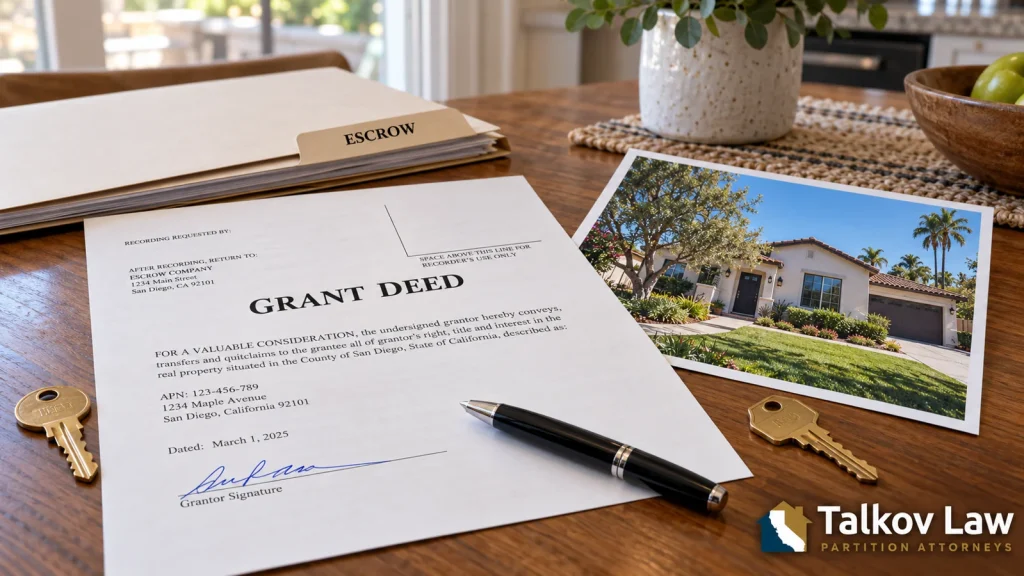
You can remove a co-owner from a house title or deed in California in two ways. If the co-owner agrees, they sign a deed. If they will not agree, you need a court order, and in California that order almost always comes from a partition action, which ends the co-ownership by sale or buyout, and a quiet title action is available only in narrow cases. This article explains each path, what it can and cannot do, and which one fits your situation.
- The co-owner agrees: a recorded deed transfers their share.
- The co-owner will not agree: a partition action ends the co-ownership, and any co-owner has the right to file one.
- The deed itself is wrong: a quiet title action asks the court to decide who really owns the property, but it is hard to win against someone who paid into the house.
Removing a Co-Owner by Agreement: A Deed
A co-owner can be removed from the property title by signing a deed. The person leaving signs as the grantor (also called the transferor). The person receiving the share is the grantee (also called the transferee). The grantee is usually the remaining co-owner, but it can be anyone.
For example, two siblings inherit a family home and disagree about what to do with it. Harry wants out and Sally wants to keep the house. They agree on a price for Harry’s share, and Harry signs a deed transferring his interest to Sally. Recording the deed with the county recorder gives public notice of the transfer, so recording it is essential.
Quitclaim Deed or Grant Deed
Co-owners usually use one of two kinds of deed. A quitclaim deed passes whatever interest the grantor has, without promising anything about that interest. A grant deed carries implied promises that the grantor has not already transferred the interest to someone else and has not placed liens or other encumbrances on it. Either kind can transfer a co-owner’s share, and the difference matters mostly to the person receiving the deed, who should consider how much assurance they want from the person leaving.
A Deed Does Not Change the Mortgage
A deed changes who owns the property. It does not remove anyone’s name from the mortgage. The person leaving the title stays responsible on the loan unless the lender releases them or the loan is paid off or refinanced. If you are the one leaving, see how to remove a co-owner from a mortgage. Because of these details, have a lawyer or title company handle the deed and consider title insurance so there are no surprises later.
A deed requires the co-owner’s signature. If they will not sign, a deed cannot remove them.
Can You Remove Someone From a Deed Without Their Knowledge or Permission?
No. A co-owner’s name comes off a deed only when that co-owner signs a deed giving up their share or a court orders it. A deed with a forged signature is void and transfers nothing, and recording one is a crime. That is true even when the co-owner has moved out, stopped paying, or abandoned the property. They remain an owner until they sign or a court ends the co-ownership.
What one co-owner can do alone is deal with their own share. You can transfer your own share without anyone’s consent, and a joint tenant can end the right of survivorship by deeding their share to themselves, as the Court of Appeal allowed in Riddle v. Harmon (1980) 102 Cal.App.3d 524. Neither step takes the other owner off title.
To remove a co-owner who will not sign, you need a court order. Two kinds of lawsuits can produce one: a quiet title action, which works only in narrow cases, and a partition action, which works in almost every case.
Do You Need a Lawyer to Remove a Name From a Deed?
Not when everyone agrees. California law does not require a lawyer to prepare or record a deed, and many co-owners handle a simple transfer through a title company. A lawyer is still worth it when there is a mortgage, a trust, or a question about how title should be held, because a mistake in a deed is expensive to fix later.
When the co-owner will not sign, the answer changes. Removing them takes a lawsuit: a complaint, service on every owner, often a partition referee, and an accounting of who paid what toward the property. That is the point to bring in a partition attorney.
How Much Does It Cost to Remove a Name From a Deed?
By agreement, the costs are modest: the county’s recording fees, documentary transfer tax if the share is sold for money, and a lawyer’s or title company’s fee if you use one. The transfer can also trigger a property tax reassessment of the share that changes hands unless an exclusion applies, such as a transfer between spouses, which is why a preliminary change of ownership report is usually filed with the deed.
Through the courts, the cost is higher. The average partition action costs about $20,000, and the court can divide those costs, including attorney’s fees, among the co-owners. See the cost of a partition action and who pays for a partition action.
Quiet Title: Only When the Deed Is Wrong
Many co-owners assume a quiet title action will remove an uncooperative co-owner. It rarely does. A quiet title action begins with a quiet title complaint filed in the county where the property is located, and it asks the court to decide who really owns the property. It fits situations where a person’s name is on the deed but they do not hold equitable title, meaning they are not a true owner despite appearing on legal title (the deed).
The difficulty is the burden of proof. Evidence Code section 662 requires clear and convincing evidence contrary to record title. Evidence that the person is only probably not a real owner is not enough. A quiet title action is therefore rarely effective against a co-owner who contributed to the down payment, made mortgage payments, or was treated as an owner at any point. These cases can also run long, with discovery, motions, and legal fees.
Partition: Getting a Court Order to Remove a Co-Owner From the Deed
The Right to Partition Is Absolute
For a co-owner who will not cooperate, partition is the most dependable route. In California, the right to partition is absolute. Any co-owner, whatever the size of their share, can ask the court to end the co-ownership. As the Court of Appeal put it, “the right of partition is absolute.”[1] A co-owner who does not want to participate generally cannot stop the action alone. Many cases end earlier through settlement negotiations, usually with a payment for one co-owner’s interest.
The court’s starting point is to divide the property among the owners, which is called a partition in kind. Under Code of Civil Procedure section 872.820, the court orders a sale instead when the owners agree to one or when a sale and division of the proceeds would be more equitable. A single house cannot be divided fairly, so most cases proceed as a partition by sale.
Ending Up as the Sole Owner
Many people hear “forced sale” and assume the house goes to a stranger. That is not what has to happen. If your goal is to keep the house, a partition can still get you there:
- Negotiate a buyout. The pressure of a pending partition often leads to a co-owner buyout by agreement, at a price based on the property’s value and each owner’s share.
- Buy the property in the sale. A co-owner can buy the property in the partition action. The statute bars only the referee, a party’s attorney, and certain guardians and conservators from buying (CCP 873.690). A partition sale will likely result in fair market value, because buyers have other homes to choose from.
- Use your share as credit. When the buyer is also an owner entitled to part of the proceeds, the referee may take the buyer’s receipt for that part instead of requiring the full price in cash (CCP 873.770). The court can also adjust for unequal payments toward the property. See CCP 872.140 on compensatory adjustments and offsets and credits.
If the sale is structured with care, the broker’s commission may be reduced when a co-owner is the buyer, and in a negotiated buyout the existing mortgage may in some cases stay in place while the buyer pays the other owner’s share. Each depends on the lender and the facts, so plan these points with your attorney before you file.
The Partition of Real Property Act
Since 2023, the Partition of Real Property Act has added a buyout step in some cases. It applies to property held as tenants in common when no written agreement among all the co-owners governs partition (CCP 874.311). When it applies and a co-owner has asked for a sale, the court first sets the property’s fair market value, usually with an appraisal. Then any co-owner other than the one who requested the sale may buy out the co-owners who did (CCP 874.317). The buyout price is the appraised value multiplied by each selling owner’s fractional share. If no one elects to buy, the case continues toward a sale or division. Because the buyout right belongs to the other co-owners, it is not a tool for the owner who filed. A filing owner who wants to end up with the house relies on a negotiated buyout or on buying at the sale.
What Happens at a Partition Sale
When the court orders a sale, a partition referee usually handles it, and the process generally has two phases:
- The property is marketed and sold, typically on the open market. A co-owner may be the buyer.
- The court sorts out the money. Co-owners can ask to be repaid for mortgage payments, taxes, insurance, repairs, and improvements, and the court can account for rent. The court also has authority to divide partition attorney’s fees among the parties.
If you do not care about staying in the house, a partition gives you your share of the equity and ends the dispute, along with the stress of owning real estate with someone you cannot work with.
Talkov Law Can Help
If your co-owner will not sign a deed, you do not need their permission to end the co-ownership. Whether you want to keep the property through a buyout or receive your share of the equity, Talkov Law can help. With 12 full-time partition attorneys and experience in over 650 partition actions, California’s #1 law firm for partition actions in California handles every step, from the first demand letter to the buyout or the referee’s sale. No fees until you win. Contact us online or call (877) PARTITION (727-8484) for a free consultation.
References
| ↑1 | Priddel v. Shankie (1945) 69 Cal.App.2d 319, 325. |
|---|







