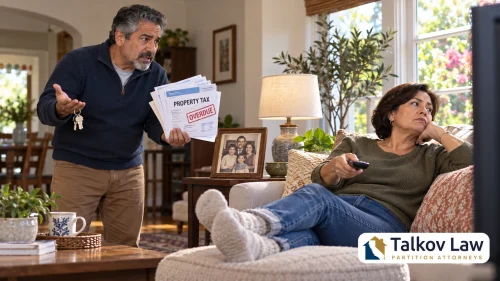

When five siblings inherit a house and three want to sell, the other two cannot stop the sale, whether one lives in the house or one is simply on the fence. Any one of the three can file a partition action, and every other sibling is named as a defendant without having to take a side. The absolute right to partition means no vote and no majority is needed.
Co-Owners Who Want to Sell Do Not Need Anyone’s Permission
Take five adult children who co-own an inherited house after their mother’s death. One lives there. Three want to sell. The fifth is on the fence: maybe they do not want the resident to know they favor a sale, maybe they have no interest in playing a part, or maybe they truly oppose it.
A private sale needs every owner’s signature on the deed. An agent can list a property with only one owner’s signature, but that listing cannot sell the whole property.
A court-ordered sale works differently. Under California Code of Civil Procedure section 872.210, a co-owner may bring a partition action, and section 872.710(b) provides that partition of concurrent interests “shall be as of right unless barred by a valid waiver.” Ownership percentage does not change that, and no majority vote is needed to file.
The sibling who lives in the house cannot:
- Require every owner to agree before the case can be filed
- Defeat the case by living in the property or paying the bills
- Stop the case by refusing to cooperate
The one real exception is a written agreement, which is why a holdout first looks for a waiver of the right to partition in the deed or a co-ownership agreement.
The Fence-Sitter Does Not Have to Pick a Side, but Must Be Named
A sibling on the fence has no duty to join anyone. Every owner has to be in the case, whether or not they want to sell:
“The plaintiff shall join as defendants in the action all persons having or claiming interests of record or actually known to the plaintiff or reasonably apparent from an inspection of the property, in the estate as to which partition is sought.”
California Code of Civil Procedure section 872.510
In the five-sibling example, one or more of the three sellers files as plaintiff, and the resident and the fence-sitter are named as defendants.
You need only one plaintiff to start the case, but it never hurts to have more. More plaintiffs show the court that the push to sell is not one person’s grudge.
If a co-owner does not want to be listed as a plaintiff, the order of the defendants matters. Name the uncooperative co-owner, here the resident, as the first defendant, so the short caption of the case reads as the plaintiff against the holdout. Then list the fence-sitting sibling as the second or third named defendant. Many times, complaints merely list the first-named plaintiff and first-named defendant, followed by “et al.,” which is latin for “and others.”
Leaving someone out does not stop the case, but it leaves a gap. Under section 874.225, the claim of a person who was not a party survives the judgment, which can cloud the sale.
Send a Cover Note to Co-Owners Who Are Only Half on Board
A fence-sitting co-owner might be confused that they are being sued when they receive the summons that lists them as a defendant. A short cover note delivered with the papers heads off the misunderstanding. It should say, in plain words:
- The law requires the plaintiffs to name every owner under section 872.510, so the co-owner is named because they own part of the property
- Being named as a defendant is not an accusation of wrongdoing
- A co-owner who agrees with the sale can just let themselves be defaulted
- Optionally, the plaintiff can agree to hold the fence-sitting defendant not liable for legal fees.
For an owner who will not answer at all, see what happens when a co-owner refuses to communicate about a sale.
The Resident May Be Able to Buy Out the Owners Who Want to Sell
The best tool for a sibling who wants to keep the house is a buyout. Under the Partition of Real Property Act, after the court determines fair market value under section 874.316, section 874.317 allows a co-owner who did not request the sale to buy out the co-owners who did. The price for each selling co-owner is the appraised value of the whole property multiplied by that owner’s fractional share.
A co-owner who asked for the sale generally cannot turn around and buy at that price. The process runs on a short clock:
- The court notifies the parties of the buyout right once it determines value
- A co-owner who wants to buy has 45 days from that notice to say so
- If several co-owners elect to buy, the right is divided among them in proportion to their existing shares
- The court sets a payment deadline at least 60 days after notice
- If no one elects or pays, the case continues under section 874.318
See how a co-owner can buy the property in the partition action and why the holdout sometimes gets a better deal.
If Nobody Buys, a Partition Referee Sells the Property
If no co-owner buys, a court generally orders partition by sale rather than partition in kind, because a single house cannot be split into fair, usable pieces. A partition referee then sells the property, and section 872.820 governs the division of the proceeds. Under section 874.320, the Partition of Real Property Act favors an open-market sale.
Nobody is shut out of the money. Mortgage payments, property taxes, and repairs a sibling paid are resolved through partition offsets and accounting, and the proceeds are divided according to each owner’s share.
Start the Partition Action Without Everyone’s Agreement
You do not need the resident’s signature or the fence-sitter’s blessing to end the co-ownership. You need a complaint that names every owner. Many cases settle before the referee gets involved, often through a section 998 offer or a negotiated buyout.
Talkov Law can help. With 12 full-time partition attorneys and experience in over 650 partition actions throughout California, our team handles every step of the process, from filing through the referee’s sale and the final distribution of proceeds. Call (877) PARTITION (727-8484) today or contact us online to get started.