
Ouster is the wrongful exclusion of one co-owner by another, and it takes clear, hostile acts like claiming the whole property, denying the other owner’s title, or refusing to let them in. That is the definition California courts apply, as restated in Hacienda Ranch Homes, Inc. v. Superior Court (2011) 198 Cal.App.4th 1122, 1128. The case also shows what is not ouster: paying all the property taxes, plowing under the weeds, and posting a “for sale” sign did not let one co-owner take the whole property from the others.
Why Hacienda Ranch Homes Matters
Every co-owner has the right to use the whole property. So when one co-owner lives there, farms it, or pays the bills, the question is whether they have merely been using their own property or have pushed the others out. That line is ouster, and it matters in two ways:
- Losing your share. A co-owner cannot take the others’ ownership by adverse possession without first ousting them.
- Collecting rent. A co-owner who has been kept out may be able to recover damages for ouster, including the rental value of their share.
Hacienda Ranch Homes defines ouster and applies the definition to everyday conduct, which is why it is cited so often. For a co-owner who lives elsewhere or never visits a vacant lot or a family farm or ranch, the answer is reassuring: staying away does not cost you your share.
The Facts: A 24.5 Percent Interest Bought at a Tax Sale
The property was a five-acre parcel of undeveloped land in Tracy, in San Joaquin County. In 1999, the Elissagarays bought a 24.5 percent interest in it at a county tax sale, making them tenants in common with Hacienda Ranch Homes and the Boersmas, who owned the rest. (Hacienda Ranch Homes, at pp. 1124–1125.)
In 2005, the Elissagarays filed a quiet title action claiming they now owned all of it. Their proof: they disced (plowed under) the weeds two or three times a year, posted a “for sale” sign near the property, and paid all of the property taxes after their purchase. The trial court thought that might be enough to go to trial. The other owners asked the Court of Appeal to step in. (Hacienda Ranch Homes, at pp. 1126–1127.)
How the Court of Appeal Reached Its Decision
A Co-Owner Must Oust the Others First
Because each co-owner is entitled to possess the whole property, one owner’s use of it is not hostile to the others. To take their title, a co-owner must give them notice “by acts of ownership of the most open, notorious and unequivocal character” that they are being shut out. (Hacienda Ranch Homes, at p. 1127.) And that proof “must be stronger than that which would be required to establish a title by adverse possession in a stranger.” (Hacienda Ranch Homes, at p. 1128.)
What Counts as Ouster
The court then gave the definition your co-owner’s conduct will be measured against:
“An ouster, in the law of tenancy in common, is the wrongful dispossession or exclusion by one tenant of his cotenant or cotenants from the common property of which they are entitled to possession.”
Hacienda Ranch Homes, at p. 1128 (quoting an earlier Court of Appeal decision)
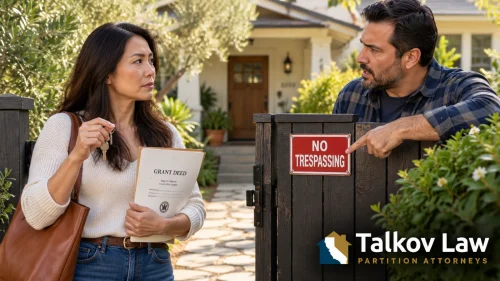
Quoting the California Supreme Court, it added that ouster is proved by acts “such as claiming the whole for himself, denying the title of his companion, or refusing to permit him to enter.” (Hacienda Ranch Homes, at p. 1128.)
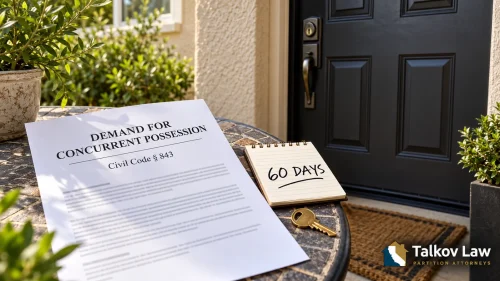
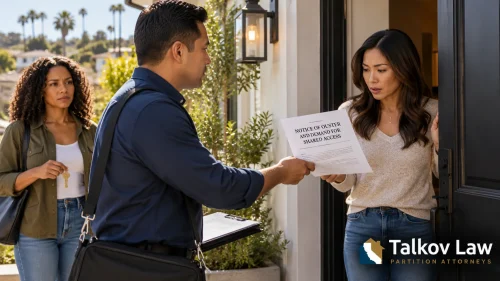
Whether conduct rises to an ouster is a legal question for the court. (Hacienda Ranch Homes, at pp. 1128–1129.) Today, a co-owner who has been kept out can also make a written demand under Civil Code section 843, explained in our article on the notice of ouster.
Taxes, Maintenance, and a Sign Are Not Ouster
The Elissagarays never told their co-owners to stay off the land, never put up a fence or barrier, and never kept anyone out. The court held:
“These circumstances, however, do not involve the type of open, notorious and unequivocal ouster of cotenants required to establish adverse possession under a claim of right. The occasional discing could be construed as routine maintenance for the benefit of all cotenants.”
Hacienda Ranch Homes, at p. 1129
A sign that was not even on the property, and statements that they owned the land, did not “clearly notify the cotenants of an unequivocal and hostile claim.” Paying the taxes did not change the result. (Hacienda Ranch Homes, at p. 1129.)
Absent Co-Owners Do Not Have to Visit
The Elissagarays argued that the other owners never tried to use the land. The court answered that “the law does not impose this requirement on cotenants of unimproved property in order for them to preserve their property interest in the absence of open, notorious and unequivocal notice of ouster.” (Hacienda Ranch Homes, at p. 1129.)
The Result: 24.5 Percent, Not 100 Percent
The Court of Appeal ordered the trial court to enter judgment for the other co-owners without a trial. (Hacienda Ranch Homes, at p. 1130.) The Elissagarays kept only what their deed gave them: 24.5 percent.
What Hacienda Ranch Homes Means for California Co-Owners
- Ouster takes clear acts: claiming the whole property, denying your title, or refusing to let you in.
- A co-owner who pays the taxes, maintains the property, or tries to sell it has not taken your share. Their extra payments are handled as partition offsets, not a transfer of title.
- You do not lose ownership by living elsewhere or never visiting. See our article on a co-owner who abandons the property.
- If a co-owner has locked you out or denied your ownership, that may be an ouster, and you may be owed rent. See whether you can collect rental value from a co-owner in possession.
If a co-owner has been treating shared property as their own, your ownership is very likely intact. You do not need to be living there to file under Code of Civil Procedure section 872.210, and in the partition the court confirms each owner’s share and orders the property sold or divided. When you are ready, you can file a partition lawsuit.
Talkov Law can help. With 12 full-time partition attorneys and experience in over 650 partition actions throughout California, our team handles every step of the process, from confirming your title through the referee’s sale and the final distribution of proceeds. Call (877) PARTITION (727-8484) today or contact us online to get started.