

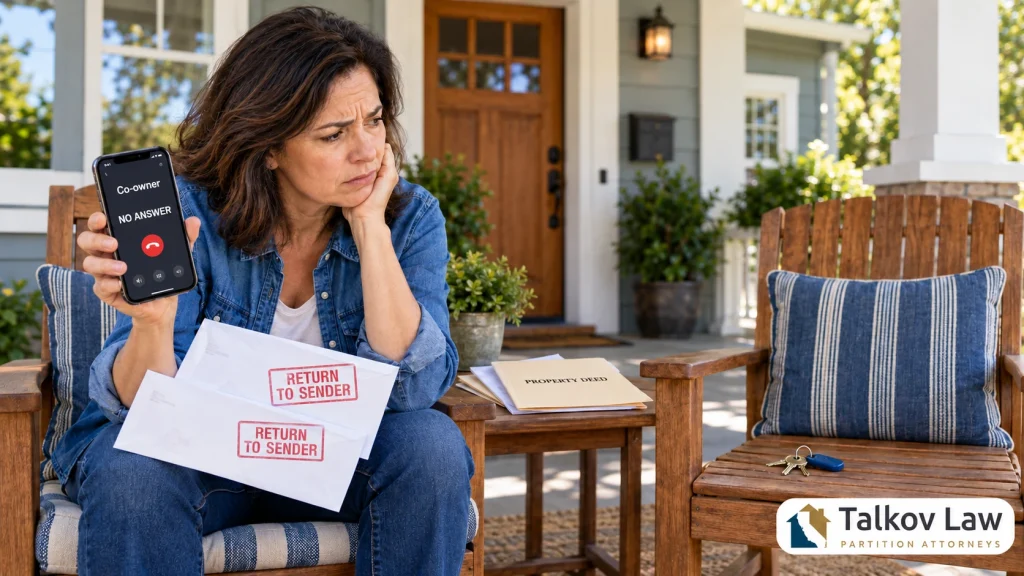

When a co-owner goes missing, a partition action is the most effective way to force the sale of the shared property. California’s partition statutes provide a clear process for serving a missing co-owner and moving the case forward.
This comes up more than people expect: in inherited property disputes where a sibling disappears, in tenancy in common situations where an investment partner walks away, or when a co-owner abandons the property. A missing co-owner cannot hold a property hostage indefinitely.
A Co-Owner’s Disappearance Does Not Block a California Partition Action
Under CCP 872.210, any co-owner of real property may file a partition action. No cooperation or consent from the other co-owners is required.
The absolute right to partition reinforces this. Code of Civil Procedure section 872.710(b) (CCP 872.710(b)) states that “partition as to concurrent interests in the property shall be as of right unless barred by a valid waiver.” Going missing is not a waiver. The court will not deny partition just because one party cannot be located.
This is the same principle that applies when a co-owner is in prison. The partition still proceeds. A missing co-owner is a procedural hurdle, not a legal barrier.
How Service by Publication Works in a California Partition Action
When a co-owner cannot be found, California’s partition statutes authorize service by publication. Code of Civil Procedure section 872.310(b) (CCP 872.310(b)) provides that unknown or missing defendants “shall be [served] by publication pursuant to Section 415.50 and the provisions of this article.”
To obtain a court order for publication, the plaintiff must submit an affidavit showing the co-owner cannot be located through reasonable diligence, documented attempts at personal service, public records searches, and similar efforts.
Once ordered, three conditions apply under Code of Civil Procedure section 872.320 (CCP 872.320):
- Post the summons and complaint on the property within 10 days.
- Record a lis pendens if not already done.
- The publication must describe the property, including its street address.
This framework applies equally under the Partition of Real Property Act for tenancy in common. A defective affidavit will get the order denied, which is why working with an experienced partition attorney from the start matters.
Obtaining a Default Partition Judgment After Serving a Missing Co-Owner
If the missing co-owner is served and fails to respond, the plaintiff can seek a default partition judgment. Default means the co-owner has given up the right to contest the partition.
The case then moves forward. A partition referee can be appointed to manage the sale, and the court oversees the distribution of proceeds. The missing co-owner’s share is preserved and they do not lose their equity, but they lose any say in how the case proceeds.
Move Forward Even If a Co-Owner Cannot Be Reached
A missing co-owner does not stop a partition action. Talkov Law can help. With 12 full-time partition attorneys and experience in over 650 partition actions throughout California, our team handles everything from the publication affidavit to the final sale. Call (877) PARTITION (727-8484) today or contact us online to get started.







