

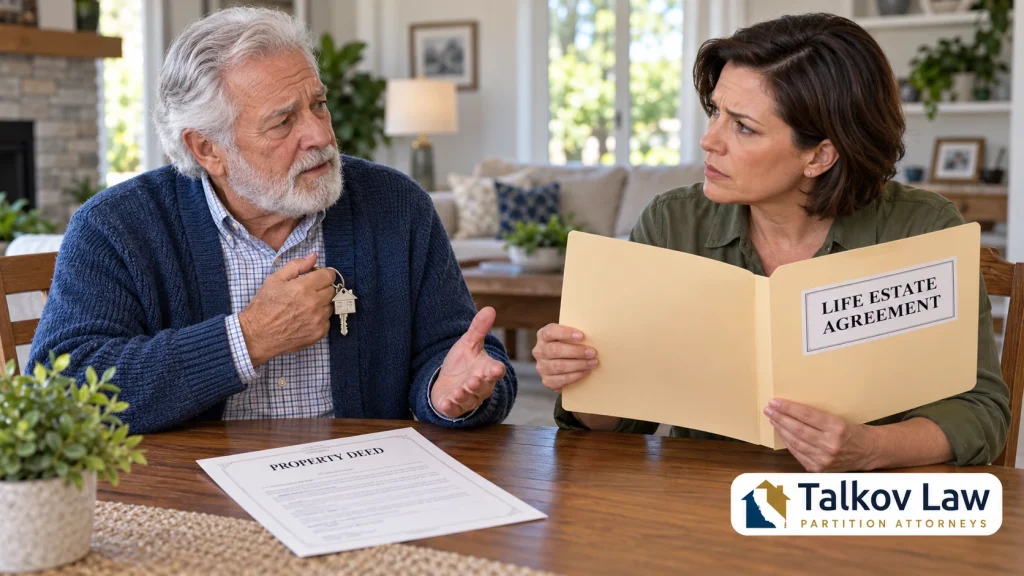

A spoken promise that someone can live in a California house for life does not create a life estate. A life estate is an interest in real property, and California law requires it to be created by a signed writing. So when a sibling, an ex, or another co-owner says they were promised the house for life, that promise does not stop a partition action from forcing the sale. The co-owner on title can still force the sale of the property, and the person claiming the promise receives only the share the deed gives them, if any. Below, we explain what a life estate is, the code sections that require a writing, and how a partition court deals with a claimed oral life estate.
The claim usually comes up in two settings. In an inherited house, the sibling who cared for a parent says Mom or Dad promised them the house for life. After a breakup, an ex on title says they were told they could always live there. Either way, the claim tends to surface once a co-owner asks to sell, as the reason the person living in the house says it cannot be sold. It does not change the rights of the co-owners on title.
What Is a Life Estate?
A life estate is an interest that can arise in ownership and co-ownership of property in which an individual, known as the life tenant, has the right to use and occupy a property for the duration of their lifetime. Upon their passing, ownership of the property automatically transfers to the remainderman, who holds the future interest.
Life estates often arise in estate planning, inheritance co-ownership disputes, and property transfers among family members, but the law requires that they be created in writing.
The exact wording of a written life estate matters too. A life estate that lasts only while the life tenant lives on the property can be worth nothing once the life tenant forces a partition sale, as the Court of Appeal held in Forrest v. Elam.
California Law Requires Life Estates to Be in Writing
Under California’s statute of frauds, including Civil Code section 1624, any agreement that creates or transfers an interest in real property, including a life estate, must be in writing and signed to be valid. Courts have repeatedly upheld this rule to prevent fraudulent claims and misunderstandings.
Code of Civil Procedure section 1971 states: “No estate or interest in real property, other than for leases for a term not exceeding one year, nor any power over or concerning it, or in any manner relating thereto, can be created, granted, assigned, surrendered, or declared, otherwise than by operation of law, or a conveyance or other instrument in writing, subscribed by the party creating, granting, assigning, surrendering, or declaring the same, or by the party’s lawful agent thereunto authorized by writing.” See also Civil Code section 1624, subdivision (a)(3), which requires a writing for an agreement to sell real property or an interest in it.
Civil Code section 1091 says the same about transfers: “An estate in real property, other than an estate at will or for a term not exceeding one year, can be transferred only by operation of law, or by an instrument in writing, subscribed by the party disposing of the same, or by his agent thereunto authorized by writing.”
Key Legal Authority:
Miller & Starr, as the leading treatise on California real estate, makes clear that: “Life estate. An agreement to create or transfer a life estate must be in writing.” [1]
Miller & Starr cites Lewis v. Brown (1913) 22 Cal.App. 38, 42–43. There, a man deeded his property outright and later claimed he had kept a life estate for himself through an oral understanding. The Court of Appeal reversed the judgment that gave him one, holding that “oral testimony cannot be considered as against the written terms of a deed for the purpose of limiting or qualifying the estate thereby granted or created.”
This means a spoken promise of a life estate does not give the person who heard it a right to stay in the house. If that person is also a co-owner on title, they may live there only on the same terms as every other co-owner, since each co-owner may occupy the whole property, and only until the partition sale.
How a Partition Court Decides an Oral Life Estate Claim
A claimed life estate does not need its own lawsuit. In a partition action, the court decides who owns what, including any claimed life estate, before it orders the property sold, as Code of Civil Procedure section 872.610 allows. The California Supreme Court settled that in De Uprey v. De Uprey (1865) 27 Cal. 329 and Martin v. Walker (1881) 58 Cal. 590.
The co-owner on title starts with the deed on their side. Under Evidence Code section 662, the owner of legal title is presumed to own the full beneficial title, and that presumption can be overcome only by clear and convincing proof. A promise nobody wrote down rarely clears that bar.
Once the court rejects the claimed life estate, the case moves forward like any other partition. The court orders the sale in an interlocutory judgment, and a partition referee sells the property. Yes, you can get the person claiming the life estate out: the referee can obtain a writ of possession, the same order a landlord gets in an eviction, to remove anyone still living there so the house can be sold.
For example, two sisters inherit their father’s house in Los Angeles. One sister cared for him and says he promised she could live there for life, but his trust leaves the house to both sisters equally and says nothing about a life estate. The other sister can file a partition action. The court decides there is no life estate, orders the house sold, and divides the proceeds equally, subject to any credits either sister has earned.
Why Oral Life Estates Lead to Legal Disputes
Despite clear legal requirements, disputes often arise when a person claims they were verbally promised a life estate in exchange for financial contributions, caregiving, or other personal agreements. Without a written document, courts will generally reject these claims, leading to eviction or forced sale of the property. California does recognize narrow exceptions to the writing requirement, such as part performance and estoppel, but they take far more than a promise and years of living in the house.
Common scenarios where oral life estate claims fail include:
- A family member claims they were promised a life estate in exchange for caring for an elderly relative
- A co-owner argues they were granted lifetime use of the property without a written agreement
- A verbal promise was made, but the owner on title later changes their mind
Without a written agreement, these claims are legally unenforceable, and the rightful property owners can seek a partition action to force a sale.
How Talkov Law Can Help
If you are involved in a dispute over a life estate or real estate ownership, Talkov Law can provide the legal expertise needed to protect your property rights and enforce California law. With 12 full-time partition lawyers, Talkov Law is the #1 partition law firm in California and has handled over 650 partition actions throughout the state.
Contact Talkov Law Partition Attorneys today at (877) PARTITION (727-8484). Our experienced partition attorneys are here to help you begin the process. There are no fees until you win, and your consultation is free.
References
| ↑1 | Agreements required to be in writing—Contract for the sale, gift, or financing of real property, 1 Cal. Real Est. (Miller & Starr, 4th ed.) § 1:74. |
|---|







