
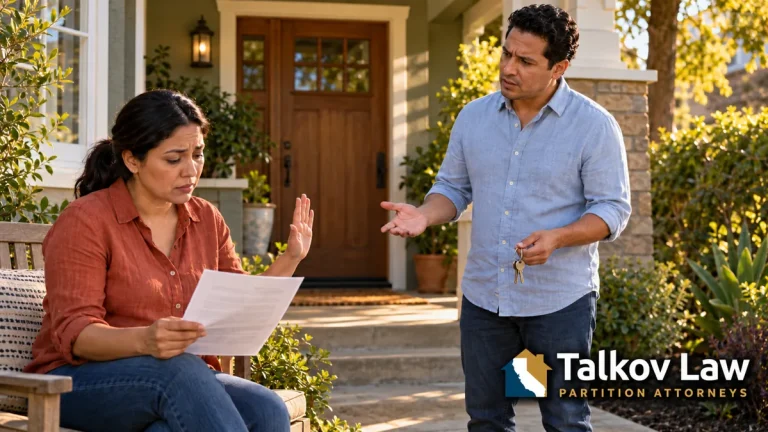
Often not, and the mortgage is usually the reason. When the co-owner who wants out is on the loan, a co-owner buyout generally means paying off that loan or getting the lender to release the departing co-owner, and a replacement loan at today’s rates can cost far more than the old one. If the staying co-owner cannot afford the new payment, a partition action ends in a sale.
One question decides most of these cases: is the co-owner who wants out on the mortgage? In our experience, roughly nine out of ten cases with a mortgage answer yes, whether that co-owner is the only borrower or one of two. That is why so many disputes between unmarried couples and siblings who inherited a house, then refinanced, end with a sale instead of a buyout.
A Buyout Usually Means Replacing a Low-Rate Mortgage
A lender looks to the borrowers named on the note, not to who owns the house. Signing a deed to your co-owner does not remove your name from the mortgage, so a release takes a payoff, a refinance, or the lender’s written approval.
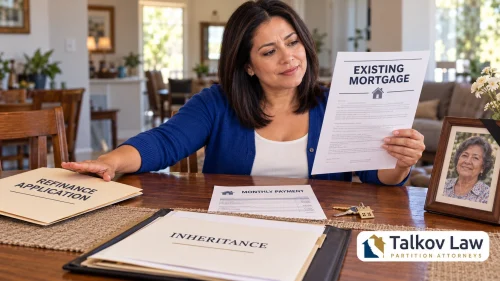
The staying co-owner must qualify alone, without the departing co-owner’s income, at today’s higher interest rates. A pre-2022 mortgage with a 3 percent interest rate can be a valuable financial advantage. Refinancing means giving up that rate.
The 2022 Interest Rate Increase Changed Co-Owner Buyouts
Before 2022, a co-owner with a mortgage rate around 3 percent could often refinance without a dramatic increase in the interest rate. That changed quickly in 2022. Freddie Mac reported that the national average for a 30-year fixed-rate mortgage rose from 3.22 percent on January 6, 2022 to 5.30 percent on July 7, 2022, then reached 6.02 percent on September 15, 2022. These are national averages for home purchase loans; an individual co-owner’s refinance rate may differ.
By the summer of 2022, the economics of a buyout had changed. A co-owner trying to keep the house could face a much higher payment just to replace the existing mortgage, before borrowing anything to pay the other owner for their equity. When refinancing is needed to release the departing co-owner from the loan, keeping a pre-2022 mortgage at around 3 percent may no longer be an option. A buyout that once looked affordable can become impossible on one income, leaving a sale as the practical way to end the co-ownership.
The Payment Increase Happens Before Any Buyout Money Changes Hands
Suppose co-owners have a pre-2022 mortgage at 3 percent with a remaining balance of $605,000 and 25 years left to pay. Their monthly payment of principal and interest is about $2,869. If the staying co-owner must refinance that balance at an illustrative 6.5 percent over 30 years, the payment becomes about $3,824, roughly $955 more each month, even if the departing co-owner is paid nothing. The new loan also stretches repayment over another 30 years. These figures leave out closing costs, property taxes, insurance, and any mortgage insurance.
Paying for equity makes it worse. Every dollar paid to the departing co-owner is added to the new loan, and a loan above 80 percent of the home’s value usually adds private mortgage insurance. To keep the house, the staying co-owner generally must:
- Qualify for the new loan on one income
- Afford today’s interest rate on the full balance
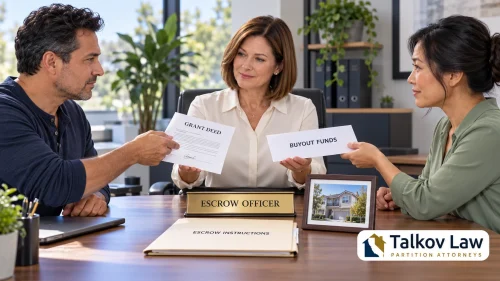
- Fund the equity payment to the departing co-owner
- Pay closing costs and any mortgage insurance
The Co-Owner Who Wants Out May Be the Only Borrower or One of Two
- Only borrower: the staying co-owner is a brand-new borrower who must qualify from scratch, and nothing requires the lender to release anyone.
- Both borrowers: the staying co-owner must qualify on one income, which is often the reason both signed the loan in the first place.
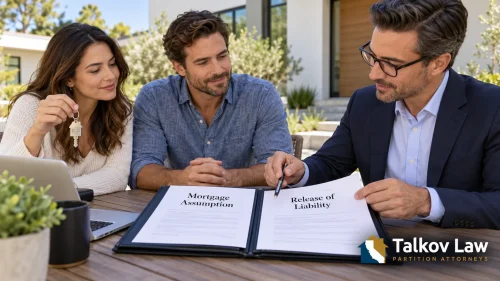
In either version, a mortgage assumption can keep the old rate, but the lender must approve the assuming borrower and sign a release, and most conventional loans cannot be assumed. Getting a co-owner off a mortgage is the real obstacle in most buyouts.
A Partition Sale Pays Off the Mortgage From the Proceeds
When a buyout fails, the court can order a sale. Under California Code of Civil Procedure section 872.820, the court orders a partition by sale when it determines that sale and division of the proceeds would be more equitable than dividing the property. Under section 872.630, the court determines the status and priority of all liens, including the mortgage. Then section 873.820 directs the proceeds, after the expenses of sale and the costs of partition, to:
“Payment of any liens on the property in their order of priority except liens which under the terms of sale are to remain on the property.”
California Code of Civil Procedure section 873.820(c) (added by Statutes 1976, chapter 73)
The mortgage is paid from the sale, and paying the loan in full ends the liability of every borrower on it. A partition referee typically handles the sale, and the remaining money is divided among the co-owners according to their shares.
The Partition of Real Property Act gives a co-owner who did not request the sale a chance to buy out the requesting co-owners at a court-determined price under section 874.317. The statute sets the price and the deadline, but it does not make the lender release the departing co-owner, so the loan problem remains.
The Exception Is a Departing Co-Owner Who Is Not on the Mortgage
In roughly one in ten cases with a mortgage, the co-owner who wants out is not on the loan. The old loan can stay in place, and the staying co-owner needs money only for the equity payment, which makes a buyout far more realistic.
If the property has no mortgage at all, the question is how the buyer will fund that payment, and a co-owner generally cannot be forced to buy your share.
Talkov Law Partition Attorneys Can Help
If you are the co-owner on the loan, the real question is how many more years you are willing to stay on it. Staying on the mortgage can be structured in a written agreement that avoids a waiver of the right to partition, and payments you make in the meantime may be claimed as mortgage payment credits.
Waiting for lower rates is a bet, and the ability to force the sale is what releases everyone from the loan.
Talkov Law can help. With 12 full-time partition attorneys and experience in over 650 partition actions throughout California, our team handles every step of the process, from filing through the referee’s sale and the final distribution of proceeds. Call (877) PARTITION (727-8484) today or contact us online to get started.