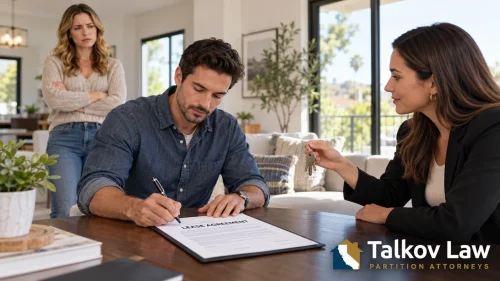

A California co-owner can lease jointly owned property without the other owner’s consent, but the lease binds only the share of the co-owner who signed it. In Swartzbaugh v. Sampson (1936) 11 Cal.App.2d 451, 458, the Court of Appeal held that a lease of the whole property by one co-owner “is not a nullity but is a valid and supportable contract in so far as the interest of the lessor in the joint property is concerned.” The owner who refused to sign could not cancel the lease, but she kept her ownership, her right to share possession, and her right to partition.
This comes up when a sibling rents an inherited house to a friend, when an ex-partner takes in a tenant after the breakup, or when a co-owner lists the property on Airbnb without permission. Our guides to whether one owner can lease jointly owned property and whether someone can move in without your permission cover the day-to-day rules. This post covers the case behind them.
Why Swartzbaugh v. Sampson Matters
- A lease by one co-owner is valid, but only as to their share. The co-owner who signs can give a tenant only what they have themselves, the same way a co-owner can transfer only their own share. (Swartzbaugh, at p. 458.)
- The other co-owner cannot cancel the lease or throw the tenant out. Where one co-owner leases to an outsider, “the other tenants in common cannot cancel the lease or recover exclusive possession of the entire property.” (Swartzbaugh, at p. 461.)
- But you cannot be shut out. The co-owner who did not sign can demand to share possession with the tenant, and if the tenant refuses, can recover “the reasonable value of the use and enjoyment of his share.” (Swartzbaugh, at p. 457.)
- Rent from outsiders must be accounted for. A co-owner who collects rent from third parties can be made to account for it to the other owners. (Swartzbaugh, at p. 455.)
- The tenant cannot take your share by adverse possession. A tenant holding under one co-owner’s lease holds for the co-owners, not against them, and even a co-owner cannot take a relative’s share by exclusive use alone, as Preciado v. Wilde held. (Swartzbaugh, at p. 462.)
Forty years later, the California Supreme Court quoted the core holding of Swartzbaugh in Tenhet v. Boswell (1976) 18 Cal.3d 150, 159, and added that a joint tenant’s lease ends when that joint tenant dies, because the survivor takes the whole property by the right of survivorship.
The Facts: A Walnut Grove, a Boxing Pavilion, and a Co-Owner Who Said No
Lola Swartzbaugh and her husband, John, owned 60 acres of bearing walnut trees in Orange County as joint tenants with the right of survivorship. In December 1933, Sam Sampson began negotiating to lease a small piece of the land fronting Highway 101 as the site for a boxing pavilion. Mrs. Swartzbaugh objected from the start, and Sampson knew she would not sign any lease. (Swartzbaugh, at p. 452.)
Her husband signed anyway: an option on January 5, 1934, a lease dated February 2, 1934, and a second lease of the land next door. Her name was on none of them. The walnut trees came out, Sampson moved in, and he built the pavilion and other improvements. (Swartzbaugh, at p. 453.)
Mrs. Swartzbaugh sued on June 20, 1934, to cancel both leases. By trial, she had received none of the rent, and Sampson held all of the leased land to her exclusion. The trial court granted a nonsuit at the close of her case, and she appealed. (Swartzbaugh, at pp. 452–453.)
How the Court of Appeal Decided the Case
The court started from the general rule protecting the co-owner who does not sign:
“It is a general rule that the act of one joint tenant without express or implied authority from or the consent of his cotenant cannot bind or prejudicially affect the rights of the latter.”
Swartzbaugh v. Sampson (1936) 11 Cal.App.2d 451, 457
The same rule is why one co-owner can sell only their own half, cannot list the whole property with only their own signature, and can borrow only against their own share. It is also why a deal approved by most of the co-owners binds none of the owners who said no, as the Court of Appeal held in Lindsay-Field v. Friendly.
That rule has a limit. Every co-owner has the right to possess the whole property, and “[p]ossession by one is possession by all.” (Swartzbaugh, at p. 454.) A co-owner who leases the property only hands the tenant the right of possession the co-owner already had. So the lease is not void:
“[A] lease to all of the joint property by one joint tenant is not a nullity but is a valid and supportable contract in so far as the interest of the lessor in the joint property is concerned.”
Swartzbaugh v. Sampson (1936) 11 Cal.App.2d 451, 458
The court noted that the rights of possession are much the same whether co-owners hold as joint tenants or tenants in common, so the rule covers both. (Swartzbaugh, at p. 458.)
The Co-Owner Who Did Not Sign Gets Let In, Not the Tenant Thrown Out
Because the tenant stands in the leasing co-owner’s shoes, the other co-owner’s remedy is to share possession, not to take it all. As the court put it, a co-owner out of possession “can only recover the right to be let into joint possession of the property with his cotenant. He cannot eject his cotenant in possession.” (Swartzbaugh, at p. 454.) That is the same reason you cannot evict a co-owner, including a sibling living in an inherited house.
Mrs. Swartzbaugh had never asked Sampson to let her into possession of her share. (Swartzbaugh, at pp. 462–463.) If a tenant refuses that request, the refusal can become an ouster, like the co-owner who changed the locks in Zaslow v. Kroenert, and the excluded co-owner can recover the value of the use of their share.
The court relied on earlier decisions explaining that a lease or deed by one co-owner is always subject to “a partition, which may be claimed by the cotenants at any time.” (Swartzbaugh, at p. 455, quoting Stark v. Barrett (1860) 15 Cal. 361.) It also quoted an Illinois decision holding that if the land is partitioned, the lease “would follow the interest” of the co-owner who signed it “and be operative only upon the land set off to him.” (Swartzbaugh, at p. 460.)
In other words, a lease signed by your co-owner does not take away your right to end the co-ownership. Any co-owner can file under Code of Civil Procedure section 872.210, and under Code of Civil Procedure section 872.710, partition is a matter of right. Our summary of De Roulet v. Mitchel explains why even a profitable lease cannot delay a partition, and our guide to partitioning a rental property with tenants covers how tenants are handled in the sale.
The Result
The Court of Appeal affirmed. The leases were valid contracts giving Sampson the same right to possess the leased land that Mr. Swartzbaugh had, so Mrs. Swartzbaugh could not cancel them. (Swartzbaugh, at p. 462.)
What Swartzbaugh v. Sampson Means for California Co-Owners
- Your co-owner can rent out the property, but not your share. A lease you never signed does not bind your interest. See our guide to leasing jointly owned property.
- Ask to be let in, in writing. Civil Code section 843 lets a co-owner prove an ouster with a written demand for concurrent possession. If the tenant or your co-owner refuses, you may be owed the value of your share’s use. Our guide to collecting rental value from a co-owner explains how.
- Your share of the rent comes back to you. A co-owner who collects rent from a tenant must account for it, and the partition accounting is where that happens.
- A tenant does not stop a partition. The lease follows the share of the co-owner who signed it, and the court can still order the property sold.
- With a joint tenancy, the lease dies with the co-owner who signed it. Under Tenhet v. Boswell, the surviving joint tenant takes the property free of the lease. Our guide to joint tenancy in California explains survivorship.
The Swartzbaughs were married. Today, disputes over a married couple’s community property go to family court, though a co-owner outside the marriage can still force a sale. Between everyone else, including unmarried partners, siblings who inherited a house, and friends, the remedy is a partition action.
Co-Owner Rented Out the Property? End It With a Partition Action
You cannot cancel your co-owner’s lease, and you cannot evict their tenant. You can end the co-ownership. A partition action lets any co-owner force a sale, with your share of the rent and expenses settled in the final accounting.
Talkov Law can help. With 12 full-time partition attorneys and experience in over 650 partition actions throughout California, our team handles every step, from the complaint through the partition sale and the final distribution of proceeds. Call (877) PARTITION (727-8484) today or contact us online to get started.