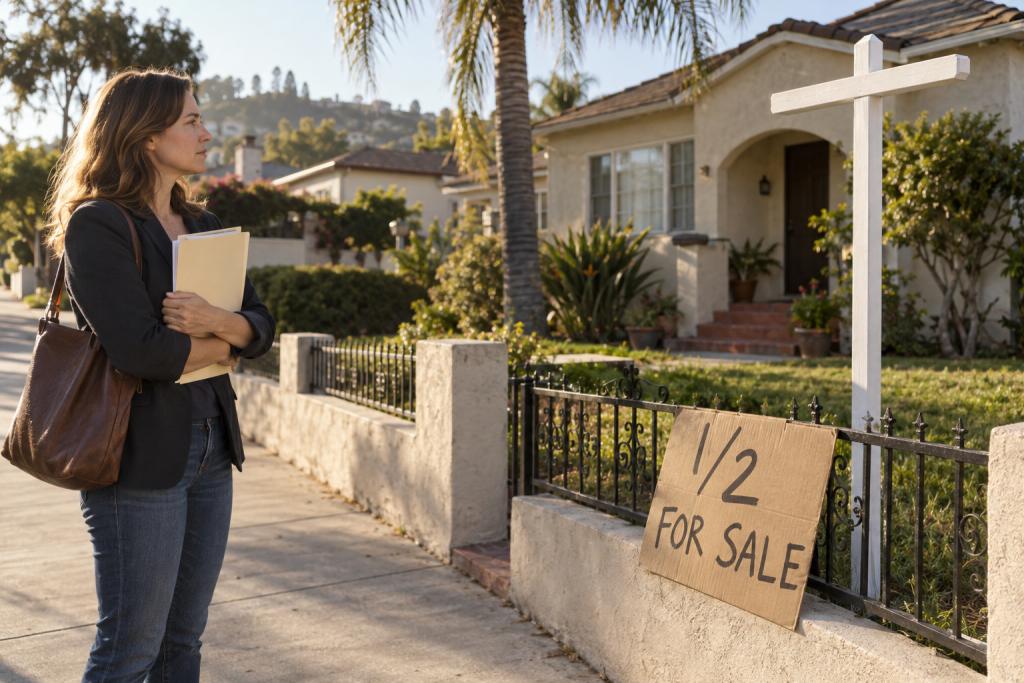

Yes. A California co-owner can sell their half of a jointly owned property without the other owner’s consent. But almost no one will buy it, and the buyer you do find will pay far less than your half is worth. Each co-owner holds an undivided interest they can sell, give away, or borrow against on their own, but no one can sell the whole property without every owner’s signature. That is why co-owners who want out almost never sell their half to a stranger. They get full value for it through a co-owner buyout or a partition action, the lawsuit that forces the sale of the whole property and splits the proceeds, whether the other owner agrees or not. California Code of Civil Procedure section 872.710 (CCP 872.710) makes that right absolute.
This question comes up most often after a relationship ends and one former partner wants their money out of a house the other won’t sell. It also comes up between siblings who inherited a parent’s home, between friends who bought a rental together, and between a parent and an adult child who went in on a property that no longer works for either of them. One sentence on married couples: if you and your spouse own the house as community property, the family court divides it in the divorce, and partition applies only in limited situations. Everyone else is in the right place.
Whether you hold title as tenants in common or joint tenants, your undivided interest is yours to transfer. A tenant in common can deed their percentage to anyone at any time. A joint tenant can do the same, and the transfer severs the joint tenancy, so the buyer becomes a tenant in common with your former co-owner and the right of survivorship ends. California courts have treated this as settled for decades:
An indisputable right of each joint tenant is the power to convey his or her separate estate by way of gift or otherwise without the knowledge or consent of the other joint tenant and to thereby terminate the joint tenancy.
Riddle v. Harmon (1980) 102 Cal.App.3d 524, 527
The conveyance destroys the unities that hold a joint tenancy together, so the buyer and the remaining owner become tenants in common (Wilk v. Vencill (1947) 30 Cal.2d 104, 108). Our guide to severing a joint tenancy walks through the mechanics and the recording rules in Civil Code section 683.2.
The same rule lets a co-owner borrow against their own share without the other owner’s signature, and it is why a joint tenant who transfers their interest leaves the buyer holding a tenancy in common. The partition statutes assume this happens: Code of Civil Procedure section 873.230 (CCP 873.230) tells the court what to do with property a co-owner sold to a buyer before the partition was filed.
What you cannot do is sell the whole property. A deed signed by one of two owners transfers only that owner’s half, and a listing agreement signed by one co-owner binds only that co-owner. If your real question is whether one owner can sell the entire property over the other’s objection, the answer is a partition action, and our post on selling jointly owned property walks through it.
Why Almost No One Buys Half a House
The right to sell your half is real. The market for it is not. Think about what the buyer gets: a 50% interest in a house they cannot live in alone, cannot rent out alone, cannot refinance alone, and cannot sell alone, with a co-owner they have never met and who did not want them there. No bank will write a conventional purchase loan on an undivided half interest, so the buyer needs cash. The only people who make these offers for a living are fractional-interest investors, and their business model is to buy your share at a steep discount, then file the same partition action you could have filed yourself and collect full value. Our post on buying and selling fractional interests explains how that trade works from both sides.
Your co-owner can also buy your half, and often that is the best outcome for everyone. But a co-owner who knows you have no other buyer has no reason to pay you fair market value. The price goes up the moment they understand you can force a sale.
The Threat of a Forced Sale Is What Gets You Fair Value
Your co-owner pays fair value for your half only when the other option is worse for them, and the worse option is a court-ordered sale of the whole house. Until you can force that sale, your co-owner has no reason to pay you anything close to what your half is worth. Once a partition is on file, the math changes: they can pay you your share now, or watch the property sell to a stranger and keep only their own share. Some co-owners still refuse. That is fine. The partition sale pays you the same share of full market value either way.
Selling Your Half Can Trigger the Lender and the Assessor
Two things happen when a half interest changes hands that co-owners rarely plan for:
- The loan can be called due. If there is a mortgage on the property, nearly every deed of trust has a due-on-sale clause, and federal law (the Garn-St Germain Act, 12 U.S.C. § 1701j-3) lets the lender enforce it when an owner transfers their interest, with exceptions for transfers to a spouse or child and a few others. Your co-owner stays on the hook for the whole loan with a stranger now on title. Our post on the due-on-sale clause and inherited houses explains when the clause applies and when it does not, and our post on mortgage assumptions in partition actions covers keeping an existing loan in a buyout.
- The transferred share is reassessed. The county assessor treats the sale of your half as a change in ownership of that half and reassesses it to current market value for property tax, which raises the tax bill on the property. For inherited homes, our post on Proposition 19 and inherited property explains what a transfer between siblings does to a parent’s old tax base.
Three Ways to Cash Out Your Half
| Option | Needs your co-owner’s agreement? | What you receive | Typical timeline |
|---|---|---|---|
| Sell your half to an investor | No | A discounted cash price for your interest | Weeks, if you can find a buyer |
| Co-owner buyout | Yes, on price and financing | Your share of the equity, usually at or near appraised value, minus or plus any credits you agree on | 30 to 90 days once terms are set |
| Partition action | No | Your share of the net sale proceeds at full market value, plus credits for what you paid beyond your share, minus your share of the costs of partition | Seven to nine months on average; most cases settle before trial |
Your Co-Owner Cannot Stop You From Forcing a Sale
Any co-owner may file a partition action under Code of Civil Procedure section 872.210 (CCP 872.210), and once you do, the court must grant it unless you signed a valid waiver of the right:
Except as provided in subdivision (b), partition as to concurrent interests in the property shall be as of right unless barred by a valid waiver.
Code of Civil Procedure section 872.710(b)
It does not matter that your co-owner lives there, that they have paid more of the mortgage, or that they think the market will be better next year. In De Roulet v. Mitchel (1945) 70 Cal.App.2d 120, the Court of Appeal held that a co-owner cannot delay a partition sale to wait for a better price. And a right of first refusal in a co-ownership agreement does not waive partition either; in LEG Investments v. Boxler (2010) 183 Cal.App.4th 484, the co-owner who wanted out had to offer their share to the other owner first, and when that owner declined, the partition sale went forward.
The sale itself is handled by a court-appointed partition referee or a court-appointed broker, on the open market, to the highest bidder. You are not selling half of anything. The whole property sells for what whole properties sell for, and you receive your share of the proceeds. Based on Talkov Law’s completed-case data, the average partition action costs about $20,000, and the court can apportion those costs, including attorney’s fees incurred for the common benefit, among the co-owners under Code of Civil Procedure section 874.040 (CCP 874.040). Our posts on the cost of a partition action and how long a partition takes have the details.
A Partition Usually Ends in a Buyout at Full Value
Most co-owners who want to keep the house find a way to buy the other owner out once a partition is filed, because the alternative is a sale to a stranger with the same money changing hands. The filing is what fixes the price. For property held as tenants in common in a partition filed on or after January 1, 2023, the Partition of Real Property Act builds this in: when a co-owner requests partition by sale, the other co-owners may elect, within 45 days of notice, to buy that co-owner’s interest at the fair market value the court sets by appraisal. Code of Civil Procedure sections 874.316 (CCP 874.316) and 874.317 (CCP 874.317). The 45-day period is the deadline to elect to purchase, not the deadline to complete the purchase, and the buyout right is triggered by a co-owner’s request for partition by sale, not by filing alone.
That is the difference between selling your half and partitioning it. An investor sets the price by what you will accept. The court sets the price by what the property is worth. Our posts on forcing a co-owner to buy your share and whether your co-owner can buy you out after you file explain the mechanics.
Worked Example: Selling Your Half vs. Forcing the Sale
Say you and your ex own a house 50/50. It would sell for $800,000, the loan balance is $300,000, and you have been paying the entire $3,000 mortgage payment alone for the past two years, or $72,000, while your ex lived there. Illustrative numbers:
| Line | Sell your half to an investor | Partition action |
|---|---|---|
| Sale price | Investor’s offer for a half interest: $100,000 | Whole property on the open market: $800,000 |
| Loan payoff | Not paid off; you stay on the loan unless the buyer assumes it | $300,000 paid from escrow |
| Costs of sale (commissions, escrow, title) | Your own closing costs | About $48,000, shared |
| Net equity | n/a | $452,000 |
| Repayment of the mortgage payments you made | Usually nothing. Investors rarely pay extra for it. | $72,000 repaid to you from the proceeds before the split |
| Remaining equity to split | n/a | $380,000 |
| Your 50% share | n/a | $190,000 |
| Your share of the costs of partition | n/a | About $10,000 if the court splits a $20,000 case equally |
| You walk away with | $100,000 | About $252,000 |
Actual credits depend on the facts of each case. The court decides them under Code of Civil Procedure section 872.140 (CCP 872.140), which allows an accounting and compensatory adjustments between co-owners, and our post on getting mortgage payments back in a partition shows how those credits are calculated. Repaying the full $72,000 before the split, rather than half of it, follows Southern Adjustment Bureau v. Nelson, which explains why repaying only half underpays the co-owner who made the payments. An investor’s offer for your half rarely pays you anything for that repayment claim.
Can I Sell My Half of an Inherited House?
Yes, once the property has been distributed to you. The same rules apply: you can deed your share to anyone, but the buyer gets the same discounted price and the same problem co-owner you had, and a sibling who wants to keep the house has little reason to pay you fair value until you can force the issue. If the estate is still in probate and title has not passed to the heirs, the personal representative controls the sale, and a beneficiary can ask the probate court to partition under Probate Code section 11950 (Probate Code 11950). Once it is yours, our post on forcing the sale of an inherited house covers the path to a buyout or sale, and the Proposition 19 post above explains why a sibling buyout, rather than a sale to a stranger, can preserve the parent’s property tax base.
Expect Your Co-Owner to Argue You Cannot Sell Without Them
Co-owners who want to keep the house say two things. First, “you can’t sell without my signature.” Half right: you cannot sell the whole property without them, but you can sell your interest, and you can file a partition that sells the whole property over their objection. Second, “I’ll just refuse to cooperate.” The partition statutes were written for exactly that. The referee signs the deed, the court confirms the sale, and a co-owner who stalls or files baseless objections can be ordered to bear more of the attorney’s fees. In Lin v. Jeng (2012) 203 Cal.App.4th 1008, the court made a sister who overclaimed her share pay all of her own fees. Co-ownership is not a lifetime commitment, despite what some co-owners might want you to believe.
Don’t Sell Your Half at a Discount. Force the Sale Instead.
You have every right to sell your half of a jointly owned property in California. You also have every right to receive what it is worth, and only a buyout or a partition action gets you there. Talkov Law is America’s first partition law firm and California’s #1 partition law firm. We do not charge a retainer; our attorney’s fees are paid at the end of the case, from escrow when the property is sold or refinanced.
Talkov Law can help. With 12 full-time partition attorneys and experience in over 650 partition actions throughout California, our team handles every step of the process, from the first demand letter to your co-owner through the buyout or the referee’s sale and the final distribution of proceeds, including the credits you are owed. Call (877) PARTITION (727-8484) today or contact us online for a free consultation with a partition attorney.