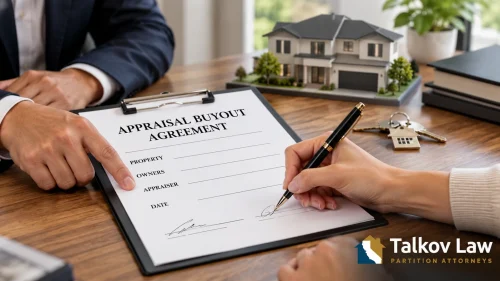

Cash for keys can help prepare a co-owned property for a partition sale. An occupant receives an agreed payment in exchange for voluntarily moving out and delivering possession. When vacant possession would improve marketing, inspections, or closing, a negotiated move-out may be worth considering alongside the cost and time of other lawful options.
This article includes a sample offer letter and an agreement framework. In a partition action to force the sale of jointly owned property, the terms must account for the occupant’s status, the court’s orders, and who has authority to make and fund the offer.
When Cash for Keys Can Help a Partition Sale
A house may be occupied by a tenant, a co-owner, or a co-owner’s relatives. A voluntary agreement can establish a predictable move-out date and allow the property to be cleaned, photographed, inspected, and shown. Vacant possession is not always necessary or economically preferable; an investment buyer may value an existing tenancy. The broker and partition referee should assess the particular property. Our guide to partitioning a rental property with tenants explains the issues involved in selling with tenants in place.
For example, siblings selling an inherited home might negotiate moving expenses for an occupying sibling who agrees to leave before marketing. Alternatively, a referee might evaluate a voluntary tenant buyout if authorized and appropriate. Neither example means the occupant must accept an offer or that a payment is automatically chargeable to everyone.
A Co-Owner Is Different From a Tenant
A co-owner’s occupancy stems from ownership and should not simply be treated as a rental tenancy. A cash-for-keys payment for moving out is also different from buying that person’s ownership share. Returning keys does not by itself transfer title or surrender the co-owner’s share of sale proceeds.
An agreement with a co-owner should expressly preserve ownership and accounting claims unless a separate, clearly stated settlement resolves them. See Can a Co-Owner Who Lives in the House Refuse to Sell? and partition offsets and accounting. Do not try to obtain possession by changing the locks without a co-owner’s permission.
Who Can Approve and Pay for the Agreement?
Identify the person authorized to sign, the source of the payment, and how it will be accounted for. One co-owner should not promise another owner’s money or bind a referee without authority. If a referee has been appointed, review the appointment order and any later instructions before making an offer.
Under Code of Civil Procedure section 873.070 (CCP 873.070), a referee or party may seek court instructions on noticed motion concerning the referee’s duties. Whether a proposed payment needs additional approval depends on the existing orders and circumstances.
The agreement or court order should specify whether the money is advanced by one party, paid from authorized funds, treated as an advance against an occupying co-owner’s proceeds, or allocated another way. Reimbursement from the common proceeds is not automatic.
Tenant Protections Still Matter
A partition case does not itself authorize ignoring tenant protections. Before approaching a tenant, check applicable state and local rules, required disclosures, cancellation periods, filing requirements, and any relocation obligations. For example, Los Angeles regulates buyouts of covered rental units through its Tenant Buyout Notification Program. San Francisco has separate tenant buyout requirements.
The samples below are drafting starting points, not substitutes for mandatory local forms. Negotiations must be voluntary. Do not use threats, utility shutoffs, or lockouts to pressure an occupant into signing.
Cash for Keys Offer Letter Template
Complete any required pre-negotiation disclosures first. Adapt this letter to the occupant’s actual legal status and the applicable court orders.
[Sender’s name and authorized capacity]
[Contact information]
[Date]To: [Occupant names]
Property: [Full address]
Re: Voluntary cash-for-keys proposalDear [Names]:
We propose a voluntary agreement for you to vacate the property by [date and time] in exchange for a payment of $[amount]. The purpose is to [prepare the property for an anticipated partition sale / other accurate purpose].
The proposed terms are: [payment source and method], [move-out requirements], [inspection and exchange arrangements], and [separate treatment of any security deposit]. Any required court approval and legally applicable cancellation period must be addressed before performance.
This letter is a proposal, not an eviction notice or an agreement transferring ownership. You may decline the proposal and consult your own attorney. If you are a co-owner, the proposal does not require you to surrender your ownership interest or accounting claims.
If you wish to discuss these terms, please contact [name and contact information]. Any final arrangement will be documented in a written agreement signed by the authorized parties and will include the disclosures required by applicable law.
Sincerely,
[Name and capacity]
Cash for Keys Agreement: Sample Framework
Drafting framework—not a ready-to-sign form for every jurisdiction. Counsel should complete the provisions, attach required disclosures, and determine who must sign. Use a separate signature line for each necessary party.
- Parties and property. This agreement is between [authorized paying party and capacity] and [occupant names] concerning [address]. The occupants’ status is [tenant / co-owner / other, accurately described]. The related partition case, if any, is [court and case number].
- Authority and approvals. The paying party’s authority is [identify consent or court order]. Any additional approval required before the agreement becomes operative is [specify]. Required disclosures, filings, and cancellation rights are [identify and attach].
- Payment. The agreed payment is $[amount], funded by [source] and delivered by [method] at [specified time or event]. Its allocation in the partition accounting is [agreed allocation or reference to court order]. No automatic charge against a nonconsenting co-owner is created.
- Voluntary surrender. Subject to applicable cancellation rights and required approvals, the signing occupants agree to vacate by [date and time], remove their belongings, and return [keys, remotes, and access devices]. Identify any other occupants whose agreement is needed; a signer cannot waive a nonparty’s independent rights.
- Condition and exchange. The agreed condition is [specific condition, allowing for ordinary wear where applicable]. The parties will conduct an inspection at [time]. Payment and delivery of possession will occur through [agreed procedure]. Disputed damage will be addressed by [procedure], rather than an undefined unilateral deduction.
- Deposits and belongings. Any security deposit will be handled separately as required by law and this agreement. Property left behind will be handled under applicable law; this agreement does not authorize unlawful disposal.
- Ownership and reserved claims. Unless a separate express settlement provides otherwise, this agreement concerns physical possession only. It does not transfer a co-owner’s title, waive sale proceeds, or release partition accounting claims. Any additional release must identify its scope and parties and comply with applicable law.
- Failure to perform. Any dispute will be addressed through the applicable lawful process and court orders. This agreement does not authorize self-help eviction, lockouts, or utility interruption.
- Execution. The parties acknowledge the voluntary nature of the agreement and their opportunity to obtain independent advice. Mandatory tenant protections and cancellation rights remain applicable. Amendments must be in writing and signed by the affected parties.
Authorized paying party: ____________________ Date: __________
Capacity and authority: ____________________
Occupant: ____________________ Date: __________
Additional occupant or necessary party: ____________________ Date: __________
Is Cash for Keys Worth the Cost?
Compare the proposed payment with the expected benefit to the sale, carrying costs during delay, legal expenses, and the likelihood of voluntary performance. There is no standard amount suitable for every partition. A small payment can still be a poor decision if the signer cannot deliver possession; a larger payment may warrant consideration if it materially improves the expected net proceeds.
If an occupant declines, assess the available legal options based on that person’s rights and the court’s orders. Cash for keys is one possible settlement tool, not a required step in every partition.
Help With Occupancy Issues in a California Partition
Talkov Law’s partition attorneys help California co-owners resolve disputes and pursue sales of jointly owned real estate. An occupancy agreement may be one part of that process. Contact Talkov Law about a co-ownership or partition matter. The firm does not handle standalone landlord–tenant disputes.