Partition Action Defenses in California
Sued by a co-owner? What can and can’t stop a partition action in California, the defenses that work, and how to keep the property or protect your share of the sale.

Essential partition defense guides
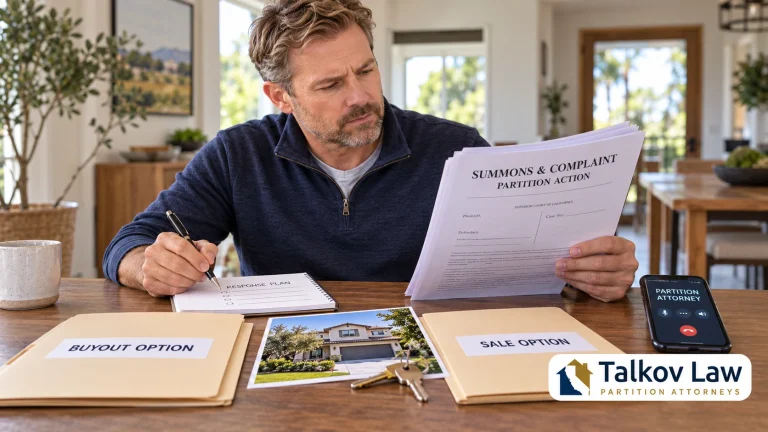 Start hereYour co-owner filed a partition action. What now?The first steps after you are served, and the choices you have.
 RespondingWhat is an answer to a partition action?The document you file to respond, and what goes in it.
 The ruleThe absolute right to partitionWhy courts almost always let a co-owner end the co-ownership.
 What won’t work“Fairness” is not a defenseWhy arguing that a sale is unfair does not stop the case.
 WaiverWaiver of the right to partitionThe one true defense, and what it takes to prove it.
 BuyoutCan I buy out my co-owner?How a defendant can keep the property when a sale is requested.
- Your sharePartition offsets and accountingCredits for the mortgage, taxes, insurance, and repairs.
- AppealDoes an appeal stop the sale?What it takes to pause a court-ordered sale during an appeal.


Latest partition defense articles
On this page
Partition action defenses in California rarely stop the case, but they often decide how it ends. A partition action is the lawsuit a co-owner files to end the co-ownership of real property, usually by asking the court to order a sale. Under Code of Civil Procedure section 872.210 (CCP 872.210), any co-owner can bring one, and courts call that right absolute.
So the real questions for a defendant are practical. The six sections below follow a defendant from the day the summons arrives: what can and can’t stop the case, which defenses actually work, and how to keep the property or protect your share of the money.
1.Respond to the lawsuit on time
A partition lawsuit starts with a summons and complaint. You generally have 30 days after being served to file a response with the court.
If you do nothing, the co-owner who sued can ask for a default judgment, and the court can order the property sold without hearing your side.
2.Know what won’t stop a partition
Usually, a partition action can’t be stopped. California courts have rejected “fairness” as a defense, and a majority owner has no veto.
Once a partition action is filed, a co-owner who does not want to sell generally cannot stop it unless a valid defense applies, such as a waiver of the right to partition, or the co-owners settle. There are also techniques to bring the case to a stop through a resolution the other co-owners will consent to, such as a buyout. Without an agreement or a valid defense, the court will order the property sold and divide the proceeds. That is true even when one co-owner lives in the property, and the court can order a co-owner who will not cooperate with the sale to move out.
The Court of Appeal has rejected the argument that there is a “requirement of fairness” in partition actions. The mistaken authority for that claim is American Medical International, Inc. v. Feller (1976) 59 Cal.App.3d 1008, 1016, which in turn cited Penasquitos, Inc. v. Holladay (1972) 27 Cal.App.3d 356. Several California courts have since dismissed the argument.
There is also no requirement that the co-owner who files have the support of a majority of the owners. An owner of just 1% of a property can bring a partition action. Partition promotes the ability to sell property, so that land does not end up held by many owners who must all agree before anything can happen.
Knowing how hard it is to stop a partition action early saves defendants from paying for arguments that will not work, and points them toward the defenses that can.
- A written agreement waiving the right to partition
- Buying out the co-owner who asked for a sale
- Credits for what you paid on the property
- Living in the house
- Owning the larger share
- Feeling that a sale is unfair
3.Raise the affirmative defenses that can work
True affirmative defenses to a partition action are rare, but they exist. The strongest is waiver: an agreement in which the co-owners gave up the right to partition. Under the Partition of Real Property Act, that waiver generally must be in a written record.
“A co-owner of property has an absolute right to partition unless barred by a valid waiver.” Orien v. Lutz (2017) 16 Cal.App.5th 957, 962, citing Code of Civil Procedure section 872.710, subdivision (b) (“partition as to concurrent interests in the property shall be as of right unless barred by a valid waiver”); see, e.g., Pine v. Tiedt (1965) 232 Cal.App.2d 734; American Medical International, Inc. v. Feller (1976) 59 Cal.App.3d 1008, 1014. Ordinarily, a waiver comes from “an agreement among co-owners of property....” Orien v. Lutz (2017) 16 Cal.App.5th 957, 963. Written agreements like that are rarely seen in California. Most co-owners simply accept a deed placing several owners on title. Establishing this defense is possible, but a writing is going to go a long way. Our guide to waiver of the right to partition covers when a waiver is valid, whether it can happen by accident, and how it must be pleaded.
A defendant can also challenge whether the plaintiff is an owner at all. Code of Civil Procedure section 872.210 allows a partition action by “An owner of an estate of inheritance, an estate for life, or an estate for years in real property where such property or estate therein is owned by several persons concurrently or in successive estates.” In some cases, the plaintiff is not a true owner of the property. Perhaps they were added to title (legal title) for a reason other than being a real owner (equitable title). Or perhaps they claim to be an owner but are not on title, meaning they are bringing a quiet title claim as part of the partition and must show equitable ownership by clear and convincing evidence under Evidence Code section 662. If the plaintiff does not hold an equitable interest in the property, whether on record title or off record title, the partition action is not proper.
Finally, partition is not available between spouses for their community property. Under subdivision (b) of Code of Civil Procedure section 872.210, that property is divided in the divorce case instead.
| Defense | What it can do |
|---|---|
| Waiver | The strongest defense: the co-owners agreed to give up the right to partition. Under the Partition of Real Property Act, it generally must be in a written record. |
| Right of first refusal | Can delay or reshape the case. |
| Heirs filed too early | A claim that heirs sued while probate is still open can delay or reshape the case. |
| No ownership interest | A plaintiff who is not a true owner cannot partition. A plaintiff who is not on title must prove ownership by clear and convincing evidence. |
| Community property | Spouses divide community property in the divorce case, not in a partition action. |
| Credits exceed the plaintiff’s equity | If an early accounting shows the plaintiff has no equity, a court may be hesitant to let the partition go forward. |
| Boilerplate defenses | Defenses with no facts behind them can be challenged and struck. |
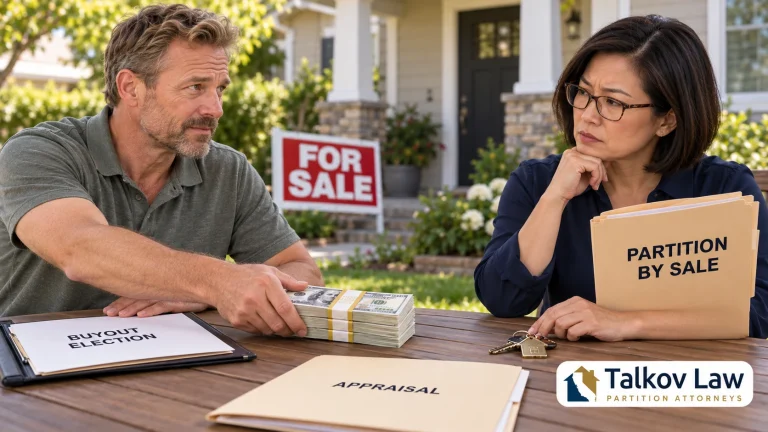
4.Use your right to buy out the co-owner
For many defendants, the best partition action defense is a buyout. If the co-owner who sued asks for a partition by sale of property held as tenants in common, Code of Civil Procedure section 874.317 lets the co-owners who did not ask for a sale buy out those who did, at the value the court sets. Some properties can also be divided rather than sold.
Our guide to buying out a co-owner covers price, financing, and the mortgage.
The Partition of Real Property Act allows a forced appraised sale to the defendant, instead of a sale on the market. Its earlier version, the Uniform Partition of Heirs Property Act, applied only to partition actions involving “heirs property” filed between January 1, 2022 and December 31, 2022. Both versions let the court order a form of partition by appraisal in which a third-party real estate appraiser determines the fair market value of the property. The co-owners who did not ask for a sale can then buy at that price if they choose. By giving those co-owners extra time and an opportunity to buy, the Act serves as a type of partition defense.
A buyout does not have to wait for the court. One of the most common ways to defeat a partition by sale is to buy out the other co-owner or co-owners by refinancing. To estimate the price, start with the likely value of the property, deduct the costs of sale (perhaps 7% to 9%), then deduct any mortgages or liens. Apply each owner’s percentage interest to what remains to find their equity. An escrow holds the deed from the selling co-owner while the buying co-owner deposits the funds. When the loan funds, the escrow pays the co-owner and records the deed. If you have the cash, you can fund the escrow with cash. Otherwise, a friend or family member with good credit can join the loan to help get a better rate.
If your co-owner thinks that a partition means you can’t buy them out, they’re wrong. A 998 offer, a statutory offer to compromise that encourages settlement and can shift certain costs to the losing party, can speed up a buyout.
A co-owner can also buy at the court-ordered sale. Code of Civil Procedure section 873.600 provides that “the court shall order sale by such methods and upon such terms as are expressly agreed to in writing by all the parties to the action.” Subdivision (a) of Code of Civil Procedure section 873.610 adds: “The court may, at the time of trial or thereafter, prescribe such manner, terms, and conditions of sale not inconsistent with the provisions of this chapter as it deems proper for the particular property or sale.” A co-owner hoping to save the home should ask the court to allow overbidding at the hearing approving the sale, so the co-owner can outbid any third party, and to credit the co-owner’s own share against the price, known as a credit bid under Code of Civil Procedure section 873.770. For example, if a co-owned house in Los Angeles sells for $300,000 and the co-owner would receive $100,000 from the sale, the co-owner needs only $200,000 more to buy it.
Some properties can be divided instead of sold through a partition in kind. Historically that worked only for large properties, such as farmland around a house. Newer laws make division possible for some single-family homes: lot splits under Senate Bill 9 and separate sales of an accessory dwelling unit under Assembly Bill 1033. Either can raise enough cash to pay the co-owner who wants out while the other co-owner stays in possession.
Filing a partition action does not by itself trigger the buyout right. A co-owner’s request for a sale does.
- § 872.210Who may bring a partition action
- § 874.311When the Partition of Real Property Act applies
- § 874.316How the court sets fair market value
- § 874.317The defendant’s buyout right
- § 874.318Division or sale if no one buys
See every section in our California partition statutes library.
5.Protect your share of the sale
If the property is sold, the fight shifts to the money: who gets credit for what.
As Wallace v. Daley (1990) 220 Cal.App.3d 1028, 1036 explained: “Every partition action includes a final accounting according to the principles of equity for both charges and credits upon each co-tenant’s interest. Credits include expenditures in excess of the co-tenant’s fractional share for necessary repairs, improvements that enhance the value of the property, taxes, payments of principal and interest on mortgages, and other liens, insurance for the common benefit, and protection and preservation of title.”
Keep careful records of what you paid, and what your co-owner did not pay, toward property taxes, insurance, mortgage payments, and repairs.
Sometimes the plaintiff seeks to force the sale and have a partition referee determine the credits later, which is the most common approach. A defendant may want the credits decided first, so the plaintiff knows what they will likely receive. Parties can ask for an accounting at the beginning of the lawsuit. If a defendant can show that the credits exceed the plaintiff’s equity under an assumed sale at fair market value, a court may be hesitant to let the partition go forward. That takes facts present only in certain cases.
- A defendant who paid the mortgage, taxes, or repairs can claim reimbursement.
- A defendant who lived in the property alone may face a charge for its rental value.
- Settlement offers and attorney’s fee requests also shape the final numbers.
- Even a co-owner hoping to defeat the partition should show cooperation with the plaintiff, the referee, any broker hired to list the property, and the court. That keeps you in the good graces of the people running the process and reduces the costs apportioned among the co-owners after the sale.
“Mr. Resnick also came up with several creative strategies that brought our case to a favorable settlement.”
Client reviews do not guarantee, warrant, or predict the outcome of your legal matter.
6.Prepare for trial, judgment, and appeal
A partition action in California has two phases. At a partition action trial, a judge, not a jury, decides the case.
- The court decides the right to partition.
- It sets each co-owner’s share.
- The court handles the sale.
- It completes the accounting between co-owners.
An appeal generally does not stop a court-ordered sale unless the appealing co-owner posts an undertaking set by the trial court.
Partition defenses in common situations
Who the co-owners are, and where they are, shapes the defense.
Partition defense FAQs
Can a partition action be stopped in California?
Usually not. Under Code of Civil Procedure section 872.210, any co-owner can bring a partition action, and courts call that right absolute. Living in the house, owning the larger share, or feeling that a sale is unfair does not stop it.
How long do I have to respond to a partition lawsuit?
You generally have 30 days after being served to file a response with the court. If you do nothing, the co-owner who sued can ask for a default judgment, and the court can order the property sold without hearing your side.
What is the strongest defense to a partition action?
Waiver: an agreement in which the co-owners gave up the right to partition. Under the Partition of Real Property Act, that waiver generally must be in a written record.
Can I keep the property if my co-owner sues for partition?
Often, yes. If the co-owner who sued asks for a partition by sale of property held as tenants in common, Code of Civil Procedure section 874.317 lets the co-owners who did not ask for a sale buy out those who did, at the value the court sets.
Does a jury decide a partition action?
No. At a partition action trial, a judge, not a jury, decides the case.
Does an appeal stop a court-ordered sale?
Generally not, unless the appealing co-owner posts an undertaking set by the trial court.
Contact an experienced partition attorney in California
Partition actions in California are complicated. Whether you want to end a co-ownership or you have been sued by a co-owner, protect your rights by talking to a partition attorney about the best course of action. Call (877) PARTITION or contact us online for a free consultation.

Scott Talkov
Founder & Managing Partner, Talkov Law
Scott Talkov founded Talkov Law and leads its partition practice, representing co-owners across California on both sides of partition actions, including defendants who have been sued by a co-owner.
Read Scott’s bio →