

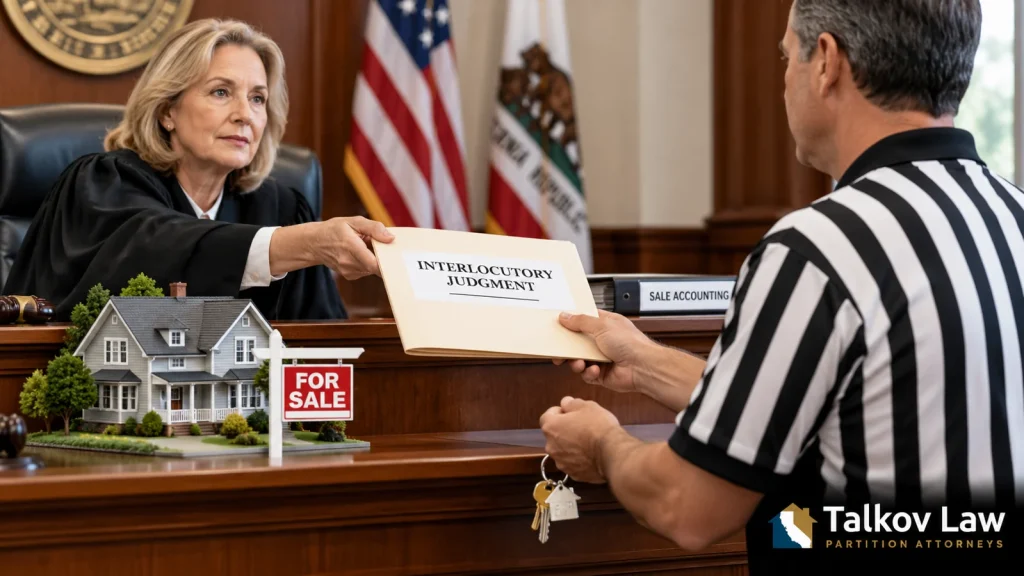
Interlocutory judgment definition: An interlocutory judgment is a judgment that decides part of a lawsuit and leaves the rest for later, before the final judgment that ends the case. In a California partition action, the interlocutory judgment decides what share each co-owner owns and orders the partition of the property, which in nearly every case means a partition by sale. The sale, the accounting of who paid what, and the final judgment come afterward.
If you are the co-owner who wants to sell, this is the ruling that matters most. It is where the court decides that the property will be sold, usually long before anyone argues over who paid for what. To find out how quickly you can get an interlocutory judgment in your case, call (877) PARTITION (727-8484) for a free 30-minute consultation.
The term confuses many people, including attorneys who do not handle partitions, because most lawsuits never have one. Generally, a case has only one judgment, and that judgment answers all issues in the case. Even if that judgment is amended, both the original and the amended judgment attempt to resolve every question in the case. During the case, the court will issue interim orders (not judgments) that answer discrete questions, such as rulings on a demurrer or a discovery dispute. A partition is different because Code of Civil Procedure section 872.720 requires a judgment in the middle of the case.
In a partition action, the court will order “that the property be sold and the proceeds divided among the parties in accordance with their interests in the property as determined in the interlocutory judgment” when either “[t]he parties agreed to such relief, by their pleadings or otherwise,” or when the “sale and division of the proceeds would be more equitable than division of the property.” Code of Civil Procedure section 872.820.
What an Interlocutory Judgment of Partition Includes
In a California partition, the interlocutory judgment of partition includes:
- Each co-owner’s ownership share in the property
- The order that the property be partitioned
- The manner of partition, which is usually a sale, unless the court decides it later
- Usually, the name of the partition referee who will carry out the sale
It does not decide the offsets and accounting of who paid what. Those are decided later, before the final judgment.
What Is an Interlocutory Judgment? Legal Definition
An interlocutory judgment decides only some of the issues in a case. The word “interlocutory” simply means that the judgment comes in the middle of the case, with more for the court to do before the case is over.
“A judgment is interlocutory if further judicial action is essential to a final determination of the rights of the parties.” [1] “An interlocutory judgment or order is a provisional determination of some or all issues in the cause.”[2]
“An interlocutory judgment or order is a provisional determination of some or all issues in the cause…. But interlocutory judgment has a narrower, more specific, and more useful meaning. In certain kinds of cases (usually equitable actions), it is desirable to have a preliminary determination of the respective rights of the parties before taking evidence or further steps to settle the controversy. Roughly classified, the principal situations are the following: (1) Unresolved issues. Where the ultimate judgment will be unconditional, but basic issues of law must be determined before evidence is heard and a final judgment rendered; e.g., an interlocutory order determining the right to an accounting, then taking of the account and judgment for the amount found due … (3) Statutory decrees. Statutory types of interlocutory decrees, such as an interlocutory order for partition.” [3] Interestingly, every partition includes a final accounting, meaning an interlocutory judgment of partition meets both of the examples set forth above.
Interlocutory Judgment vs. Final Judgment
An interlocutory judgment is entered in the middle of the case. The final judgment is entered at the end, after the property is sold and the proceeds are divided. But interlocutory does not mean tentative. What the interlocutory judgment decides, it decides for good. Older partition cases call the same ruling an “interlocutory decree.”
“An interlocutory decree in an action for the partition of real property, although preliminary to the final judgment of conformation, is conclusive as to the matters determined therein.”[4]
Interlocutory Judgment vs. Default Judgment
The two terms answer different questions. “Interlocutory” describes how much of the case the judgment decides: part of it, with more to come. “Default” describes how the judgment was obtained: against a party who was served with the lawsuit and never responded. A judgment can be both. When a properly served co-owner never responds to a partition complaint, the court can enter the interlocutory judgment by default, though it still determines each co-owner’s interest first. Our post on how to get a default judgment in a partition action explains the steps.
The Interlocutory Judgment of Partition Under CCP 872.720(a)
In partitions, a California partition statute exists providing that the court “shall” enter an “interlocutory judgment” as follows:
If the court finds that the plaintiff is entitled to partition, it shall make an interlocutory judgment that determines the interests of the parties in the property and orders the partition of the property and, unless it is to be later determined, the manner of partition.
Miller & Starr explains that: “If the court finds that the plaintiff is entitled to partition, it must make an interlocutory judgment that determines the interests in the property and orders partition of the property.”[5] As a recent California Court of Appeal ruling found, “a viable interlocutory partition judgment must include both a determination of the parties’ interests and order partition. But while it may, it need not, include the manner of partition.” Summers v. Superior Court (2018) 24 Cal.App.5th 138, 142, as modified (June 27, 2018).
Dispositive motion practice means that trial is hardly the only method to enter an interlocutory judgment.[6]
The Court of Appeal has affirmed that “an interlocutory judgment on the pleadings was rendered against the defendants” where the “complaint…asks for a sale of the property…and partition of the proceeds thereof, and that a receiver be appointed to take charge of the property….”[7]
Summers v. Superior Court: Ownership Shares Come Before a Partition Sale
The Interlocutory Judgment Comes First, Before the Sale and the Accounting
Citing “C.C.P. 872.720(a),” Witkin, a leading secondary source on California law, explains that, “[i]n an action for partition, the court first makes an interlocutory order or decree directing partition and determining the respective interests of the parties.” [8]
An unpublished opinion in 2025 explained this order of operations in a partition as follows:
In a partition action, the trial court initially issues an interlocutory judgment that decides the plaintiff’s right to partition (§ 872.710) and the parties’ respective interests in the property (§ 872.610). (See § 872.720, subd. (a); Summers v. Superior Court (2018) 24 Cal.App.5th 138, 142-143.) The interlocutory judgment typically dictates the manner of partition as well. (§§ 872.810–872.840). Thereafter, a court-appointed referee divides or sells the property (§§ 873.010, subd. (a), 873.210, 873.510, 873.790), and the court orders disbursement of the sale proceeds (§ 873.810) and enters a final judgment of partition (§ 874.210).
Cliff R. Russell v. Robert J. Russell (Cal. Ct. App., Aug. 29, 2025, No. A167911) 2025 WL 2490516.
As one unpublished case explained: “It is only when the sale is accomplished, the proceeds obtained, expenses and costs are paid or allocated, and the residue is ready for distribution, that a final judgment of partition may be entered.” Schacherbauer v. Sherwood (Cal. Ct. App., Apr. 13, 2004, No. C041575) 2004 WL 792116, at *4.
The Two Phases of a California Partition Action
Many general civil litigators will erroneously believe that a partition trial must decide all issues in the case. However, the law provides that the order of operations first calls for an interlocutory judgment of partition, followed by a sale and final division of proceeds. The interlocutory judgment usually names the partition referee, and when the co-owners agree on who should serve, they can instead submit a stipulation and order appointing a partition referee. As one unpublished 2022 opinion set forth: “In an action for partition, the trial court determines the plaintiff’s right to partition (§ 872.710), the interests of the parties in the property (§ 872.610), and the manner of partition (§§ 872.810–872.840). The court then issues an interlocutory judgment. (§ 872.720.) The court appoints a referee to divide or sell the property. (§§ 873.010, subd. (a), 873.210, 873.510, 873.790.) The court then orders the proceeds of sale disbursed (§ 873.810) and enters a judgment of partition (§ 874.210).” [9]
Many courts refer to this as the first phase of a partition being the entry of an interlocutory judgment, which is followed by the second phase of a partition being the accounting of offsets and distribution of proceeds, in a sale, or division of the property, in a partition in-kind. While some attorneys may refer to this as the first trial and second trial, the reality is that many partitions are decided without trial, especially on the first phase of an interlocutory judgment of partition.
For example, an unpublished 2021 Court of Appeal decision described the two-step partition process as follows:
In the first phase of the trial, the court on May 19, 2016, denied the relief sought by Cremoux in her cross-complaint and ordered partition of the property. In the second phase of the trial in August 2016, the trial court heard evidence concerning Cremoux’s initial investment in the property and the parties’ respective contributions for expenses related to the property, including repairs and improvements. [10]
The Partition Accounting Will Depend Upon the Interlocutory Judgment of Partition
Once the property is sold, partition law provides that the funds ultimately result in a: “Distribution of the residue among the parties in proportion to their shares as determined by the court.” Code of Civil Procedure section 873.820. Indeed: “Except as otherwise provided in this article, the court shall apportion the costs of partition among the parties in proportion to their interests or make such other apportionment as may be equitable.” Code of Civil Procedure section 874.040.
In other words, if the interlocutory judgment finds the parties to be 50/50 owners, the proceeds will be distributed 50/50 absent some other finding on offsets.
However: “The ordering of an accounting under the partition statute falls under the wide range of discretion accorded a court in equity.” [11] “Because an action for partition is an equitable proceeding, it is governed by the principle that ‘[a] court of equity has broad powers and comparatively unlimited discretion to do equity without being bound by any strict rules of procedure.’”[12]
How to Obtain an Interlocutory Judgment of Partition in California
You obtain an interlocutory judgment of partition in California, thereby closing the first phase of the case, by showing the court, at trial or by motion, that you have the right to partition and what share each co-owner owns. In a California partition action, that showing is often made without a trial, through summary judgment, judgment on the pleadings, default, or an agreement between the co-owners.
Under Code of Civil Procedure section 872.720, an interlocutory judgment of partition determines the parties’ interests, orders partition, and usually sets the manner of partition, leaving the sale and the partition offsets and accounting for the second phase.
What the Court Must Decide Before Entering an Interlocutory Judgment
Whichever route you take, the California partition statutes require the court to reach the same findings:
- Each party’s interest in the property, starting from the record title presumption in California Evidence Code section 662
- The right to partition, which Code of Civil Procedure section 872.710(b) grants “as of right unless barred by a valid waiver”
- The manner of partition, unless the court decides it later under CCP 872.720
The interests cannot be postponed. In Summers v. Superior Court (2018) 24 Cal.App.5th 138, the Court of Appeal held that the trial court could not order a sale while leaving ownership shares for later, explaining that the ruling “ordered the property to be sold before the parties’ interests were resolved.” Our analysis of the Summers decision explains why the court must only resolve those interests, not wait for every co-owner to agree on them.
Can a California Court Enter an Interlocutory Judgment by Motion Instead of Trial?
Yes. One route is summary judgment. Under California Code of Civil Procedure section 437c(c), a summary judgment motion “shall be granted if all the papers submitted show that there is no triable issue as to any material fact and that the moving party is entitled to a judgment as a matter of law.”
A partition plaintiff does not have to disprove every defense up front. Under section 437c(p)(1), the plaintiff meets its burden by proving each element of the cause of action, and the burden then shifts to the defendant to show a genuine factual dispute about the claim or a defense.
In LEG Investments v. Boxler (2010) 183 Cal.App.4th 484, the Court of Appeal directed the trial court to grant summary adjudication of the partition claim and “to enter an interlocutory judgment directing partition of the Property by sale.” The co-owners’ right of first refusal did not waive the right to partition.
Timing matters. The motion generally must be served at least 81 days before the hearing and heard no later than 30 days before trial, so it is usually filed once the answer shows the defendant has no real dispute about ownership.
Judgment on the Pleadings Works When the Answer Admits the Key Facts
California Code of Civil Procedure section 438(c)(1)(A) lets a plaintiff move on the ground that “the complaint states facts sufficient to constitute a cause or causes of action against the defendant and the answer does not state facts sufficient to constitute a defense to the complaint.”
The motion is available in a partition action because the statutes and rules governing civil actions generally apply to partition actions, except where they conflict with the partition statutes (CCP 872.030). A plaintiff may direct it at the entire answer or at one or more of the defendant’s affirmative defenses (Code of Civil Procedure section 438(c)(2)(B)).
This motion is decided on the pleadings and matters the court may judicially notice, without declarations, because Code of Civil Procedure section 438(d) requires the grounds to appear on the face of the challenged pleading or from judicially noticeable matter. That is the difference from summary judgment, which tests the evidence. The pleadings in a partition case often show whether ownership is contested: the complaint must allege each owner’s known interest (CCP 872.230(b) and (c)), and the answer must state the interest the defendant claims and any facts disputing the complaint (CCP 872.410(a) and (b)). It fits cases where the answer to a partition action admits co-ownership and raises only boilerplate affirmative defenses rather than recognized affirmative defenses to a partition action.
The motion asks only whether the answer, as written, states a defense. It does not let the court weigh evidence, notably when the required elements are not disputed by the pleadings. A court may also grant the motion with or without leave to amend the answer, and when leave is granted the defendant has 30 days to amend (Code of Civil Procedure section 438(h)).
The plaintiff may bring the motion once the defendant has answered and the time to demur to the answer has passed. Section 438(e) bars it once a pretrial conference order has been entered, or within 30 days of the date the action is initially set for trial, whichever is later unless the court permits it.
A judgment on the pleadings resolves only the first phase. As in any interlocutory judgment, the manner of partition may be left for later (CCP 872.720(a)), and the offsets and accounting are not decided by this motion.
Default and Agreement Are the Fastest Routes to an Interlocutory Judgment
When a properly served co-owner never responds, the plaintiff can seek a default partition judgment, including after service by publication on a co-owner who cannot be found. The court still determines each party’s interest before entering the interlocutory judgment, typically on declarations and title records.
Co-owners can also agree. Code of Civil Procedure section 872.820 directs a sale when “[t]he parties agree to such relief, by their pleadings or otherwise,” and a stipulated interlocutory judgment often sets the terms for a co-listing or a buyout.
When a Trial Is Needed to Decide the Interlocutory Judgment
A trial is needed when the co-owners genuinely dispute the facts that control the judgment, such as claims with sufficient evidence that change ownership shares from what is shown on the deed, an equitable title claim against record title, or a waiver defense based on a written agreement. Courts generally do not allow a partition action jury trial since partitions are equitable actions decided by the judge.
Whatever the route, the moving co-owner should gather:
- The recorded deed and the chain of title
- Any title report obtained under Code of Civil Procedure section 872.220
- Any written agreement between the co-owners
- Proof of service on every party, including lien holders
- Records of contributions if anyone claims unequal shares
Whichever route produces it, an interlocutory judgment of partition is appealable (Code of Civil Procedure section 904.1(a)(9)), and once the time to appeal passes it is final and conclusive on the matters it determined. In Starcevic v. Pentech Financial Services, Inc. (2021) 66 Cal.App.5th 365, 375–376, the Court of Appeal explained that the trial court cannot amend such a judgment after it becomes final, even to correct an error. Our analysis of the Starcevic decision explains how it affected a creditor’s lien priority.
Once the interlocutory judgment is entered, the court appoints a partition referee and the case moves into the sale and accounting stages described in our partition action timeline.
Your Co-Owner Cannot Delay the Sale by Demanding the Accounting First
One of the most common attempted delay tactics by defendants is to claim that the court must determine all offsets before ordering a sale of the property. This, they claim, means that the court must decide how many lightbulbs the defendant changed, determine the cost of each lightbulb, and find that the defendant owes their fractional share for those lightbulbs. The law on interlocutory judgments provides just the opposite that the interlocutory judgment of partition can be entered, and offsets decided later before a final judgment. Hiring a skilled partition attorney in California will ensure that the case is handled appropriately to bring about a prompt resolution.
Move Your Partition Action to Judgment With Talkov Law
The fastest partition actions reach the interlocutory judgment by motion, not by waiting for trial. Choosing the right motion at the right time can save months.
Talkov Law can help. With 12 full-time partition attorneys and experience in over 650 partition actions throughout California, our team handles every step of the process, from the interlocutory judgment through the referee’s sale and the final distribution of proceeds. Call (877) PARTITION (727-8484) today or contact us online to get started.
References
| ↑1 | 40A Cal. Jur. 3d Judgments § 6 citing Barth-Wittmore Ins. v. H. R. Murphy Enterprises, Inc. (1985) 169 Cal.App.3d 124, 130 (“decree is interlocutory if further judicial action is essential to a final determination of the rights of the parties”). |
|---|---|
| ↑2 | Yeboah v. Progeny Ventures, Inc. (2005) 128 Cal.App.4th 443, 448, as modified on denial of reh’g (May 5, 2005) |
| ↑3 | Nature of Determination, 7 Witkin, Cal. Proc. 6th Judgments (2022) § 12 |
| ↑4 | Starcevic v. Pentech Financial Services, Inc. (2021) 66 Cal.App.5th 365, 375–376 (quoting Pista v. Resetar (1928) 205 Cal. 197, 199, and citing Holt v. Holt (1901) 131 Cal. 610, 611–612 (“interlocutory decree of partition … is a final judgment, certainly, as to all questions determined in it”).)” Starcevic explained that: “As a final judgment on the matters determined therein, the court does not have the power to amend an interlocutory judgment after it becomes final, even in cases of error.” |
| ↑5 | Partition—in general, 12 Cal. Real Est. (4th ed.) § 40:126. |
| ↑6 | San Diegans for Open Government v. Har Construction, Inc. (2015) 240 Cal.App.4th 611, 626 (“the parties were free to bring other dispositive motions (e.g., a motion for summary judgment or judgment on the pleadings)”). |
| ↑7 | White v. White (1936) 11 Cal.App.2d 570, 571. |
| ↑8 | Statutory Types, 7 Witkin, Cal. Proc. 6th Judgments (2022) § 21. |
| ↑9 | George v. Williams (Cal. Ct. App., Jan. 18, 2022, No. 2D CIV. B309218) 2022 WL 152195, at *3. |
| ↑10 | Colmet-Daage v. Cremoux (Cal. Ct. App., Apr. 5, 2021, No. H045033) 2021 WL 1248196, at *1. One secondary source focused largely on non-California partition law explains that: “In the standard procedure, there has traditionally been the First Trial and the Second Trial. In a traditional partition suit, the First Trial would include three main issues: (i) determination of ownership interests, (ii) determination of equitable adjustment, and (iii) determination of the ability to partition the property in kind.” R. Shaun Rainey, Uniform Partition of Heirs’ Property Act: Partition with an Acetate Overlay, 13 Est. Plan. & Community Prop. L.J. 233, 248 (2020); see Bowman v. Stephens (Tex. App. 2018) 569 S.W.3d 210, 222 (“At the conclusion of the first stage of the partition litigation, a trial court may conclude that the property is susceptible to partition in kind and appoint and instruct commissioners to divide the property, taking into account the equitable and legal matters resolved in the first stage.”). |
| ↑11 | Finney v. Gomez (2003) 111 Cal.App.4th 527, 542. |
| ↑12 | Colmet-Daage v. Cremoux (Cal. Ct. App., Apr. 5, 2021, No. H045033) 2021 WL 1248196, at *5 (quoting Richmond v. Dofflemyer (1980) 105 Cal.App.3d 745, 766). |







