

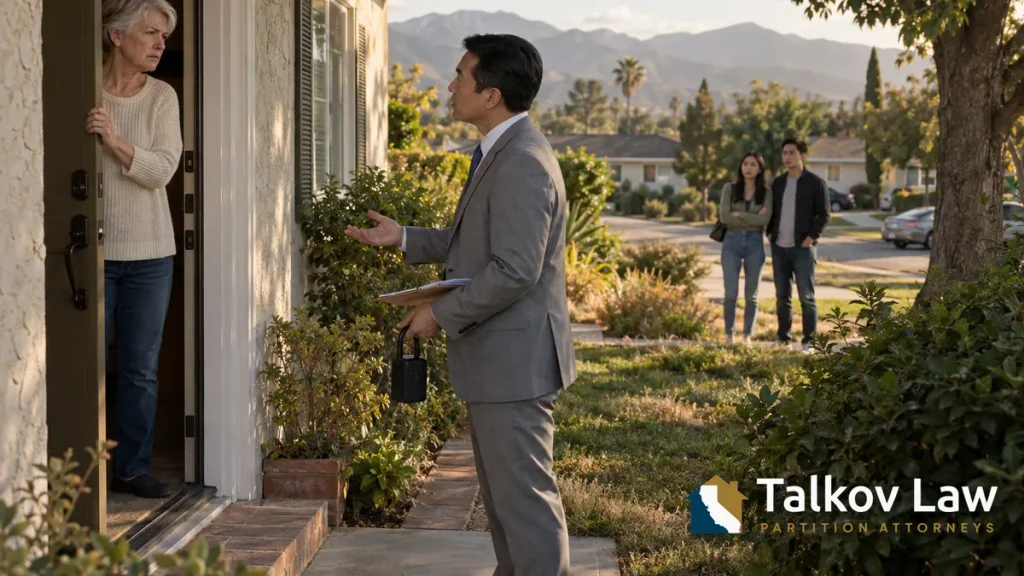
A co-owner who won’t cooperate in selling can end up paying for the value the property loses. In Larson v. Thoresen (1953) 116 Cal.App.2d 790, 796, the California Court of Appeal upheld a partition accounting that charged a $2,800 drop in a co-owned house’s value to the co-owners who failed to cooperate in its sale, including the loss after the lawsuit was filed. If your co-owner is stalling a sale while the market slips, our guide on what to do when you want to sell before prices drop but your co-owner wants to wait walks through your options.
Why Larson Matters
- Lost value can be charged to the co-owner who blocked the sale. The court upheld a $2,800 depreciation award in favor of the co-owners who had tried to sell. (Larson, at p. 796.)
- Loss after the lawsuit is filed counts. The co-owners harmed by the delay could recover “for all detriment resulting after the commencement of the action.” (Larson, at p. 796.)
- The partition court settles it. Damage claims between co-owners belong in the same partition case that orders the sale. (Larson v. Thoresen (1951) 36 Cal.2d 666, 669.)
- The money comes out of the sale proceeds. The court divided the sale fund by adjusting each side’s share for what it put in and what it owed. (Larson, at p. 795.)
- Living in the house was not the problem. The co-owners who stayed in the house owed no rent, because their occupancy protected the property and helped it sell. (Larson, at pp. 796-797.)
The Facts: A New House in El Monte That Never Sold
In August 1947, two couples, the Larsons and the Thoresens, signed a written agreement to buy a lot in El Monte, build a house and garage, split the costs equally, and sell the property for a profit they would divide equally. Once the buildings were finished, the agreement said, the property “shall be placed on the market for sale” at a price and on terms the couples would agree on, and each side would sign the papers needed to carry it out. Title was taken in both couples’ names. (Larson, at pp. 791-792, 794, fn. 1.)
When the house was finished, the Thoresens moved in and the Larsons moved away. “Irritation developed; ill feelings arose,” the court wrote, and because of the strained relations the sale never happened. In April 1948, the Larsons filed a partition action, asking for damages for depreciation they blamed on the Thoresens, for rent, and for waste. The Thoresens cross-complained that the Larsons had failed to pay their share of the bills, put the property on the market, or agree on a price or terms. (Larson, at p. 792.)
After the trial court ordered the couples to sell the house themselves, the California Supreme Court dismissed the first appeal because that order was not a partition judgment. The trial court then appointed a receiver, who sold the house for $8,200. It had been worth $11,000 when it was finished. The couples agreed that their rights would move to the sale money and that the court could sort out who owed what as if the house had not been sold. (Larson, at pp. 792-793, 795.)
How the Courts Decided the Case
The First Appeal: Partition Was the Right Lawsuit
The Supreme Court held that the couples’ agreement made them joint venturers, but that a partition by sale was still the right way to end the dispute, because every money claim between them could be resolved inside it (36 Cal.2d at p. 669):
“The action for partition was proper since all of the equitable adjustments and claims of damage as between the partners as well as claims of lienholders could be disposed of by the application of the code provisions governing partition.”
Larson v. Thoresen (1951) 36 Cal.2d 666, 669
The same idea runs through Bacon v. Wahrhaftig, where the court held that damage and accounting claims between co-owners are part of one partition case.
The Co-Owners Who Didn’t Cooperate Paid for the Lost Value
On retrial, the court found that the Thoresens had done what the agreement required and that the Larsons had not, because they failed to cooperate in the sale. The Larsons argued that they did not have to cooperate because the Thoresens had paid $504.63 less toward the project. The Court of Appeal rejected that excuse: “A more reasonable and just interpretation of the writing is that the duties of cooperating and paying expenses are independent.” (Larson, at pp. 794-796.)
The trial court found the property had depreciated $2,800. The Larsons attacked that figure because the Thoresens’ answer had alleged only $2,500. The Court of Appeal upheld the full amount:
“While the latter sum may have been the extent of the depreciation at the time of filing the answer, respondents were entitled to recover for all detriment resulting after the commencement of the action.”
Larson v. Thoresen (1953) 116 Cal.App.2d 790, 796
The court relied on Civil Code section 3283, which allows damages for harm that happens after a lawsuit begins. And the numbers were simple: “Whereas the evidence showed the value at completion to have been $11,000, at the sale by the receiver it brought only $8,200.” (Larson, at p. 796.) The Larsons’ failure to pay their share of the construction bills also cost them: $288.12 in interest that built up on those bills was taken out of their share of the sale money. (Larson, at p. 797, fn. 4.)
The Co-Owners Living in the House Owed No Rent
The Larsons also wanted rent from the Thoresens for living in the house. The court found that the Larsons had left on their own, that the Thoresens never kept them out, and that the Thoresens stayed to protect the house, keep it clean, and help sell it. Their occupancy caused no damage, did not hinder the sale, and actually made the house easier to sell. Without an ouster, the Larsons had no claim to rental value. (Larson, at pp. 796-797.)
The Result
From the $8,200 sale fund, after the receiver paid taxes, costs and the outstanding construction bills, the trial court awarded the Thoresens $4,673.91 and the Larsons $1,455.83. The Court of Appeal affirmed. In its words: “The court determined many facts with reference to the investments of each party in order to be enabled fairly to divide the proceeds.” (Larson, at pp. 793, 795, 798.) That is the partition accounting at work: credits for what each owner paid in, charges for what each owner owes, and the balance paid from the sale proceeds. The same approach appears in Mercola v. Chester, where the co-owners who funded a building were repaid before any profit was split.
Is Larson Still the Law?
Larson is a published opinion, decided under the partition statutes that California replaced in 1976. Today, Code of Civil Procedure section 872.140 gives the court the same power: “The court may, in all cases, order allowance, accounting, contribution, or other compensatory adjustment among the parties according to the principles of equity.” That rule is how a modern partition court charges one co-owner and credits another, as it did in Goodenow v. Ewer for rent. And Code of Civil Procedure section 872.130 lets the court order a co-owner to stop “unlawful interference with a partition of the property ordered by the court.”
What Larson Means for California Co-Owners
- A duty to cooperate makes the claim. In Larson, the duty came from a written agreement to market the house. Today it can also come from a court order: once the court enters an interlocutory judgment ordering a sale and appoints a partition referee, a co-owner who blocks showings or refuses to sign is defying the court.
- Your co-owner can’t make you wait for a better market. A co-owner cannot delay partition hoping prices rise, as De Roulet v. Mitchel and Rich v. Smith hold. And a co-owner who appeals only to stall can be sanctioned, as in Hummel v. First National Bank.
- Prove the loss and the cause. Larson turned on two numbers, the value when the house was ready to sell and the price it brought, and on a finding that the other side failed to cooperate. A drop caused by the market alone is not the same as a drop caused by your co-owner, so keep a record of every refused showing, ignored request and violated order.
- Delay can cost them their fees too. Courts can divide attorney’s fees in a partition by fairness instead of ownership share under Code of Civil Procedure section 874.040, as in Lin v. Jeng, where an owner who overreached paid all of her own fees.
- Physical damage is a separate claim. If your co-owner is damaging the house itself, see what to do if your co-owner damages the property.
Co-Owner Stalling the Sale? Start the Partition
The longer a stalled sale drags on, the more you stand to lose. If your co-owner refuses to sell, a partition action puts a court-ordered sale in motion and settles what each owner is owed. Your co-owner cannot stop it, because the right to partition is absolute unless it was waived, and every month counts, because how long a partition action takes depends in part on how quickly you file.
Talkov Law can help. With 12 full-time partition attorneys and experience in over 650 partition actions throughout California, our team handles every step, from proving your right to partition through the partition sale and the final division of proceeds. No fees until you win. Call (877) PARTITION (727-8484) today or contact us online for a free consultation.







