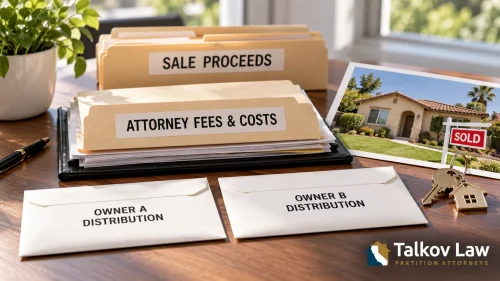
Co-owners who file a partition often want the other side to pay all of their attorney’s fees. Finney v. Gomez (2003) 111 Cal.App.4th 527, 545–548 shows where that starts: the fees spent to partition the property are split by ownership, so a 50 percent owner ordinarily pays half, and a court that charges one co-owner with all of them needs evidence in the record to justify it. Because the trial court had no such evidence, the Court of Appeal cut the fee award against the other co-owner in half.
The case is the starting point for anyone asking who pays for a partition action. Later courts have given judges more room to shift fees, as explained below, but the rule this case applied, sharing fees by ownership, is still where every fee fight starts.
Why Finney v. Gomez Matters
In most lawsuits, each side pays its own lawyer. Partition is different. California Code of Civil Procedure section 874.010 treats “reasonable attorney’s fees incurred or paid by a party for the common benefit” as costs of partition, and California Code of Civil Procedure section 874.040 requires the court to divide those costs “among the parties in proportion to their interests or make such other apportionment as may be equitable.” (Finney v. Gomez, at p. 545.)
That second phrase is where the fights happen. The co-owner who did the work of forcing the sale wants the other side to pay everything. The case answers three practical questions:
- What is the normal split? By ownership share.
- Can a court charge one co-owner with all the fees? Only if the record supports a different split.
- Which fees count? Only fees that benefited all of the owners, and only if they were reasonable.
The Facts: A 50/50 House and a 100 Percent Fee Award
Kevin Finney and John Gomez bought a four-bedroom house in Torrance, in Los Angeles County, as tenants in common. Each paid half the down payment, and they agreed to split all costs equally. After Gomez moved to New York, Finney paid the taxes, insurance, and upkeep, and in 1999 Gomez stopped paying the mortgage. (Finney v. Gomez, at pp. 531–532.)
Finney filed a partition action. Gomez never responded, and the court ordered a partition by sale. The partition referee sold the house to Finney. The trial court then entered a judgment charging Gomez with 100 percent of Finney’s partition attorney’s fees and referee costs, plus 100 percent of a $3,000 fee Finney paid a bankruptcy attorney after Gomez talked about filing for bankruptcy. Gomez appealed. (Finney v. Gomez, at pp. 532–533.)
How the Court of Appeal Reached Its Decision
Proportional Sharing Is the Rule
The Second District Court of Appeal read California Code of Civil Procedure section 874.040 narrowly:
“Section 874.040 has been consistently interpreted as giving courts only two options in apportioning the costs and fees of a partition action.”
Finney v. Gomez, at p. 545
The court may split fees by ownership or make some other equitable split, but it treated the second option as the rare exception. Relying on the Law Revision Commission’s official comment to the statute, it described only two situations that justify departing from ownership shares: when the litigation for the common benefit involves only some of the owners, and when the owners’ interests differ from parcel to parcel. (Finney v. Gomez, at pp. 545–547.)
Nothing Supported an Unequal Split
Neither situation applied. Finney and Gomez were the only owners, each owned half, and Finney himself said they had agreed to share costs equally. Finney’s partition attorney’s fees were $5,630 and the referee’s costs were $2,668.84, so an equal split meant Gomez owed $4,145, not $8,290. (Finney v. Gomez, at pp. 547–548.) As the court put it:
“In fact it seems counterintuitive for the trial court to order the proceeds of the property split based on the parties’ interest in ownership but only award the costs and fees for the common benefit of the partition to Finney.”
Finney v. Gomez, at p. 548
With no evidence supporting a different split, charging Gomez with all of the fees was an abuse of discretion, meaning the record gave the court no basis for the ruling.
The Bankruptcy Attorney’s Fee Did Not Benefit Both Owners
Only fees spent for the common benefit count as costs of partition. Finney’s only evidence about the bankruptcy lawyer was that he wanted the lawyer’s “input on what I should do on the case.” Nothing showed the advice helped Gomez, and the trial court never decided whether the fee was reasonable. The court threw out that fee entirely. (Finney v. Gomez, at pp. 548–550.)
The Result: Half the Fees, Not All of Them
The Court of Appeal reversed and ordered a new judgment of $20,645, which included Gomez’s $4,145 half of the partition fees and costs. (Finney v. Gomez, at pp. 550–551.) The rest of the reduction came from a separate ruling: because Gomez never responded to the lawsuit, the money award could not exceed the $16,500 Finney’s complaint asked for. Our article on default judgments in partition actions covers that issue.
How Later Courts Treat Finney v. Gomez
The narrow “two situations” reading did not last. Nine years later, another panel of the Court of Appeal found that “Finney is inconsistent with the current statutory language.” (Lin v. Jeng (2012) 203 Cal.App.4th 1008, 1022.) It held:
“The statute’s broad language does not limit the trial court’s equitable discretion, and we decline to follow Finney by doing so.”
Lin v. Jeng (2012) 203 Cal.App.4th 1008, 1025
There, the court upheld an order making a sister pay all of her own fees after she tried to cut her siblings out of the family home. (Lin v. Jeng (2012) 203 Cal.App.4th 1008, 1025–1026.) And Orien v. Lutz (2017) 16 Cal.App.5th 957, 966 later held that fees spent on contested issues can still be for the common benefit.
So the law today is this: fees start out split by ownership, as Finney v. Gomez holds, but a court has broad power to shift them when a co-owner’s conduct makes an equal split unfair, and the record must show why.
What Finney v. Gomez Means for California Co-Owners
- Expect partition fees and costs to be split by ownership unless you give the court a reason to do otherwise.
- To shift fees onto a co-owner who stalls or refuses to cooperate, build a record of that conduct as the case goes on.
- Fees for side matters, like a bankruptcy consultation, are recoverable only if they benefited every owner and were reasonable.
- A settlement offer under Code of Civil Procedure section 998 can shift more of the costs onto a co-owner who refuses a fair deal.
Our guides to attorney’s fees in a California partition action and recovering fees against an uncooperative co-owner explain how to make that case.
When the court divides the sale proceeds, the costs of partition, including attorney’s fees, come out before the owners are paid, and each owner bears their share. If your co-owner made the case harder than it needed to be, the record you build can shift more of that cost to them. When you are ready, you can file a partition lawsuit.
Talkov Law can help. With 12 full-time partition attorneys and experience in over 650 partition actions throughout California, our team handles every step of the process, from filing through the referee’s sale and the final division of proceeds and fees. Call (877) PARTITION (727-8484) today or contact us online to get started.