

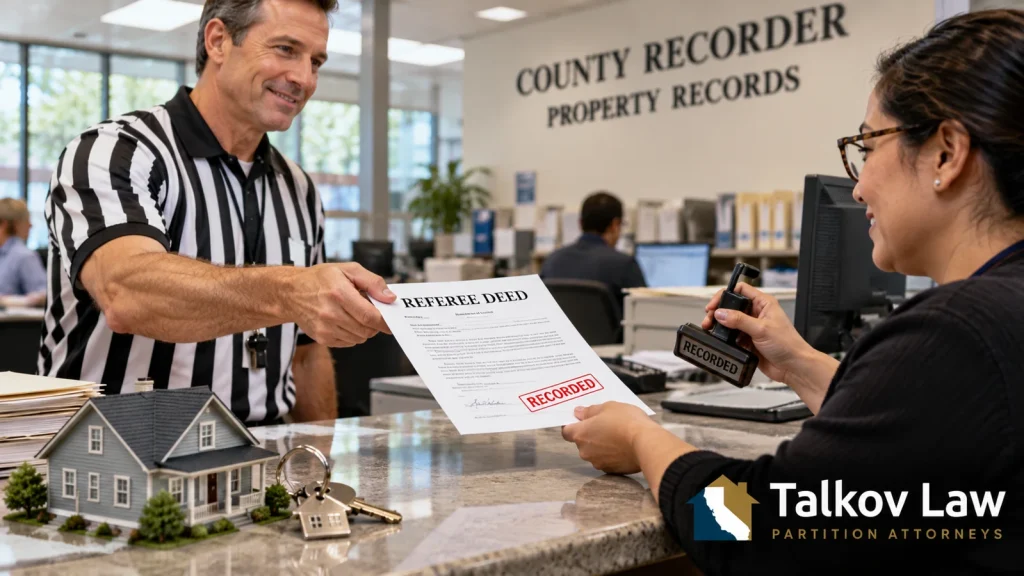

California Code of Civil Procedure section 873.790 (CCP 873.790) is the step that transfers title in a partition sale. Once the buyer fulfills the terms of sale, the partition referee signs the deed or other transfer document, and the deed and the court order authorizing it are recorded in every county where the property is located. It is one of the California partition statutes that bring a partition action to a close.
Full Text of CCP 873.790
(a) Upon fulfillment of the terms of sale, the referee shall execute a conveyance or other instrument of transfer to the purchaser.
(b) The conveyance or transfer of real property and the order authorizing such conveyance or transfer shall be recorded in each county in which the property is located.
California Code of Civil Procedure section 873.790 (added by Statutes 1976, chapter 73)
What CCP 873.790 Means for the Partition Deed
Section 873.790 has two parts:
- The referee signs. When the buyer has fulfilled the terms of sale, usually by paying the price into escrow, the referee “shall execute a conveyance or other instrument of transfer to the purchaser.” For a house or land, that document is a referee’s deed.
- The deed and the order are recorded. For real property, both the deed and the court order authorizing it must be recorded in each county where the property is located.
The word “shall” matters. Once the terms of sale are met, signing is the referee’s duty, and no further court order is needed. The co-owners do not sign the deed, so a co-owner who opposes the sale cannot hold up the transfer by refusing to cooperate.
Recording the order with the deed gives the buyer, the title insurer, and the public a clear record of the court’s authority for the transfer. Our post on title insurance in a partition action explains why that record matters to the buyer.
For example, if co-owned ranch land straddles the line between Kern County and Tulare County, the referee records the deed and the order in both counties. A house that sits in one county needs only one recording.
The Law Revision Commission Comments on CCP 873.790
The California Law Revision Commission recommended the partition statutes the Legislature enacted in 1976. Its comment on section 873.790 reads:
Subdivision (a) of Section 873.790 is new. Subdivision (b) continues the substance of the first portion of former Section 787.
California Law Revision Commission Comment to Code of Civil Procedure section 873.790 (1976)
In other words, the recording rule carries forward earlier California law, while the referee’s express duty to sign the deed was new in 1976.
How California Courts Apply CCP 873.790
In Solis v. Vallar (1999) 76 Cal.App.4th 710, 713, a partition of a co-owned home in Hayward, the Court of Appeal discussed how final an order confirming a partition sale is. It described the referee’s role this way: “Section 873.790 requires no further action by the court; it directs the referee to execute and record the conveyance or transfer upon fulfillment of the terms of sale.”
The court tied that duty to CCP 874.240, which makes a conveyance or transfer under sections 873.750 and 873.790 binding and conclusive, in the same manner as a judgment. The court also noted that in a partition by appraisal, title passes under section 873.960 instead.
Common Questions About the Referee’s Deed
Who Signs the Deed in a California Partition Sale?
The partition referee. Under section 873.790(a), the referee executes the conveyance once the terms of sale are fulfilled. The co-owners’ signatures are not needed.
Where Is the Referee’s Deed Recorded?
With the county recorder in each county where the property is located. Section 873.790(b) requires recording both the deed and the court order authorizing it.
Is the Sale Final Once the Referee’s Deed Is Recorded?
The law treats it that way. Section 874.240 makes a conveyance under sections 873.750 and 873.790 binding and conclusive, in the same manner as a judgment, which gives the buyer and the co-owners who wanted the sale a clean finish.
Where CCP 873.790 Fits in the California Partition Statutes
Section 873.790 is the last section of Article 3 of the sale chapter (Chapter 6) of the partition title, which takes a sale from the referee’s report to the deed. The report of sale comes under section 873.710, the motion to confirm under section 873.720, the confirmation hearing under section 873.730, and increased offers under section 873.740. After confirmation, section 873.750 directs the referee to complete the sale, section 873.760 addresses a buyer who fails to pay, section 873.770 allows a credit for a buyer who is owed part of the proceeds, and section 873.780 covers closing orders before the deed is signed under section 873.790.
The rules for setting up the sale come earlier, in sections 873.600 through CCP 873.690. Once the deed is recorded, sections 873.810 through CCP 873.850 govern how the proceeds are divided.
Talkov Law Partition Attorneys Can Help
The referee’s deed is the moment the co-owners’ dispute over the property ends and the buyer takes title. Making sure the terms of sale are met and the deed and order are recorded correctly avoids title problems after closing.
Talkov Law can help. With 12 full-time partition attorneys and experience in over 650 partition actions throughout California, our team handles every step of the process, from the complaint and the court-ordered sale through the referee’s deed and the final distribution of proceeds. Call (877) PARTITION (727-8484) today or contact us online to get started.







