

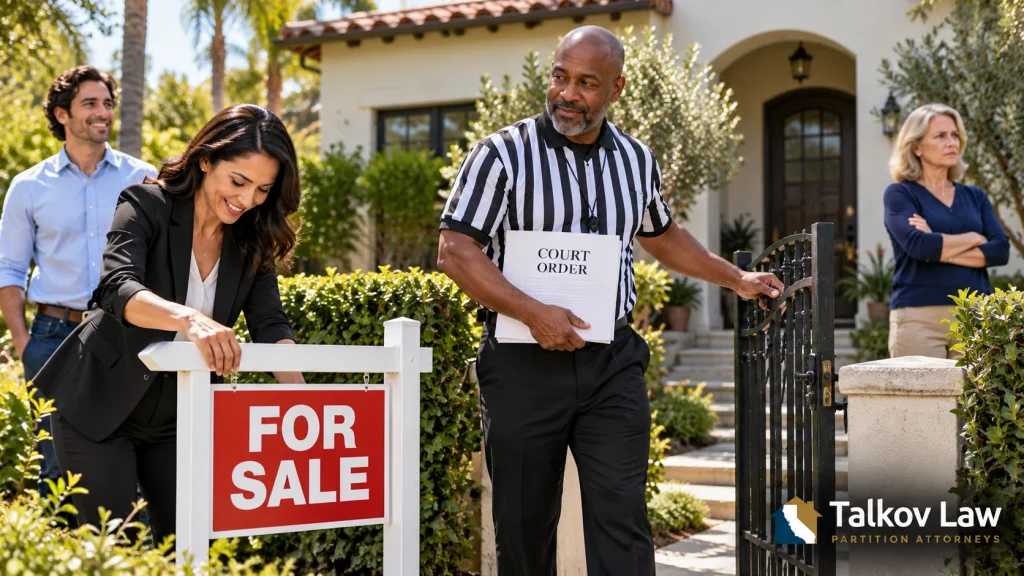
To force the sale of a house or other jointly owned property in California, a co-owner files a partition action asking the court to order the property sold and the proceeds divided. No other owner has to agree: under California Code of Civil Procedure section 872.710(b), partition of co-owned property “shall be as of right unless barred by a valid waiver,” which is why California treats the right to partition as absolute.
A forced sale of property between co-owners is a sale the court orders when a co-owner will not agree to sell, and in California it happens through a partition by sale. This guide explains the steps to file a partition lawsuit, how a court-ordered sale works under the Partition of Real Property Act, and why the size of your share, the other owner’s hardship, or an inherited title does not stop the sale.
Do All Co-Owners Have to Sign to Sell a Jointly Owned House in California?
No. Outside of court, selling the whole property takes every owner’s signature, but a co-owner who wants out does not need the others to agree. In a partition action, the court orders the sale, and once the terms of sale are met, the court-appointed partition referee signs the deed to the buyer in place of the owners under California Code of Civil Procedure section 873.790. No co-owner can hold the others hostage in a failed co-ownership.
What If One Co-Owner Wants to Sell and the Other Doesn’t?
The co-owner who wants to sell can force the sale, unless the owners gave up the right to partition in a valid waiver. Refusing to sign a listing agreement, staying in the house, or ignoring the lawsuit does not stop it. The co-owner who wants to keep the property has two real choices: buy out the other owner’s share in a co-owner buyout, or let the property be sold and take a share of the proceeds.
Wanting to keep the house is not the same as being able to pay for it. Since mortgage rates rose in 2022, many co-owners cannot qualify for a new loan at today’s rates on one income, and a mortgage assumption is possible only on some loans. When your co-owner cannot afford the buyout, the property is sold.
For example, two siblings inherit their mother’s house in equal shares. One wants to sell, and the other wants to keep it. The sibling who wants to sell files a partition action. If the other sibling buys that half, either at an agreed price or, in a case under the Partition of Real Property Act, at the value the court sets, the case ends in a buyout. If not, the court orders the house sold, and the siblings split the proceeds after the accounting for who paid what.
The Steps to Force the Sale of Jointly Owned Property in California
A partition action to force a sale usually moves through these steps:
- File a complaint for partition in the county where the property is located and record a lis pendens, which warns buyers and lenders that the case is pending
- Serve every co-owner, plus anyone else with a recorded interest, such as a lender holding a deed of trust
- Obtain an interlocutory judgment of partition under California Code of Civil Procedure section 872.720, which determines each owner’s share and orders the partition, usually by sale
- Have the court appoint a partition referee under California Code of Civil Procedure section 873.010 to sell the property, usually by listing it on the open market
- Ask the court to confirm the sale under California Code of Civil Procedure section 873.720
- Divide the proceeds after the partition offsets and accounting for mortgage payments, property taxes, repairs, and rental value
How Long Does It Take to Force the Sale of a House?
Forcing the sale of a house in California usually takes about 4 to 8 months from hiring a partition attorney to the close of the sale when the other co-owner agrees to sell once the lawsuit is filed, and about 6 to 12 months when the co-owner ignores the lawsuit and a court-appointed partition referee must sell the property. Even when the other co-owner fights, most cases are over in less than 12 months. If the other co-owner buys you out by refinancing instead, you can be paid in as little as 30 to 60 days.
Our partition action timeline explains how long each step usually takes, and our guide to how a partition referee sells property covers the sale itself.
Why Co-Owners Force a Partition Sale
In a partition by sale, the court orders the whole property sold, and any buyer, including one of the co-owners, may purchase it. For partition actions filed on or after January 1, 2023, the Partition of Real Property Act adds steps before the sale when the co-owners have no written agreement binding all of them that governs partition. The court determines the property’s fair market value under California Code of Civil Procedure section 874.316, and the co-owners who did not ask for a sale may buy out the shares of those who did at that value under CCP 874.317. If no buyout occurs and dividing the land would cause great prejudice to the co-owners as a group, the court orders a sale, usually an open-market sale through a licensed real estate broker under CCP 874.320.
The court can also order a partition in kind, which physically divides the land, but that rarely works for a house. None of the partition actions Talkov Law has handled has ended in a division in kind.
Co-owners of a jointly owned property may choose to exercise their right to partition for a variety of reasons, usually due to a disagreement or dispute that arose between the co-owners. How can the co-owners make best use of the property? What if one co-owner wants to sell, but the other doesn’t? What if one co-owner is in possession of the property while the others pay expenses? These disputes (and many more) can be resolved in California as explained in our guide on partition actions in California.
Under California law, the right to file a partition action requesting that the property be sold is absolute. Under California Code of Civil Procedure section 872.210, any co-owner of real estate may file, no matter what kind of property is at stake or how large or small that co-owner’s share is.
If you are the co-owner bringing the case, our tips on how to win a partition action explain how to set up the sale and the accounting in your favor. If a co-owner has filed against you, our guide on whether you can stop a partition action explains why a buyout or a negotiated sale is usually the realistic path, and which affirmative defenses to a partition action courts recognize.
California Law on Partition
Multiple cases in California have established the absolute right to partition. One case explained that: “Ordinarily, if the party seeking partition is shown to be a tenant in common, and as such entitled to the possession of the land sought to be partitioned, the right to partition is absolute, and cannot be denied, ‘either because of any supposed difficulty, nor on the suggestion that the interest of the cotenants will be promoted by refusing the application or temporarily postponing action…’” Priddel v. Shankie (1945) 69 Cal.App.2d 319, 325.
Another case set forth that: “The action for partition . . . is a special proceeding regulated by the provisions of the statute and ordinarily, if the party seeking partition is shown to be a tenant in common, and as such entitled to the possession of the land sought to be partitioned, the right is absolute.” Bacon v. Wahrhaftig (1950) 97 Cal.App.2d 599, 603.
Even the leading treatise on California real estate law, Miller & Starr, explains under the heading “Absolute right to partition” that “each cotenant has an ‘absolute’ right to partition the common property.” Right of partition—In general, Miller & Starr, California Real Estate (4th edition), volume 4, section 11:14. The main exception is a valid waiver, such as an agreement among the co-owners giving up partition, which our guide to the waiver of the right to partition explains. Those cases are rare, and no partition action Talkov Law has handled has been denied.
The Rights of the Co-owners (Co-Tenants / Tenants-in-Common)
Fractional Interest of Co-owners
Because the right to partition is absolute, the fractional interest of co-owners is not a deciding factor. A co-owner with even a small share can file a partition action, which matters because a fractional interest is very difficult, if not impossible, to sell on its own at anything close to full value, as our post on whether you can sell your half of a jointly owned property explains. The property will either be sold, with each co-owner receiving a share of the proceeds matching his or her ownership after the accounting, or the land will be physically divided in a partition in kind, in which each owner receives sole ownership of a separate parcel in proportion to his or her interest under California Code of Civil Procedure section 872.810. Our comparison of partition by sale versus partition in kind explains the difference.
Co-owners Can File for Partition Without Conflict
Additionally, a partition action can be filed without conflict among the co-owners. For example, an ex-husband co-owner can file a partition action against his ex-wife co-owner even if their relationship is entirely amicable. In general, partition actions usually involve parties who were or are very close, since co-owning a property with another person is a serious commitment. Parties usually include past or present family members, romantic partners, and close friends and are entered into voluntarily, based on trust at that time, or involuntarily (such as by a trust, will, or divorce decree). Conflict often arises when these once-intimate relationships dissolve. Although such conflict is not a necessary prerequisite to file a partition action, it is all too common.
Hardship to the Co-Owner Living in the Property Does Not Stop the Sale
Lastly, any hardship that the co-owner living in the property faces does not defeat the other co-owner’s right to partition, because fairness is not a defense to partition. So, an ex-wife can file a partition action against her ex-husband who lives in the house, even if he has nowhere else to go. He can buy the property in the partition action like any other buyer, and in a case governed by the Partition of Real Property Act, if she asked for a sale and he did not, he may buy her share at the court-determined value under CCP 874.317.
If he does not buy the property, the ex-wife’s share of the proceeds is not reduced because the sale is hard on him. When the co-owner living in the property refuses to cooperate with an orderly sale, the court and the partition referee can move the sale forward without him.
How to Force the Sale of Inherited Property
California recognizes the absolute right to partition a house that you have inherited from your parents, family members, or friends. This right does not depend on who lives there, whether a sibling, aunt, uncle, friend, or anyone else, and not all heirs have to agree to sell. You may have inherited through a will, trust, joint tenancy with right of survivorship, or transfer on death deed. Our guide to forcing the sale of an inherited house walks through the process, and the sooner you begin the partition of inherited property, the sooner your co-ownership troubles will end.
Force the Sale of Your Jointly Owned Property With a California Partition Action
You do not need your co-owner’s permission or signature to end the co-ownership. A partition action lets the court order the sale, settle who paid what, and divide the proceeds.
Talkov Law can help. With 12 full-time partition attorneys and experience in over 650 partition actions throughout California, our team handles every step of the process, from filing through the referee’s sale and the final distribution of proceeds. Call (877) PARTITION (727-8484) today or contact us online to get started.







