A California co-owner who sues for partition does not need a separate lawsuit for every wrong a co-owner committed. That is the holding of Bacon v. Wahrhaftig (1950) 97 Cal.App.2d 599, where the Court of Appeal revived a partition of Kern County oil land that the trial court had thrown out. Partition was the plaintiff’s one “primary right,” and the partition court could decide fraud, damages, and accounting disputes along with it to do complete justice.
The case also repeats the rule that runs through California partition law: a co-owner’s right to partition is absolute. For the full picture, see our guide to the absolute right to partition in California.
The Facts: An 18% Owner of Kern County Oil Land
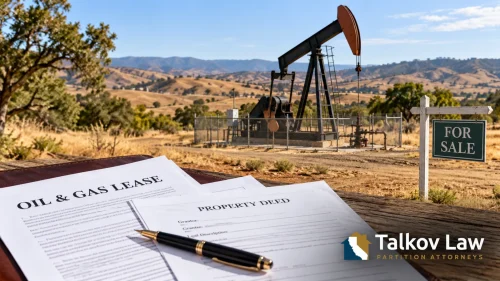
Joseph C. Bacon owned an undivided 18.13 percent of three sections of land in Kern County. About a dozen co-owners held the rest, including other Bacon family members, the Mitchel family, the Salvation Army, and two other charitable missions. (Bacon, at pp. 600–601.) The land was subject to oil and gas leases held by Seaboard Oil Company and Bandini Petroleum Company.
Bacon alleged that the Mitchels had reworked the lease deals for their own benefit. They kept an 8 1/3 percent overriding royalty on 160 acres, released the oil companies from drilling obligations on the rest of the land, and in 1946 signed an agreement extending the time to drill and waiving the companies’ defaults, all without regard to the other co-owners’ interests. Bacon alleged this was a fraud on his co-owners, that the oil companies took part in it, and that the companies let large amounts of wet gas blow into the air. (Bacon, at pp. 601–602.)
Bacon sued for partition. He alleged the land could not be divided in kind, so it should be sold and the proceeds divided according to each owner’s rights. (Bacon, at p. 603.)
The Trial Court Dismissed the Case
The defendants filed demurrers, which are motions arguing that a complaint is legally defective. They argued that the wrong parties were sued, that several claims were improperly combined, and that the complaint was uncertain. The trial court agreed. Bacon declined to amend, and the court entered judgments of dismissal. Bacon appealed. (Bacon, at p. 603.)
The Court of Appeal Reversed on Every Ground
The Right to Partition Is Absolute
The court started with the basic rule. Citing Priddel v. Shankie, it held that “ordinarily, if the party seeking partition is shown to be a tenant in common, and as such entitled to the possession of the land sought to be partitioned, the right is absolute.” (Bacon, at p. 603.) Owning only about 18 percent made no difference. As we explain in Can a Minority Owner Force a Partition in California?, the size of your share does not limit your right to file.
Today, Code of Civil Procedure section 872.710 (CCP 872.710) states the same rule: partition between co-owners is a matter of right unless it was given up in a valid waiver.
Everyone With an Interest Belongs in the Case
“No partition can be had until the interests of all the parties have been ascertained and settled by a trial.” (Bacon, at p. 603.) Bacon had to set out every person’s interest in the land, including the interests created by the oil leases, so the co-owners and the oil companies were all “necessary and proper parties.” (Bacon, at pp. 603–604.) The modern versions of these rules are CCP 872.230’s rules on the contents of the complaint, CCP 872.510 on who must be joined, and CCP 872.620 on determining the state of title.
Fraud, Damages and Accounting Claims Are Part of the Partition
The defendants argued Bacon had improperly mixed separate claims: rescinding the leases, quieting title, breach of the leases, fraud, and an accounting. The court disagreed. The primary right was partition, and “The fact that a plaintiff may be entitled to several species of relief for the enforcement of a single right does not mean he has more than one cause of action.” (Bacon, at p. 604, quoting an earlier Court of Appeal decision.)
Then came the line that gives the case its lasting value: “This is an equitable action and the court has jurisdiction to hear and determine all issues necessary to do complete justice.” (Bacon, at p. 604.) Quoting the California Supreme Court in Sears v. Rule (1945) 27 Cal.2d 131, 148–149, the court added that a court of equity “will adjust all the differences between the parties arising from the cause of action in order to do complete justice and prevent further litigation, whether or not the particular relief was requested,” and may order an accounting even when the complaint did not ask for one. (Bacon, at p. 604.)
Today, CCP 872.140’s rule on accounting and compensatory adjustment lets the court order an allowance, accounting, contribution, or other compensatory adjustment among the parties under principles of equity. Our guide to the scope of a partition action explains everything the court can decide.
The Complaint Was Clear Enough
The demurrers for uncertainty also failed. The transactions were documented in writings attached to the complaint, and “A special demurrer should not be sustained when the allegations of the complaint are sufficiently clear to apprise the defendant of the issues which he is to meet.” (Bacon, at p. 605.) For another case where demurrers could not stop a partition, see De Uprey v. De Uprey.
Oil Leases Are Interests in Real Property
The oil companies argued that a co-owner cannot use partition to end a lease all the co-owners signed. The court left that question open: “We are not here deciding this precise question.” (Bacon, at p. 606.) It held only that “the right of a lessee in an oil and gas lease is a profit a prendre, that is an incorporeal hereditament or interest in real property,” meaning a right to take resources from someone else’s land. Because it is an interest in the property, it had to be set out in the complaint, and the oil companies’ arguments were for the trial court to decide at trial. (Bacon, at p. 606.) Today, CCP 872.540 on oil and gas interests addresses how those interest holders are handled in a partition.
The Result: Judgments Reversed
The Court of Appeal reversed both judgments of dismissal, sending the partition back for trial. (Bacon, at p. 606.)
What Bacon v. Wahrhaftig Means for California Co-Owners
- Your right to partition is absolute, even if you own a small fraction of the property.
- One lawsuit can do it all. Claims that a co-owner mismanaged the property, took more than their share, or acted in bad faith can be decided in the partition.
- The court can order an accounting to make the division fair, even if your complaint did not specifically ask for one.
- Leases, royalties and other interests are sorted out in the same case, so everyone’s rights are settled before the property is sold.
Put an End to the Co-Ownership
If a co-owner is using the property for their own benefit or refuses to sell, a partition action lets the court order a partition by sale and settle the accounting between co-owners in the same case. When you are ready, you can file a partition lawsuit.
Talkov Law can help. With 12 full-time partition attorneys and experience in over 650 partition actions throughout California, our team handles every step of the process, from filing through the referee’s sale and the final distribution of proceeds. Call (877) PARTITION (727-8484) today or contact us online to get started.