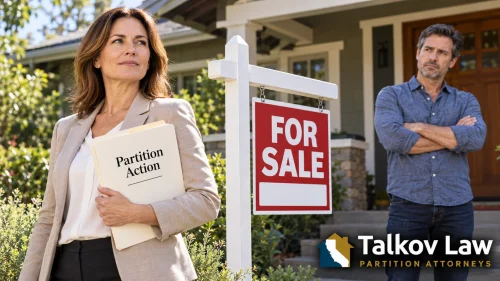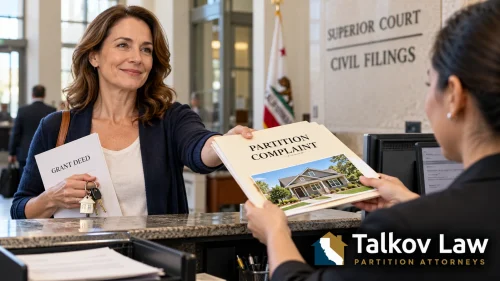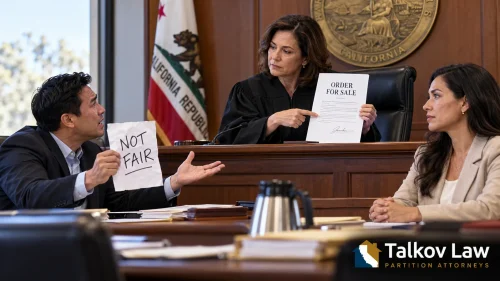
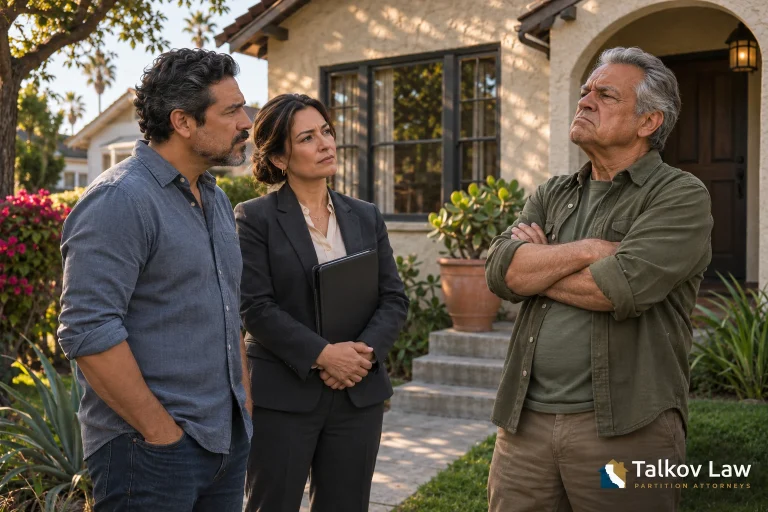
In California, a co-owner’s right to partition is absolute, and another co-owner’s homestead on their own share cannot stop it. That is the holding of Priddel v. Shankie (1945) 69 Cal.App.2d 319, 325, a case still quoted today for the rule that “the right to partition is absolute.” The Court of Appeal affirmed a court-ordered sale of a small Los Angeles lot over every objection the other co-owner raised.
The case explains why a co-owner who wants out does not need anyone’s permission, a principle now written into California Code of Civil Procedure section 872.710. For the full picture, see our guide to the absolute right to partition in California.
The Facts: Two Co-Owners and a Small Los Angeles Lot
Priddel and Shankie each owned an undivided one-half interest in “a rectangular city lot, 40 by 140 feet, located in the middle of a block” facing Buchanan Street in Los Angeles. (Priddel, at p. 322.) Shankie had received his half through a will while he was single, so it was his separate property. The lot held two houses and garages.
Two events complicated the title. First, the County of Los Angeles had given Shankie hospital aid, and in December 1941 he signed a promissory note and a mortgage on his half for $1,295.22. The county recorded that mortgage in April 1942. Second, in August 1943, Shankie recorded a “Husband’s Declaration of Homestead” covering his undivided half. (Priddel, at pp. 321–322.)
Priddel, who lived in Ontario, Canada, filed a partition action.
The Trial Court Ordered a Sale
The trial court found that the lot was so situated that it could not be divided “without great prejudice and that a sale therefore was necessary.” (Priddel, at p. 323.) It ordered partition referees to sell the property at a private sale. From the proceeds, the court paid the taxes and the costs of sale, then Priddel’s half of the balance. The county’s $1,295.22 came out of Shankie’s half, and Shankie received whatever was left. (Priddel, at pp. 323–324.) Shankie appealed.
The Court of Appeal: The Right to Partition Is Absolute
The court began with the basic rule. Under the partition statutes then in effect, once the co-ownership was proved, the court “must order a partition.” (Priddel, at pp. 324–325.) It then wrote the sentence the case is known for:
“Ordinarily, if the party seeking partition is shown to be a tenant in common, and as such entitled to the possession of the land sought to be partitioned, the right to partition is absolute, and cannot be denied, ‘either because of any supposed difficulty, nor on the suggestion that the interest of the cotenants will be promoted by refusing the application or temporarily postponing action, . . .'”
Priddel v. Shankie (1945) 69 Cal.App.2d 319, 325
Today, California Code of Civil Procedure section 872.710, subdivision (b), states the same rule: partition between co-owners “shall be as of right unless barred by a valid waiver.” A court does not weigh whether a partition seems fair to the co-owner who wants to keep the property. As we explain in fairness is not a defense to partition, that argument does not stop the case.
Shankie’s main argument was that his recorded homestead on his half barred Priddel’s partition. The court held that this contention “cannot be sustained.” (Priddel, at p. 325.) Quoting the California Supreme Court, it explained that a homestead gives the claimant only the occupancy rights he already had, “and the other cotenant’s interest is in no way affected.” It added: “If he objects to his cotenant, his remedy is by partition.” (Priddel, at p. 325.)
The court noted that a different result had been reached in a case between a husband and wife. Priddel and Shankie were not married, and Shankie’s homestead covered only his own half. (Priddel, at p. 326.)
A Small Lot With Two Houses Had to Be Sold
Shankie’s own testimony supported the sale. He described the property as an inside lot, 40 by 140 feet, “improved by two dwelling houses and three garages so situated that the property could not be partitioned in kind.” (Priddel, at p. 326.) Today, California Code of Civil Procedure section 872.820 lets a court order a sale when it “would be more equitable than division of the property,” which is why most homes end in a partition by sale rather than a partition in kind.
The Other Objections Failed Too
- Shankie’s wife did not need to be sued. His half was separate property, so his wife “was not a necessary party defendant to the action in partition.” (Priddel, at p. 327.)
- A co-owner living in Canada could sue. Priddel was not acquiring property by inheritance or by will. He was dividing property he already owned, so living outside the United States did not bar the case. (Priddel, at p. 327.)
- The county’s mortgage was valid and came first. The county recorded its mortgage in April 1942, before Shankie’s homestead in August 1943, so the homestead did not defeat it. (Priddel, at p. 330.) The debt was paid only from Shankie’s half, the same rule we discuss in Zieve v. Dhindsa: A Co-Owner’s Loan Reaches Only Their Own Share.
The Result: Sale Affirmed
The Court of Appeal affirmed the judgment, concluding that the parties’ rights were “adequately protected at all points.” (Priddel, at p. 331.) The lot was sold, Priddel received his half, and the county was paid from Shankie’s share.
What Priddel v. Shankie Means for California Co-Owners
- Any co-owner can force a partition. The right is absolute, and today California Code of Civil Procedure section 872.710 makes it a right unless it was given up in a valid waiver.
- A homestead recorded on another co-owner’s share does not stop your partition.
- You can bring a partition even if you live in another country.
- A loan secured only by your co-owner’s share is paid from your co-owner’s share, not yours.
- When a lot cannot be fairly divided, the court orders a sale, and a partition referee sells the property.
For plaintiffs, the lesson is that a co-owner’s objections rarely change the outcome. Prove the co-ownership, and the court moves the case toward a sale and a division of the proceeds.
Enforce Your Absolute Right to Partition
If your co-owner refuses to sell, you do not need their agreement. A partition action lets the court order the property sold and the proceeds divided. When you are ready, you can file a partition lawsuit.
Talkov Law can help. With 12 full-time partition attorneys and experience in over 650 partition actions throughout California, our team handles every step of the process, from filing through the referee’s sale and the final distribution of proceeds. Call (877) PARTITION (727-8484) today or contact us online to get started.