

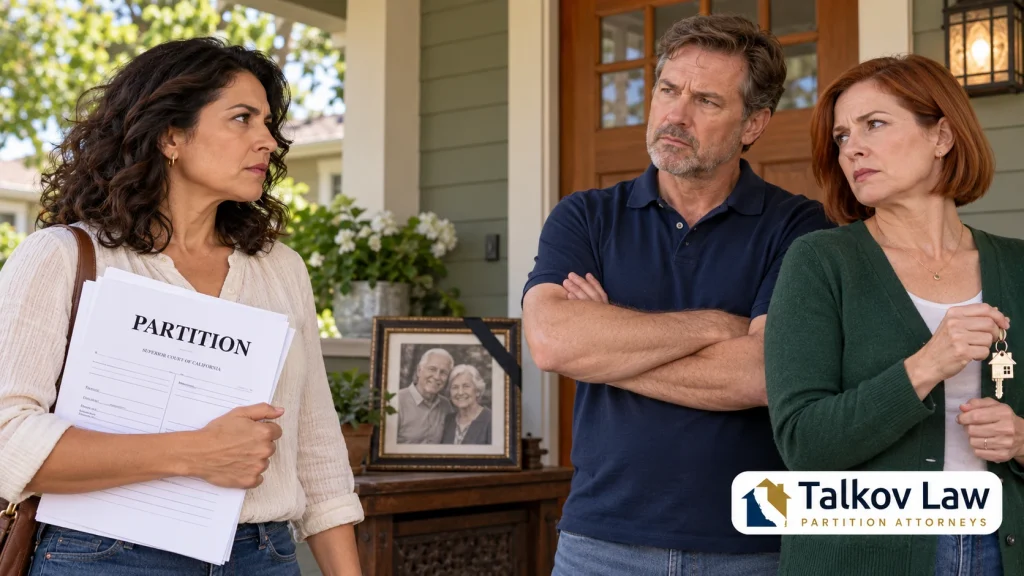
No. In California, the heirs do not all have to agree to sell inherited property. Any heir who co-owns the house can force its sale through a partition action, even when a sibling or other heir refuses to sell or sign. The exceptions are narrow: a valid, written waiver of the right to partition, which is rarely found in inheritance situations, and a house that is still in probate or held in a trust, where the heirs do not hold title yet.
Is a sibling refusing to sell the house you inherited? You can force the sale without their signature. Get a free 30-minute consultation or call (877) PARTITION (727-8484). No fees until you win.
This comes up most often when siblings inherit a house and one wants to sell while another wants to keep it, rent it out, or keep living there. Losing a close family member is hard enough, and inheriting a house with a family member who won’t sell makes it harder. The best way to preserve a relationship with a loved one who is also a co-owner may be to end the co-ownership. If the disagreement is with your own spouse over a share you inherited, see what to do when your spouse won’t sell an inherited house below.
Can Siblings Force the Sale of Inherited Property?
Yes. Whether you inherited a home or vacant land with a sibling or another co-owner, the “right to partition is absolute.” Priddel v. Shankie (1945) 69 Cal.App.2d 319, 325. As one treatise on California law explains:
Ordinarily, therefore, if a party seeking partition is shown to be a tenant in common or a joint tenant, the right is absolute and cannot be denied, either because of any supposed difficulty or on the suggestion that the interests of the cotenants will be promoted by refusing the application or temporarily postponing the action. The only indispensable requirement is that a clear title be shown, and in no event is a partition to be denied because it might result in financial loss to the cotenants.
48 California Jurisprudence, Partition, section 36
The Legislature wrote the same rule into Code of Civil Procedure section 872.710, subdivision (b), which provides that partition “shall be as of right unless barred by a valid waiver.” A forced sale of inherited property does not depend on a family vote. If even one heir wants to sell, a partition action can force the sale, and the other heirs cannot prevent it without a valid, written waiver. No partition action Talkov Law has handled has been denied.
Selling Inherited Property With Multiple Owners: Does Majority Rule?
No. Heirs who inherit a house together, whether through a will, a trust, a transfer on death deed, or intestate succession (inheritance without a will), usually become tenants in common. Each heir owns a fractional interest in the property, even if the shares vary under the estate plan.
Under Code of Civil Procedure section 872.210, a partition action can be filed by any co-owner with an interest in the property, even a small fractional interest. Neither unanimous nor majority agreement is required, so being a majority owner is not a prerequisite to forcing the sale of the jointly owned property. When some heirs want to sell and others are on the fence, one heir can still file, and the rest are simply named in the case.
The reason is practical. You can sell your own share of an inherited property without the other heirs’ consent, but few, if any, buyers will pay full value for a fractional interest in a house. Selling the whole property lets every heir receive a fair share of the proceeds, divided by each heir’s ownership interest after the court settles who paid what.
What If the Sibling Who Won’t Sell Is Living in the House?
Living in the house does not let your sibling block the sale. See what happens when one sibling is living in an inherited property and refuses to sell for how you get them out, what they owe for living there, and who is repaid for the mortgage.
If the holdout is not a sibling, see what to do when a co-owner refuses to sell.
How One Triplet Moved an Inherited-Home Dispute Forward
In one Talkov Law case, three triplet brothers inherited their mother’s home, but their shared history did not lead to a shared plan for the property. Our client wanted to sell. One brother continued living in the house while the others waited to access the equity in their inheritance.
Our client filed a partition action, and the brother in possession ultimately agreed to a sale. The brothers did not begin with a shared decision to sell; the agreement came after the lawsuit was filed. This inherited-property case illustrates how filing can move a family dispute toward an agreed sale.
What If a Family Member Won’t Sell the Inherited Property?
You do not need their signature, and you do not have to wait for them to change their mind. A family member who won’t sell inherited property in California can hold up a private sale, but not a partition action. In Crittenden v. Crittenden (1963) 221 Cal.App.2d 299, two brothers forced the sale of an inherited San Diego building over the third brother’s objection. That is true whether the holdout is a sibling who insists on “keeping the family home,” a stepparent who won’t sell the house you inherited, a relative who ignores you, or an heir who promises to buy you out “someday.”
If you want to try once more before filing, a direct message gets further than an argument. Put a specific proposal in writing, tell your sibling when you need an answer, and say what you will do if the talks stall. For example:
I’d like us to settle what happens with the house by [date]. There are two ways to do it. We can sell it and divide the net proceeds, with an accounting for the taxes, insurance, and repairs each of us has paid. Or you can buy my share at a price based on a licensed appraisal, with financing in place by [date]. Please tell me which you prefer by [date]. If we can’t agree, I’ll talk to a partition attorney about asking the court to resolve it.
The message works because it offers a real choice between a sale and a buyout. The date is your own, not a legal deadline, so choose one that is reasonable and follow through. The last sentence says what you will do, not what a court will do: how the costs of the case are shared is left to the court under Code of Civil Procedure section 874.040.
A buyout offer is real when it names a price method, a financing date, and a closing timeline. A promise to buy you out “someday” is a request to wait, and co-ownership does not have to continue while you do.
You are also free to skip the message. Filing a partition action is not the end of the negotiation. It is usually where a real one starts. If you do write, speak with a partition attorney before sending a warning of your own: a pointed letter from a co-owner can weaken your position later, while a letter from an attorney fits into a plan to file. Once you decide to file, stop negotiating directly and let your attorney handle further discussions.
How to Sell Inherited Property in California With Multiple Heirs
- Confirm that the heirs hold title. The right to partition begins when the heirs receive their interest in the property, which is generally when the deed from the executor or successor trustee is recorded.
- Ask for an agreed sale or a buyout. If every heir agrees, the house can be sold and the proceeds divided without a lawsuit. A negotiated buyout can end the standoff when the heirs agree on a value and the buyer can pay for it.
- File a partition action if any heir refuses. One heir can file alone. Filing does not end the negotiation, and it often starts one.
- Expect a buyout offer or a sale. Most buyouts are agreed to voluntarily after filing. In some partitions, the court may also determine fair market value and give the heirs who did not ask for a sale the chance to buy out those who did, as explained below.
- Sell the house and divide the proceeds. For a single house, the court almost always orders a partition by sale rather than a physical division of the land, known as partition in kind. No partition action Talkov Law has handled has ended in a division in kind. Once the court orders the sale, the property can be sold regardless of whether the other heirs agree.
Based on Talkov Law’s completed-case data, the average partition action resolves in seven to nine months and costs about $20,000. The court generally apportions the costs of the partition itself under Code of Civil Procedure section 874.040 in proportion to the parties’ interests or in another equitable way.
Can One Heir Keep the Inherited House by Buying Out the Others?
Often, yes. Most buyouts are agreed to voluntarily, because the other heirs usually just want their money. In some partitions, the court may also set the fair market value under the Partition of Real Property Act and give an heir who did not ask for the sale the right to buy out the heirs who did at that value. If no one buys, the house is listed on the open market. Our guide to how to buy out a sibling from an inherited house covers the price, credits and financing step by step.
Who Pays the Expenses While Heirs Disagree?
An inherited house keeps generating costs while the heirs disagree about it: property taxes, insurance, repairs and maintenance, utilities, and any mortgage payments. Often one heir advances most of them, while the other heirs’ equity stays tied up in the house. Heirs also disagree over how the property should be maintained or improved.
When the property is sold through a partition action, the court can sort out who paid what through partition offsets and accounting. Code of Civil Procedure section 872.140 allows the court to order “allowance, accounting, contribution, or other compensatory adjustment among the parties according to the principles of equity.” An heir who paid more than their share of the expenses can ask for credit for those payments. The court may order reimbursement, but paying more does not give that heir a larger ownership percentage, and the credit is not automatic. It depends on the facts, the records, and the court’s equitable adjustments, so keep tax bills, insurance statements, invoices, and proof of payment.
Waiting has a cost too. While the heirs hold the house together, the expenses continue and each heir’s equity stays tied up. If the heirs cannot agree on a buyout, a partition sale ends the shared ownership and turns each heir’s share into proceeds, after the accounting.
What If My Spouse Won’t Sell an Inherited House?
Sometimes the disagreement is inside a marriage. One spouse inherits a share of a parent’s house, and the couple disagrees about what to do with it. One wants to sell and use the money to move or invest elsewhere, while the spouse who inherited wants to keep the home for sentimental reasons.
Start with who owns the share. Under Family Code section 770, property acquired during marriage by “gift, bequest, devise, or descent” is the separate property of the spouse who received it. If a wife inherits a share of her parents’ house, that share generally belongs to her alone, and her husband does not gain ownership of it simply because they are married. This often surprises couples who assume that everything acquired during marriage becomes community property.
The real conflict is usually with the other heirs. The spouse who inherited typically co-owns the house with brothers and sisters, and one of them refuses to sell. The spouse who did not inherit often sees the situation more neutrally and urges a sale, while the spouse who inherited lets an unhealthy co-ownership continue by not acting. The decision belongs to the spouse who owns the share, and that spouse does not need the siblings’ consent: any co-owner can file a partition action, and for a single-family home the court typically orders the house sold and the proceeds divided.
Can Heirs Force a Sale During Probate or While the House Is in a Trust?
Generally, not yet. When the owner of a property dies, the house can end up with several owners in a few ways, and the timing of the heirs’ right to partition depends on which one applies.
Probate. If the owner had no trust, or the house was never put in the trust, probate may end with each heir receiving a fractional interest in the property. While the estate is still in probate, the heirs do not yet own the house, so an heir generally cannot file a partition action until the probate court distributes it. In Amundson v. Catello (2025) 111 Cal.App.5th 817, the Court of Appeal reversed a partition judgment that siblings obtained while probate was still pending. During probate, the personal representative may file a partition action under Probate Code section 9823, and beneficiaries can ask the probate court to divide the property under Probate Code section 11950. A co-owner who already held a share before the death is different: that co-owner can usually force the sale without waiting for probate.
Joint tenancy. If a parent held the house with several children as joint tenants, the parent’s share passes outside probate to the surviving joint tenants through the right of survivorship. The surviving children still co-own the house as joint tenants with one another, and any one of them can file a partition action, just as a tenant in common can.
Trusts and transfer on death deeds. An ordinary living trust can leave a property to several beneficiaries, as can a transfer on death deed with multiple beneficiaries. While the house is still held in the trust, the trustee generally decides whether to sell it under the terms of the trust. Once the trustee deeds it to the beneficiaries, they are co-owners like any others, and a no contest clause in the trust almost never stops one of them from filing a partition action.
However the heirs ended up as co-owners, a partition action is how the law ends the co-ownership when they cannot agree.
If your family member will not agree to a sale or a fair buyout, a partition action is how you get your share, and you can file one even if you inherited a minority share. But it is rarely the courtroom fight people picture. A partition action is a lawsuit, governed by the ordinary rules of civil procedure under Code of Civil Procedure section 872.030, yet the outcome is seldom in doubt. As a leading treatise puts it, “each cotenant has an ‘absolute’ right to partition the common property.” (4 Cal. Real Est. (4th ed.) § 11:14.) The question is almost never whether the co-ownership will end, only how.
It is normal to feel conflicted or guilty about taking legal action against a brother, a sister or another relative. Two things help. First, the heir who files is not the one who created the problem. The person who files is usually the one who has been kept from an inheritance while a family member lives in the house or refuses to act. Second, you are not going against your parent’s wishes. Your parent’s will or trust, usually prepared with an attorney, left the house to all of you. Asking the court to carry out that written plan is following your parent’s wishes, even when a sibling says Mom promised them the house.
The process is also built around a neutral. Under Code of Civil Procedure section 873.010, subdivision (a), “[t]he court shall appoint a referee to divide or sell the property as ordered by the court.” The partition referee is a neutral third party who handles the sale, so the family no longer has to negotiate every step with each other. As the Court of Appeal explained in LEG Investments v. Boxler (2010) 183 Cal.App.4th 484, 493: “Partition is a remedy much favored by the law. The original purpose of partition was to permit cotenants to avoid the inconvenience and dissension arising from sharing joint possession of land. An additional reason to favor partition is the policy of facilitating transmission of title, thereby avoiding unreasonable restraints on the use and enjoyment of property.”
Many siblings say they do not want to sue family. But the longer the co-ownership drags on, the more money is lost, and the relationship often suffers anyway. Once the house is resolved, brothers and sisters no longer have to deal with each other as business partners, which is often what finally lets a family grieve and move forward.
End the Standoff Over an Inherited House With a Partition Action
If you are facing a disagreement with family members over inherited real estate, you do not have to stay stuck in limbo. A partition action gives every heir a clear path: an agreed buyout or sale if the family can reach one, and a court-ordered sale if it cannot. Deciding whether to sue a family member to obtain your share is never easy, but it is often the only way to move forward.
Talkov Law’s attorneys handle inherited property disputes throughout California, including Los Angeles, San Jose, Sacramento, Riverside, Orange County, San Diego, and San Bernardino.
Talkov Law can help. With 12 full-time partition attorneys and experience in over 650 partition actions throughout California, our team handles every step of forcing the sale of an inherited house, from filing through the referee’s sale and the final distribution of proceeds. Call (877) PARTITION (727-8484) today or contact us online for a free consultation with a partition attorney.








