

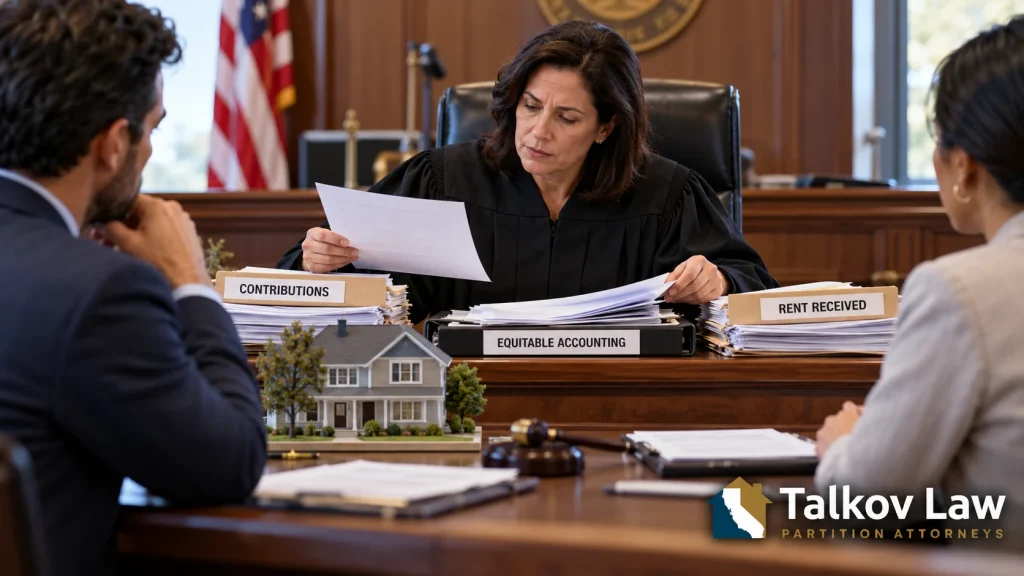
California Code of Civil Procedure section 872.140 (CCP 872.140) is the compensatory adjustment statute. It gives the court in every partition action the power to order an accounting, contribution, and other compensatory adjustment between co-owners according to the principles of equity. It is the statute behind partition offsets and accounting, and it sits in the general provisions of the California partition statutes.
Full Text of CCP 872.140
The court may, in all cases, order allowance, accounting, contribution, or other compensatory adjustment among the parties according to the principles of equity.
California Code of Civil Procedure section 872.140 (added by Statutes 1976, chapter 73)
What CCP 872.140 Means in Plain English
Section 872.140 lets the court even out what each co-owner put into and took out of the property before the sale proceeds or the land is divided. The words “in all cases” mean the accounting is available in every partition action, whether the property is sold or divided.
The adjustments courts most often consider include:
- Credits for mortgage payments one co-owner made for the others
- Credits for property taxes and insurance
- Credits for necessary repairs and qualifying improvements that enhance the property’s value
- Charges for rents one co-owner collected from tenants
- Charges for the rental value of a co-owner’s exclusive possession, in the circumstances discussed below
Each co-owner should raise these claims. Under CCP 872.430, “The answer may set forth any claim the defendant has for contribution or other compensatory adjustment.” A defendant can raise them in the answer without filing a cross-complaint, because the Assembly committee comment to that section says it “avoids the need of the defendant to file a cross-complaint for affirmative relief.” The court usually decides these claims after the interlocutory judgment of partition, often with help from a partition referee report on offsets.
Does CCP 872.140 Change the Ownership Percentages?
A reimbursement adjustment can change the dollars each owner receives without changing their ownership percentages. Start with each owner’s share, then account for allowed credits and charges. Paying more of the common expenses does not, by itself, establish a larger ownership interest.
Example: Reimbursing a Co-Owner Without Counting the Payment Twice
Assume two tenants in common each own 50 percent. After the mortgage payoff and sale expenses, $400,000 remains. One owner paid $40,000 in qualifying common expenses from separate funds, and the court allows the entire expenditure in the accounting. Assume no other claims, agreements, or offsets.
One method returns the $40,000 advance to the paying owner and divides the remaining $360,000 equally. The paying owner receives $220,000; the other receives $180,000. An equivalent method starts with $200,000 each and shifts $20,000—the nonpaying owner’s half of the expense—to the paying owner.
Do not reimburse the full $40,000 first and then charge the other owner another $20,000. That counts the same contribution twice. Miller & Starr’s discussion of contribution and partition distributions describes these alternative approaches. See 4 Miller & Starr, California Real Estate (4th ed., June 2024 update), sections 11:10 and 11:18. Our guide to two ways to calculate co-owner reimbursements provides further examples.
Are Improvement Costs Automatically Reimbursed?
No. A receipt proves an expenditure, but it does not automatically establish the allowable credit. The court considers the nature of the work, the benefit to the common property, and any agreement allocating responsibility. For improvements, evidence of the resulting increase in property value may be important; the invoice amount and the increase in value are different figures.
In Wallace v. Daley (1990) 220 Cal.App.3d 1028, 1035–1038, the court recognized a credit for a predecessor co-owner’s value-enhancing improvements, but denied credits for the claimant’s own work under a rental arrangement that placed improvement costs on her. The decision shows why both the ownership history and the parties’ agreements matter. See also 4 Miller & Starr, California Real Estate, section 11:19.
Rental Income and an Occupying Co-Owner’s Use Are Different
Money received from third-party tenants is an accounting item distinct from the rental value of a co-owner’s own occupancy. Identify who received the rent and which common expenses were paid from it. A co-owner should not claim a personal contribution for an expense already funded with shared rental income. Our post on a co-owner collecting the rent and not paying you half lists the most common ways rent gets underpaid.
In Hunter v. Schultz (1966) 240 Cal.App.2d 24, 30–32, the court distinguished an automatic rent obligation from a defensive offset against the occupying owners’ reimbursement claims. It upheld an offset for use of the absent owner’s interest against mortgage interest, taxes, and insurance. An occupancy offset therefore requires its own factual and legal analysis; sole occupancy alone does not establish rent liability.
What Records Help Prove an Equitable Adjustment?
Organize the accounting by date, payment source, expense category, and amount. Preserve mortgage statements, bank records showing who actually paid, tax and insurance bills, invoices, leases, rent deposits, and agreements about sharing expenses. For an improvement credit, preserve evidence of the work and its effect on value. For an occupancy offset, gather evidence of the relevant period and reasonable rental value.
A useful schedule separates personal advances from expenses paid with shared funds and identifies any reimbursement already received. See our guides to proving mortgage payments and the evidence needed for a referee’s offset report.
The Law Revision Commission Comment on CCP 872.140
The California Law Revision Commission recommended the partition statutes that the Legislature enacted in 1976. Its comment on section 872.140 reads:
Section 872.140 continues the substance of the last sentence of former Section 792. It makes clear the court’s authority to order compensatory adjustment for such items as common improvements, unaccounted rents and profits, and other matters for which contribution may be required. See, e.g., Hunter v. Schultz, 240 Cal.App.2d 24, 49 Cal.Rptr. 315 (1966) (equitable adjustment offsetting use value of property against expense of improvements). For a provision for payment of owelty in cases of unequal division, see Section 873.250.
California Law Revision Commission, Recommendation Relating to Partition of Real and Personal Property (January 1975), page 427, comment to proposed section 872.140
The comment confirms that section 872.140 reaches common improvements, unaccounted rents and profits, and other matters for which contribution may be required. When property is divided rather than sold and the shares are unequal in value, the separate owelty payment under CCP 873.250 evens out the difference.
How California Courts Have Applied CCP 872.140
In Wallace v. Daley (1990) 220 Cal.App.3d 1028, 1035–1036, the Court of Appeal explained that partition includes an equitable accounting of charges and credits, including qualifying expenditures beyond a co-owner’s proportionate share. Our analysis of the Wallace decision discusses the case in more detail. The right to contribution is much older than the statute: in Willmon v. Koyer (1914) 168 Cal. 369, 374, the California Supreme Court held that a co-owner who pays a common burden, such as the taxes, is entitled to have the other owner refund a proportionate share, and approved a lien on that owner’s share to secure it.
Hunter v. Schultz, discussed above, illustrates the defensive use-value offset. Our post on offsets for rental value against co-owners in sole possession explains that distinction further.
The purchase-payment rule requires care. In Demetris v. Demetris (1954) 125 Cal.App.2d 440, 445, the court reformed a joint-tenancy deed after finding that it did not reflect the parties’ intended ownership, then considered the father’s excess purchase payments in the partition. The case therefore does not hold that a true joint tenant can recover a larger share merely by showing that they paid more. In Milian v. De Leon (1986) 181 Cal.App.3d 1185, 1194–1195, the court addressed a true joint tenancy and evidence that the parties agreed to own equally despite differences in their contributions. It held that unequal initial purchase payments cannot be reimbursed in a true joint tenancy unless an agreement requires repayment. The parties’ ownership arrangement and any repayment agreement therefore matter. A higher down payment alone does not establish a reimbursement right for a true joint tenant. That is why unequal down payments are a frequent accounting issue.
In Finney v. Gomez (2003) 111 Cal.App.4th 527, 538–539, 543–544, the Court of Appeal recognized that a partition action may include a final accounting but held that section 872.140 does not displace section 580’s notice limits for a default judgment. A general request for partition does not authorize an unspecified money award against a co-owner who defaults. For expenses that continue accruing after the complaint is filed, Finney identified two options: plead an estimate and limit any default award to that amount, or serve a precise statement of damages before default is entered. This holding concerns default judgments; it does not decide how a fully litigated accounting is calculated from the evidence.
Where CCP 872.140 Fits in the California Partition Statutes
Section 872.140 is the last section in the “Powers of Court” article of the partition title, which runs from CCP 872.110 on jurisdiction and venue through section 872.140. It follows CCP 872.130 on restraining orders and comes before CCP 872.210 on who may file.
Two neighboring powers make the accounting work in practice. Under CCP 872.120, the court “may hear and determine all motions, reports, and accounts,” which covers a referee’s accounting report.
And when the property sells before the co-owners’ claims are resolved, CCP 873.850 lets the action continue between the parties so the court can decide how the unallocated proceeds are divided. That is why a partition by sale can close escrow while the accounting is still being decided.
Common Questions About Partition Accounting Under CCP 872.140
Does a Co-Owner Living in the Property Owe Rent to the Others?
Generally not, because each co-owner may possess the whole property. A co-owner in possession may owe rental value after an ouster under California Civil Code section 843, or as an offset when that co-owner asks for credits for payments made while living there, as in Hunter. Our guide to damages for ouster covers the first situation.
How Are Credits and Charges Calculated?
Courts compare what each co-owner paid and received against that co-owner’s ownership share. Our explanation of the two ways to calculate co-owner reimbursements shows the math with examples.
Is a Separate Cause of Action for an Accounting Needed?
Usually not for claims between co-owners over the property itself. Section 872.140 applies “in all cases,” and Wallace explains that every partition action includes a final accounting. In Bacon v. Wahrhaftig (1950) 97 Cal.App.2d 599, 604, the Court of Appeal held that a co-owner’s requests for an accounting, damages, and other relief were all part of one partition cause of action, and noted that a court of equity can order an accounting even when the complaint did not ask for one. (Against a co-owner who defaults, Finney‘s notice limits still apply.) What decides the outcome is pleading each credit and proving it with records, and our guide to the evidence needed for a referee’s offset report covers what to gather.
Are Attorney’s Fees Part of the Accounting?
Attorney’s fees are not compensatory adjustments under section 872.140. Reasonable fees incurred for the common benefit are costs of partition under CCP 874.010. Under CCP 874.040, the court may apportion those costs by ownership interests or make another equitable apportionment. In Lin v. Jeng (2012) 203 Cal.App.4th 1008, 1023–1025, the Court of Appeal rejected Finney’s narrower interpretation of section 874.040 and confirmed the court’s authority to make an equitable allocation. Lin addressed attorney-fee apportionment; Finney’s default-notice holding is a separate issue. Our guide to attorney’s fees in a partition action explains how that works.
Protect Your Credits in a California Partition Accounting
The accounting is often worth more than the arguments over the sale. Keeping records of every payment and pleading every credit early protects your share of the proceeds.
Talkov Law can help. With 12 full-time partition attorneys and experience in over 650 partition actions throughout California, our team handles every step of the process, from pleading your credits through the referee’s accounting and the final distribution of proceeds. Call (877) PARTITION (727-8484) today or contact us online to get started.








