

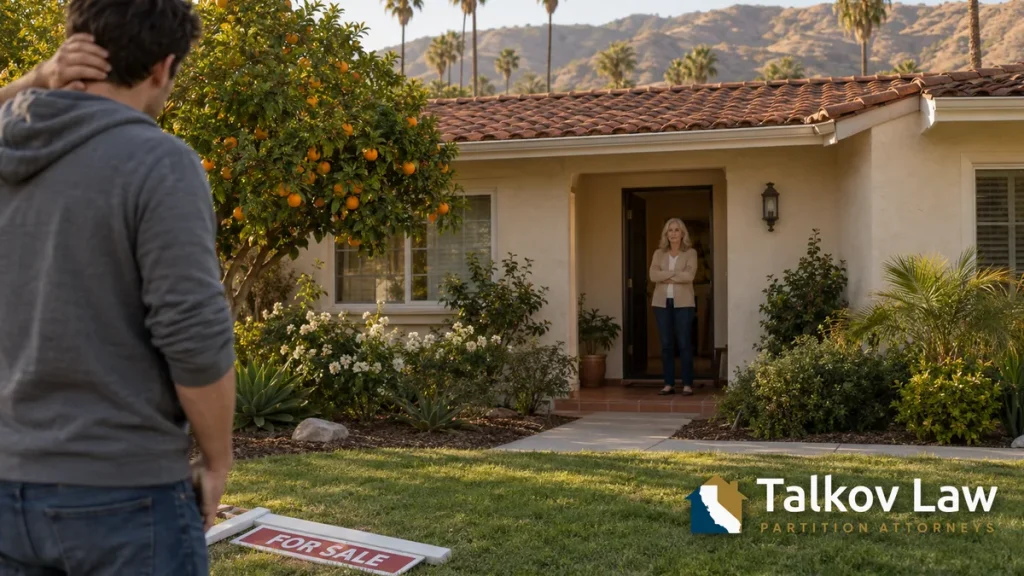
If you inherited a share of your parent’s house and your stepparent won’t sell, you can force the sale. As long as you share title with your stepmom/stepdad, a partition action can force a sale or buyout of the house regardless of the family relationship.
Stepparent won’t sell the house you inherited? You can force the sale or a buyout. Get a free 30-minute consultation or call (877) PARTITION (727-8484). No fees until you win.
The story is usually the same. Your mom or dad remarried. When your parent died, their will or trust left their share of the house to you and your siblings, and your stepparent kept their own share and kept living there. Now your stepparent won’t sell, won’t buy you out and won’t return your calls. You may feel you are going against your parent by pressing the issue. You aren’t. Your parent chose, with their estate planning attorney, to leave part of the house to their children. Following that plan is following your parent’s wishes, and a stepparent living in the house can’t cancel it by refusing to sign a listing agreement.
Does My Stepmom/Stepdad Get Everything If My Parent Died?
Not usually, but the deed and your parent’s estate plan decide what you own. Check these first:
- Joint tenancy or a right of survivorship. If your parent and stepparent held title as joint tenants or as community property with a right of survivorship, your stepparent took the whole house at your parent’s death, and a will can’t change that.
- Your parent left a will, trust or transfer on death deed. A house bought during the marriage is usually community property. Under Probate Code section 100, half belongs to your stepparent and half to your parent, and under Probate Code section 6101 your parent could leave their half to you, whether by will, trust or a transfer on death deed. A house your parent owned before the marriage is usually their separate property, and your parent could leave all of it to their children. Or the will or trust may split it, leaving part to your stepparent and part to you, which also makes you co-owners. Our article on how a spouse can leave only half of the community property explains how a child and a stepparent end up co-owning the house.
- Your parent died with no will, and your stepparent is still there. Under Probate Code section 6401, your stepparent inherits your parent’s half of the community property, so your stepparent owns that house outright. For your parent’s separate property, your stepparent takes one-half if your parent left one child and one-third if your parent left more than one child, and the children share the rest.
So does your stepmom/stepdad get everything when your parent dies? Only if the deed or the law gives it to them. When the deed, will, trust or intestate succession leaves you a share, you and your stepparent are co-owners, usually as tenants in common, and you have the same rights to the house that your stepparent does.
Is the House Still in Probate or Your Parent’s Trust?
Timing matters. While your parent’s estate is in probate, the heirs don’t own their shares yet, so they can’t file for partition in their own names. In Amundson v. Catello (2025) 111 Cal.App.5th 817, the Court of Appeal threw out a partition judgment won by heirs while probate was still open. Until probate closes, the executor or administrator can bring the partition for the estate under Probate Code section 9823.
That is exactly what happened in Estate of Sanchez (2023) 95 Cal.App.5th 331. A father’s will left his half of the family home in San Jose to his three children and disinherited his wife, who was not their mother, as to that half. His daughter, as executor, sued her stepmother for partition by sale. The Court of Appeal confirmed she had the power to do it: “That is not to say that Leslie did not have authority to bring the action on behalf of the estate. Clearly she did.” Her mistake was filing without a lawyer, so the probate court struck her complaint and gave her time to hire one. If you are your parent’s executor, hire a partition attorney before you file.
If the house is in your parent’s trust, the trustee controls it until the house is distributed to the beneficiaries. If you believe your stepparent changed the trust or took your inheritance, that fight belongs in probate court. Once the house is deeded out to you and your stepparent, partition takes over, as our guide on whether all heirs have to agree to sell inherited property explains.
My Stepparent Is Living in Mom’s or Dad’s House. Do They Owe Me Rent?
Your stepparent has the right to live in the house, because each co-owner may occupy the whole property. That means your stepparent generally does not owe you rent just for living there. Two things change that. If your stepparent shuts you out, for example by refusing to let you in after they change the locks, that can be ouster, and your stepparent can owe you your share of the rental value. And if your stepparent asks for credit for the mortgage, property taxes or insurance they paid after your parent died, the court can charge the rental value of their exclusive use against those credits in the partition accounting under Code of Civil Procedure section 872.140.
Yes, You Can Force the Sale of Your Parent’s House
You don’t need your stepparent’s agreement. Any co-owner who inherited a share can file under Code of Civil Procedure section 872.210, and under CCP 872.710’s rule on the right to partition, partition between co-owners “shall be as of right unless barred by a valid waiver.” That your stepparent is your parent’s widow or widower, has lived there for years, or says your parent wanted them to stay doesn’t change it. This is the absolute right to partition.
If the house is sold, the court appoints a partition referee to handle the sale, and the referee can obtain a writ of possession, the same order a landlord gets in an eviction, if your stepparent won’t move out. So yes, you can get your stepmom/stepdad out of the house if they won’t buy you out. Our guide on whether you can evict a co-owner walks through how that works.
Can My Stepparent Buy Me Out Instead?
Possibly. In some partitions, the court may give your stepparent a buyout right under the Partition of Real Property Act (PRPA). If it does, the court sets the fair market value of the house under CCP 874.316’s rule on court-determined value, and your stepparent can buy your share for your percentage of that value under CCP 874.317’s co-owner buyout rule. If your stepparent doesn’t buy, or can’t pay, the case moves to a sale. Our article on whether your co-owner can buy you out after you file explains each step.
In practice, most buyouts are voluntary. Stepchildren usually just want their money, not the house, and your stepparent may be able to force a buyout under the PRPA, but most families agree to one without a court order once a price is on the table. A buyout is also simpler than many people expect. In inheritance cases, the stepchild is rarely on the mortgage, so your stepparent doesn’t need to refinance to take your name off a loan; they only need to pay you for your share. Our article for surviving spouses whose stepchildren inherited half of the house covers the buyout from your stepparent’s side. You can also negotiate a buyout of a co-owner after filing. There’s nothing wrong with filing first: the lawsuit is what gets a stepparent who won’t return your calls to the table.
Example: Your Parent’s House in Riverside
Say your parent bought a house in Riverside before remarrying, so it was your parent’s separate property. Your parent died without a will, leaving a surviving spouse and two children from an earlier marriage. Under Probate Code section 6401, your stepparent inherits one-third, and you and your sibling each inherit one-third. After probate closes and the house is distributed, your stepparent still lives there and refuses to sell.
You and your sibling file a partition action and ask for a sale. An appraisal values the house at $750,000, and the case settles: your stepparent buys your two-thirds for $500,000, which is $250,000 each, with no real estate commission taken out. If the house had gone to a sale instead, after about 5 percent in costs of sale ($37,500), each one-third share would have been $237,500. These are illustrative numbers before attorney’s fees and any credits in the accounting, and each case is different.
Talkov Law has handled numerous cases for heirs whose stepparent refused to sell or buy them out. With 12 full-time partition attorneys and experience in over 650 partition actions throughout California, our team helps stepchildren end co-ownership with a stepparent who won’t sell, whether that means a court-ordered sale or a buyout at full value. Learn more about our inherited property partition attorneys. No fees until you win. Call (877) PARTITION (727-8484) or contact us online for a free 30-minute consultation.








