

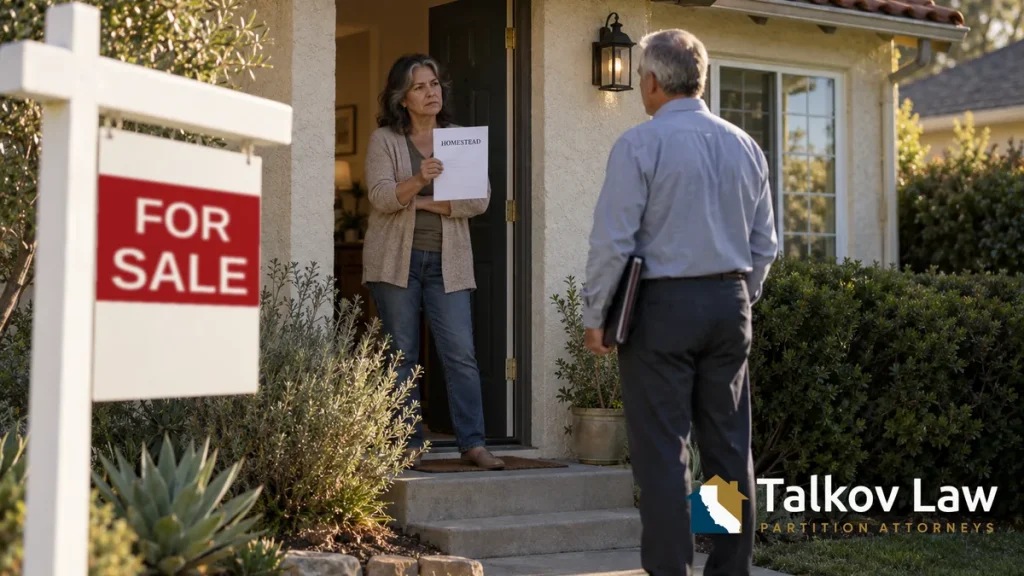
No. A homestead, whether it is the automatic homestead exemption or a recorded declaration of homestead, protects a homeowner’s equity from that homeowner’s creditors. It does not take away a co-owner’s right to partition. If your ex-spouse, sibling or fellow heir is a co-owner living in the property and says a homestead lets them stay, the court can still order the house sold in a partition action and the money divided.
The Short Answer: A Homestead Is About Creditors, Not Co-Owners
- A homestead does not stop a partition. California courts have held that a co-owner’s homestead is no bar to a partition and sale.
- A homestead protects a dollar amount of equity, not the house itself. The amount is set by statute.
- A homestead works against the creditors of the person who claims it. It gives that person no new rights against the other owners.
- Liens against one co-owner are paid from that co-owner’s side. In a partition sale, a debt that is only your co-owner’s comes out of your co-owner’s share of the money.
What a Homestead Is in California Today
California’s homestead law is found in Code of Civil Procedure section 704.710 (CCP 704.710) and the sections that follow it. Those sections are part of the Enforcement of Judgments Law, which took effect in 1983 and governs how a creditor collects on a money judgment. There are two kinds of homestead:
- The automatic homestead exemption. It applies to a person’s principal home without recording anything.
- The declared homestead. A homeowner records a homestead declaration with the county recorder under CCP 704.910 and the sections that follow it.
Both are exemptions. An exemption limits what a judgment creditor can take from a debtor. Neither kind of homestead is a deed, and neither changes who owns the property or how co-owners hold title as joint tenants or tenants in common.
A Homestead Protects a Dollar Amount, Not the House
The size of the homestead exemption is set by CCP 704.730’s rule on the amount of the homestead exemption. The amount is the greater of $300,000 or the county’s median sale price for a single-family home in the prior year, up to $600,000, and both figures are adjusted each year for inflation.
That number is a ceiling on the equity a judgment creditor cannot reach. It is not a right to keep the house, and it does not make the claiming co-owner’s undivided interest any larger than it was before.
For how the exemption works against creditors and in bankruptcy, see our guide to the homestead exemption in California.
Why a Homestead Does Not Stop a Co-Owner’s Partition
California’s partition law begins at Code of Civil Procedure section 872.010 (CCP 872.010) and was enacted in 1976. Under CCP 872.710’s rule on the right to partition, partition between co-owners “shall be as of right unless barred by a valid waiver.” A homestead is not a waiver of partition.
When the Legislature wrote that rule, its official comment to CCP 872.710 said that it “does not affect the law relating to partition of cotenancy property on which a homestead has been declared”, and pointed to Squibb v. Squibb. That is why two older cases still state the rule today.
Squibb v. Squibb: The Ex-Spouse Living in the House
In Squibb v. Squibb (1961) 190 Cal.App.2d 766, 769-770, a divorced wife who lived in the former family home with the children recorded a declaration of homestead and argued it was a defense to her ex-husband’s partition. The Court of Appeal disagreed and affirmed the order selling the house. The court explained that homestead interests “serve primarily to protect the title or interest of the claimant against the demands of creditors”, and then drew the line between creditors and co-owners:
“But as between co-tenants, a homestead interest does not affect the rights, interests or estates of persons holding adversely or collaterally.”
Squibb v. Squibb (1961) 190 Cal.App.2d 766, 769
The person who claims the homestead “acquires only such rights of occupancy as he had before the creation of the homestead”. (Squibb v. Squibb (1961) 190 Cal.App.2d 766, 769.) The court concluded: “The law is now clear that a statutory homestead interest does not deprive the co-tenant of the right to have the common property partitioned and sold”.
Priddel v. Shankie: A Homestead Recorded After the Lawsuit
In Priddel v. Shankie (1945) 69 Cal.App.2d 319, 325, one of two co-owners of a Los Angeles lot recorded a homestead on his half after the partition was filed. The Court of Appeal held: “Appellant’s contention that the recording of a homestead declaration by one co-tenant covering the undivided one-half interest of such co-tenant will defeat the other co-tenant’s right to partition, cannot be sustained.”
Both cases were decided under an earlier homestead law in the Civil Code, which has since been repealed. They are cited here only for the point current law still follows: a co-owner’s homestead is not a bar to partition. For the other arguments an occupying co-owner may raise, see defenses to partition and why the fairness defense fails.
Squibb involved former spouses. Spouses who are still married and hold a home as community property divide it in family court, not by partition, under CCP 872.210’s rule on who may file a partition. A probate homestead, which a probate court can set apart for a surviving spouse or minor children during an estate, is a separate court order with its own rules. A co-owner cannot create one by recording a form.
What a Homestead Can Do in a Partition
A homestead matters in one place: between the co-owner who claims it and that co-owner’s own judgment creditors. To see why, look at how the money is paid out. CCP 873.820’s rule on applying the sale proceeds sets the order:
- The expenses of the sale.
- The other costs of the partition.
- “Payment of any liens on the property in their order of priority except liens which under the terms of sale are to remain on the property.”
- The rest to the co-owners, in proportion to their shares as the court has determined them. See how the proceeds are divided.
The court decides the status and priority of the liens under CCP 872.630’s rule on liens in a partition. A lien on the whole property, such as a loan both owners signed, comes off the top. A lien on only one co-owner’s interest, such as a judgment against a co-owner, follows that co-owner’s share. In Cathcart v. Redlands Security Co. (1945) 67 Cal.App.2d 591, 594, the Court of Appeal described the rule for a partition sale: the property is “sold free and clear of all liens and the lienholders are to be satisfied out of the share of the proceeds coming to the person upon whose interest the lien previously existed.” Cathcart is an older case, and the same order of payment is now written into CCP 873.820.
This is where the homestead exemption comes in. It may limit how much of the occupying co-owner’s share that co-owner’s own judgment creditors can reach. That is a question between your co-owner and the creditor. It is not a reason to deny the partition, and it does not come out of your share. If the two of them dispute a lien, the Legislature’s comment to CCP 873.820 explains that “the proceeds may be deposited in court pursuant to Section 873.810 pending resolution of the dispute.” (See CCP 873.810’s rule on the court’s order disbursing proceeds.)
An Example: The Brother Who Recorded a Homestead
Maria and her brother David inherit their mother’s house as tenants in common, half each. David moves in, records a declaration of homestead and tells Maria she can never make him sell. Maria files a partition action.
David’s homestead does not stop the case. As in Squibb v. Squibb, the court orders the house sold by a partition referee. Say it sells for $800,000. Under CCP 873.820’s rule on applying the sale proceeds, the referee pays:
- $60,000 for the sale expenses and the costs of the partition.
- $140,000 for the mortgage on the whole house, which is paid off first.
- The remaining $600,000, split $300,000 to Maria and $300,000 to David.
Now say David owes a creditor $50,000 on a judgment against him alone. That lien follows David’s share, not Maria’s, so Maria receives her full $300,000. David’s homestead exemption may limit how much of his $300,000 his creditor can reach. That is a fight between David and his creditor, and it does not delay Maria’s payment or reduce it.
What This Means If You Want to Sell
- A recorded homestead is not a reason to wait. It does not change your right to force the sale of the house.
- Living there does not give your co-owner the house. When a co-owner refuses to sell, or a sibling is living in the inherited house, the answer is a partition, and you may also have a claim for rental value.
- Your co-owner’s debts stay with your co-owner. A judgment against your co-owner is paid, if at all, from your co-owner’s share.
- A buyout is still on the table. A co-owner who wants to stay can buy out a co-owner at a fair price instead of relying on a homestead.
Co-Owner Claiming a Homestead?
A homestead does not let one co-owner hold the property forever. A partition action lets the court order the home sold by a partition referee and the proceeds divided.
Talkov Law can help. With 12 full-time partition attorneys and experience in over 650 partition actions throughout California, our team handles every step, from filing the partition action through the referee’s sale and the final distribution of proceeds. Call (877) PARTITION (727-8484) today or contact us online to get started.








