A partition action is a lawsuit that lets a co-owner of real estate force the sale or division of the property when the co-owners cannot agree. In California, the court ends the co-ownership by dividing the property or, usually, by ordering it sold and dividing the proceeds, and it can do so even when the other owners object. Sometimes called a partition lawsuit, a partition action is governed by Code of Civil Procedure section 872.010 (CCP 872.010) and the sections that follow it. A co-owner generally can force the sale of jointly owned property without the consent of the other co-owners, and the court divides the money among all the co-owners fairly. This guide answers the questions co-owners ask most: who can file, what happens, what it costs, how long it takes, and how the proceeds are divided.
Key takeaways about partition actions in California:
- Any co-owner can file. You do not need a majority share or the other owners’ consent. The right to partition is absolute unless a valid waiver, such as an agreement not to partition, bars it.
- Three outcomes. The court orders a partition by sale (the most common), a partition in kind (physical division), or, when the parties agree, a partition by appraisal. In many cases filed since 2023, a co-owner may also buy out the others at a court-determined value under the Partition of Real Property Act.
- Cost. Based on Talkov Law’s completed-case data, the average partition action costs about $20,000, and the court can apportion those costs, including attorney’s fees incurred for the common benefit, among the co-owners.
- Timeline. The average partition action resolves in about seven months, and most take six to nine months.
- Money is divided fairly, not always equally. Before dividing the proceeds, the court credits co-owners for the mortgage payments, property taxes, insurance, and repairs they paid.
What Does Partition Mean in Real Estate?
To partition a property means to end co-ownership, either by dividing the property among the co-owners or by selling it and dividing the money according to each owner’s share. A co-owner who no longer wants to share ownership generally can file a partition action to end the relationship, even when the other owners object. The two main court-ordered outcomes are physical division, called partition in kind, and a partition by sale. A house usually cannot be divided into separate properties in a practical way, making a sale an important option when the owners cannot agree on a buyout. Partition in kind is more realistic for vacant land or a building with several separate units.
Partition actions can involve single-family homes, duplexes and triplexes, commercial property, and vacant land. The statutes also permit partition of personal property under sections 872.010 and 872.210, but this guide focuses on California real estate.
In California, the right to partition is absolute for co-owners of concurrent interests, meaning that a co-owner may commence a partition action without the consent of the other co-owners. That right has a short list of limits, which the next section explains.
Who Can File a Partition Action in California?
Most co-owners can. A partition action is generally available when all of the following are true:
- You own an interest in California real property, such as a house, land, or a rental building, in any share; no majority vote is needed
- At least one other person or entity owns the property with you
- The dispute is not between spouses over community property
- You have not signed a valid agreement giving up the right to partition
If each statement fits your situation, you can file, and the rest of this guide explains what happens next. If you would rather talk it through first, call (877) PARTITION (727-8484) for a free consultation with a partition attorney.
A co-owner of California real estate generally may file a partition action without owning a majority share or obtaining the other owners’ consent. CCP 872.210 identifies the ownership interests that qualify. Eligibility to file is the starting point; the court must also determine whether partition is available under the rules discussed below. A majority owner cannot defeat an otherwise valid partition claim merely by outvoting a minority owner.
Can a Partition Action Be Stopped?
Rarely. Under California Code of Civil Procedure section 872.710(b) (CCP 872.710(b)), a co-owner’s right to partition is allowed as of right unless a valid waiver bars it. A waiver is a binding agreement not to partition, so the first thing to check is whether any agreement you signed gives up that right.
A few uncommon situations work differently. Partnership property can be partitioned only if the court finds it a suitable remedy and the partnership’s unsecured creditors will not be harmed (see CCP 872.730). Community property between spouses is divided in the family court instead. When ownership is split over time, such as a life estate followed by a right to inherit, the court allows partition only if it is in the best interest of all the parties.
Outside those situations, a co-owner’s objection to the sale is generally not a defense, and a co-owner cannot “beat” a partition action by refusing to sell, by living in the home, by paying the bills, or by disputing what the other owner contributed. Those financial disputes are decided in the accounting, not by denying partition, because fairness is not a defense to partition. Our article on whether a partition action can be stopped explains the few defenses that remain and why the realistic path for a co-owner who wants to keep the property is a negotiated buyout.
When Is a Partition Action Needed?
A partition action may become necessary when a co-owner wants to leave the ownership arrangement but the others will not agree to a sale or complete a fair buyout. For example, a former partner may remain in the home while refusing to sell, buy you out, or contribute to the mortgage. Other disputes involve unpaid property expenses or someone moving into the jointly owned home. Partition provides a way to end the co-ownership, while offsets and accounting address the owners’ financial contributions and claims.
Partition actions most commonly arise in four situations:
- Siblings who have inherited property from their parents or other family members and cannot agree on whether to sell
- Unmarried couples who bought a home together and are no longer romantically involved
- Friends or family members who bought an investment property together
- Previously married couples who still co-own property after the divorce judgment
What Happens in a California Partition Action?
A partition action generally begins with a determination of the right to partition and the owners’ interests, followed by implementation of the partition and resolution of the remaining financial issues. Under California Code of Civil Procedure section 872.720 (CCP 872.720), the interlocutory judgment of partition determines the parties’ ownership interests and orders partition. It also specifies whether the property will be divided or sold unless the court reserves that question for later.
The court cannot skip a disputed ownership determination and simply order a sale first. In Summers v. Superior Court (2018) 24 Cal.App.5th 138, the Court of Appeal held that the manner of partition must be decided when or after the parties’ ownership interests are determined, not before. Determining ownership percentages is a different question from calculating reimbursements and the final amounts each owner receives.
Under California Code of Civil Procedure section 873.010 (CCP 873.010), the court appoints a partition referee to carry out the division or sale it orders, and the case ends with an accounting that credits each co-owner for the mortgage payments, property taxes, insurance, and repairs they paid, through the partition offsets and accounting.
What Are the Steps in a Partition Action?
Most California partition actions follow the same eight steps from the first demand to the distribution of the proceeds:
- Demand letter (before filing). Many co-owners begin with a letter warning of a partition action, which often produces a buyout or an agreed sale without a lawsuit.
- Complaint (a few days to prepare and file). The co-owner files a complaint for partition in the superior court of the county where the property is located, as CCP 872.110 provides. Under CCP 872.230, the complaint describes the property, states each owner’s interest, asks for partition, and, if the plaintiff wants a sale, states the facts that justify one.
- Notice of pending action (immediately after filing). The plaintiff records a notice of pending action, called a lis pendens, with the county recorder under CCP 872.250, which puts buyers and lenders on notice of the case.
- Service and response (30 days after service). Every co-owner and lienholder named under CCP 872.510 is served with the summons and has 30 days to respond. Many cases settle at this stage through a buyout or an agreed listing.
- Interlocutory judgment (weeks to a few months after the response deadline). The court confirms the right to partition, determines each owner’s share, and orders a sale or division under CCP 872.720. In one Talkov Law case, the court entered the judgment 49 days after service.
- Referee (appointed in the judgment). The court appoints a partition referee under CCP 873.010 to list and sell the property or to divide it.
- Sale and confirmation (two to five months). The referee sells the property, usually on the open market, and reports the sale to the court, which confirms it at a hearing under CCP 873.730.
- Accounting and distribution (two to six weeks after the sale closes). Under CCP 873.820, the sale proceeds pay the expenses of sale, the other costs of partition, and any liens, and the balance is distributed to the owners in proportion to their shares after the court’s accounting for mortgage payments, taxes, insurance, and repairs.
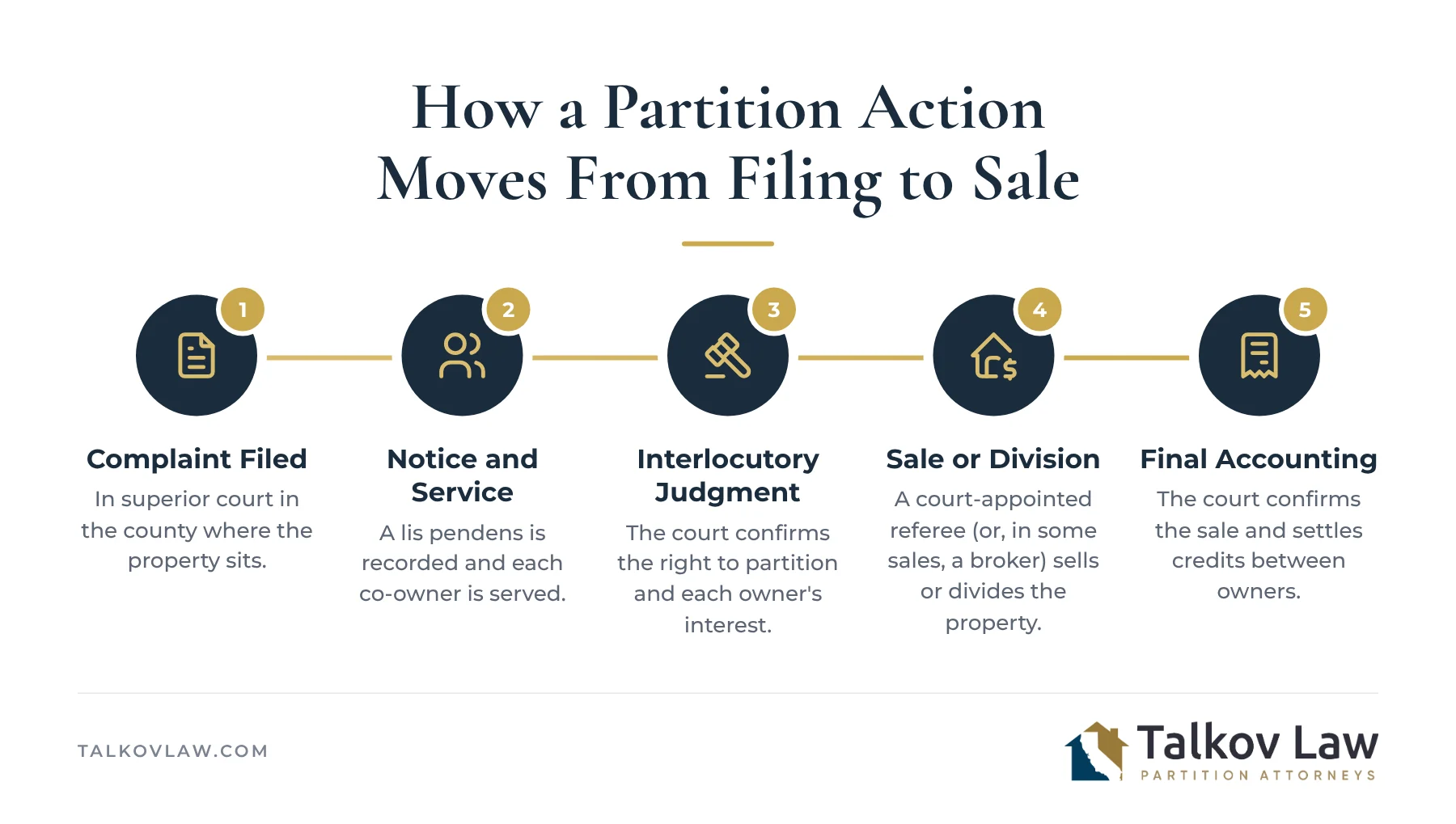
Our partition action timeline explains how long each step usually takes, and our California partition action forms show each document.
Who Must Be Named in a Partition Action?
A partition case must account for more than the owners who want a sale. Under Code of Civil Procedure section 872.510 (CCP 872.510), the plaintiff must join as defendants people with interests in the estate being partitioned that appear in the records, are actually known to the plaintiff, or are reasonably apparent from inspecting the property. Reviewing title and identifying the relevant interests is therefore an important early step.
Being named as a defendant does not necessarily mean a co-owner did anything wrong or opposes the sale. For example, when one sibling files to partition an inherited home, the other siblings can be defendants even if they also want to sell. The case brings their ownership interests before the court so it can resolve the co-ownership.
Can the Court Protect the Property While the Case Is Pending?
Yes. Co-owners do not always have to wait for the final sale to address threats to the property. Code of Civil Procedure section 872.130 (CCP 872.130) allows temporary restraining orders and injunctions to prevent waste, protect the property or its title, and restrain unlawful interference with a court-ordered partition. Whether a particular order is appropriate depends on the facts and the relief requested; filing the complaint alone does not put those protections in place.
Does a Partition Action Divide the Money Equally?
Not necessarily. Ownership percentages and the final distribution of money are different questions. Even when two people each own 50 percent, their final distributions may differ because of allowable reimbursements, offsets, or the allocation of partition costs. Our article on how proceeds are divided after a partition sale walks through each step.
California Code of Civil Procedure section 872.140 (CCP 872.140) authorizes the court to order an accounting, contribution, and other equitable financial adjustments. Depending on the facts, the court may consider payments toward the mortgage, property taxes, insurance, repairs, and other property expenses. An unequal final distribution does not necessarily mean the court changed the ownership percentages.
A reimbursement claim may also be reduced by an offset. In Hunter v. Schultz (1966) 240 Cal.App.2d 24, 30-32, the court upheld an offset for the value of the occupying co-owners’ use against their claims for mortgage interest, taxes, and insurance. This does not mean every co-owner who lives in the property automatically owes rent. Our guide to partition offsets, credits, and reimbursements explains these adjustments in more detail.
What If One Co-Owner Lives in the Property?
Every co-owner has an equal right to possess the whole property, so a co-owner living in the home generally owes no rent to the others, and living there is not a defense to partition. That changes after an ouster, when the co-owner in possession excludes another. Under California Civil Code section 843, the excluded co-owner may serve a written demand for concurrent possession; if the co-owner in possession does not offer it within 60 days, an ouster is established, and the excluded owner may seek the fair market rental value of their share, a claim that can be made in the partition action itself.
See our guides to damages for ouster and what to do when a co-owner in sole possession refuses to cooperate.
What Are the Three Ways to Partition Property in California?
The court orders one of three manners of partition:
- Partition in kind. Under California Code of Civil Procedure section 872.810 (CCP 872.810), the court orders the property divided among the parties in accordance with their interests as determined in the interlocutory judgment.
- Partition by sale. Under California Code of Civil Procedure section 872.820 (CCP 872.820), the court orders a sale and divides the proceeds when the parties agree or when it decides that a sale would be more equitable than dividing the property.
- Partition by appraisal. Under California Code of Civil Procedure section 873.910 (CCP 873.910), parties whose interests are undisputed or adjudicated may agree to a partition by appraisal.
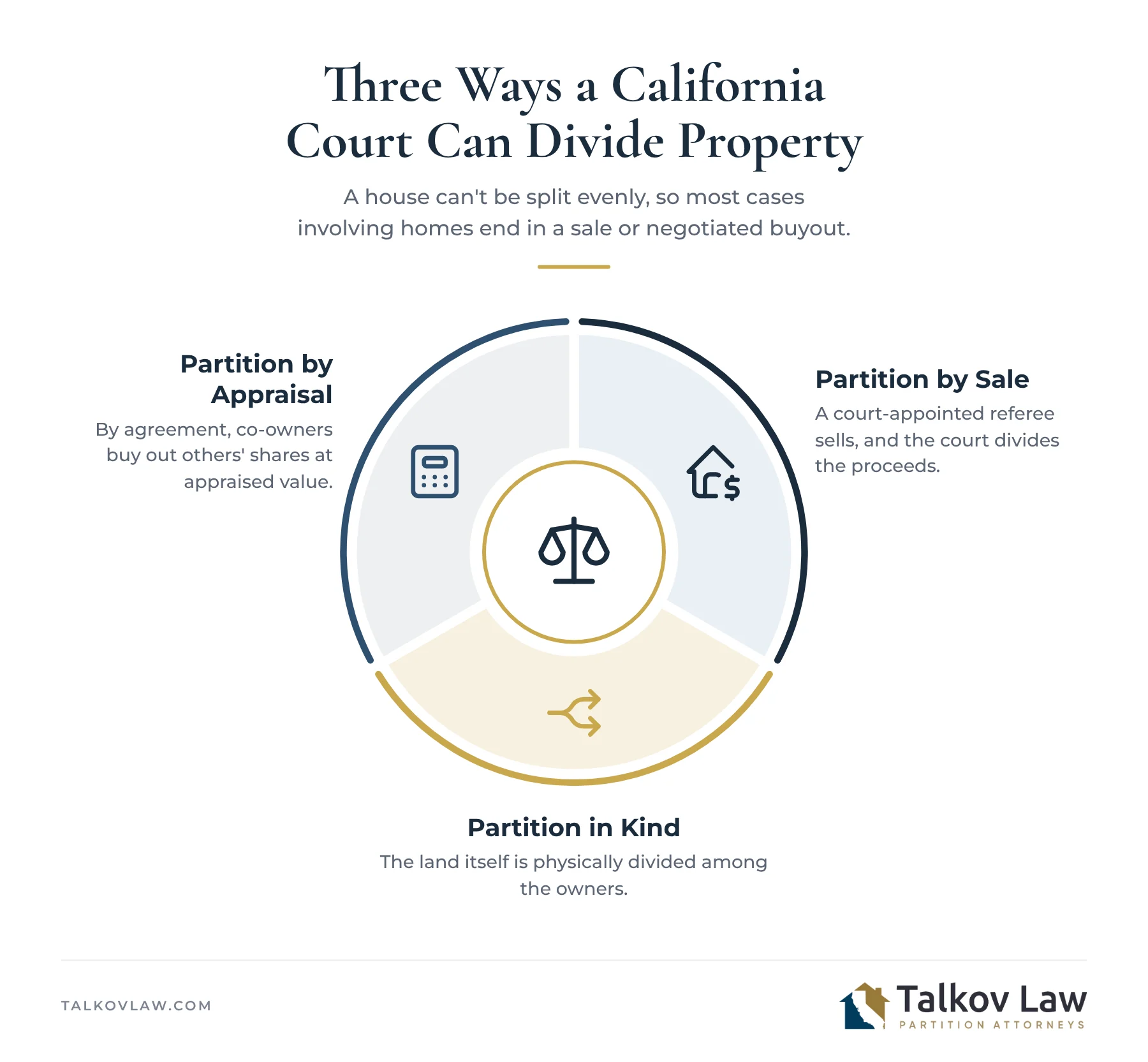
| Manner of partition | What happens | When it is used | Statute |
|---|---|---|---|
| Partition by sale | A referee sells the property and the court divides the proceeds | Houses and other property that cannot be fairly divided; the most common outcome | CCP 872.820 |
| Partition in kind | The property itself is divided among the owners | Vacant land, farmland, or buildings with separate units | CCP 872.810 |
| Partition by appraisal | One or more owners buy the others’ shares at an appraised value | Only when the co-owners agree to it in writing | CCP 873.910 |
Our comparison of partition by sale and partition in kind explains when each is used.
Cases covered by the Partition of Real Property Act have additional requirements. When the case reaches the choice between division and sale under CCP 874.318, the court must order partition in kind unless it finds that physical division would cause great prejudice to the co-owners as a group, after considering the factors in CCP 874.319. The ordinary test of whether a sale is more equitable is therefore not the complete analysis for every case.
In an action to which the Partition of Real Property Act applies, a sale is an open-market sale unless the court finds that sealed bids or an auction would be more economically advantageous and in the best interest of the cotenants as a group. See California Code of Civil Procedure section 874.320 (CCP 874.320).
Can One Co-Owner Buy Out the Others Instead of Selling?
Yes, but the legal route matters. Co-owners can negotiate a voluntary buyout. California law also provides two distinct procedures that should not be confused:
Agreed Partition by Appraisal
Under CCP 873.910, parties whose interests are undisputed or have been adjudicated may agree to a partition by appraisal. This procedure requires agreement; it is not a unilateral right to demand an appraisal and purchase everyone else’s interests. In practice, it is rarely used, because co-owners who can agree on that much usually do not need a court to oversee the process.
Statutory Buyout Under the Partition of Real Property Act
The Act is not limited to inherited property. Under Code of Civil Procedure section 874.311 (CCP 874.311), it applies to real property held in tenancy in common when no agreement in a record binds all the co-owners and governs partition, in actions filed on or after January 1, 2023. California was the first state to potentially allow appraised buyouts in every partition action involving tenants in common.
The court determines the property’s fair market value under CCP 874.316. The parties may agree to a value or a valuation method. When the court orders an appraisal, the statute provides for objections and a valuation hearing. The appraiser’s figure is not automatically the court’s final determination.
If a co-owner requests partition by sale, CCP 874.317 gives co-owners who did not request partition by sale an opportunity to purchase all of the sale-requesting owners’ interests. The statutory price for each interest is the court-determined value of the whole property multiplied by that owner’s fractional share.
The 45-day period is the deadline to elect to purchase, not the deadline to complete the purchase. Eligible co-owners must notify the court of their election within 45 days after the court sends the buyout notice. The court later sets a separate payment deadline, at least 60 days after its subsequent notice identifying the electing buyer or buyers. See section 874.317(b)-(e) and our explanation of whether a co-owner can buy you out after you file for partition.
How Much Does a Partition Action Cost, and Who Pays?
The costs of partition include reasonable attorney’s fees incurred or paid by a party for the common benefit, the fee and expenses of the referee, the cost of a surveyor or other person the referee employs, and the reasonable cost of a title report. See California Code of Civil Procedure section 874.010 (CCP 874.010). Under California Code of Civil Procedure section 874.040 (CCP 874.040), the court apportions those costs in proportion to the parties’ interests or makes another apportionment that is equitable. Our article on who pays for a partition action explains how this works in practice.
“Except as otherwise provided in this article, the court shall apportion the costs of partition among the parties in proportion to their interests or make such other apportionment as may be equitable.”
California Code of Civil Procedure section 874.040
Based on Talkov Law’s completed-case data, the average partition action costs about $20,000. The cost may be much higher or lower depending on the complexity of the case and how much the opposing co-owners resist. Attorney’s fees in a partition action may also be recoverable, especially against an uncooperative co-owner.
How Long Does a Partition Action Take?
Based on Talkov Law’s completed-case data, the average partition action resolves in about seven months, and most take six to nine months. Many end sooner, because a co-owner who is served with the complaint often agrees to a buyout or a listing rather than litigate a case in which the right to partition is rarely in doubt. A case that ends in a default judgment or an early settlement moves quickly, while contested ownership, a complicated accounting, a buyout under the Partition of Real Property Act, or a trial adds months. The statutes set part of the pace: co-owners have 45 days to elect a buyout under the Act, and a referee’s sale must be reported to the court and confirmed at a hearing before the referee completes it. Our partition action timeline breaks down each stage, and our guide to how long a partition action takes explains what speeds a case up.
How Do Partition Actions Work for Inherited Property?
Heirs who inherit a house together often hold it as tenants in common. A co-owner generally may seek partition without every sibling or other heir agreeing to a sale. When the property meets the requirements of the Partition of Real Property Act, the valuation and buyout procedures explained above apply. Our inherited property dispute guide explains the issues that commonly arise when family members cannot agree.
What Is an Example of a Partition Action?
Two cases from Talkov Law’s files show how a partition action plays out in practice, one between heirs and one between a former couple. Our collection of partition action examples has more.
Example 1: Triplet Brothers Who Inherited a Home and Could Not Agree
In one Talkov Law case, three triplet brothers inherited a home from their mother. One brother wanted to move forward with a sale, but the brothers could not agree. One of the other brothers continued living in the property while his brothers’ inheritance remained tied up in the home.
Talkov Law filed a partition action on behalf of the brother seeking a sale. The defendant brother living in the home ultimately agreed to sell, providing a path to end the co-ownership and release the equity tied up in the property.
Their story shows that even the strongest family bonds and a lifetime of shared experiences do not guarantee agreement over inherited property. For the brother living in the house, delaying a sale meant keeping a place to live. For his brothers, it meant waiting to access their inheritance. A partition action helped move their inherited-property dispute toward a resolution when they could not agree on selling the home.
Example 2: A Partition Action After a Boyfriend and Girlfriend Break Up
In one Talkov Law case, a boyfriend and girlfriend purchased a California home together, with the boyfriend providing the entire down payment and making all mortgage payments. Not long after the purchase, they decided they would not marry. The girlfriend nevertheless refused to transfer her ownership interest, even though she was not a borrower on the mortgage and had contributed nothing toward the down payment or mortgage payments.
Talkov Law filed a partition complaint on behalf of the boyfriend. After consulting with counsel, the girlfriend agreed to accept a modest settlement payment in exchange for a deed transferring her interest to him. The agreement provided a way for him to keep the home and end their co-ownership.
The relationship had ended, but the shared ownership remained. This case illustrates how a partition action can help resolve a property dispute between an ex-boyfriend and ex-girlfriend through a negotiated buyout. It also shows why unequal financial contributions and reimbursement claims can be central to resolving the dispute. This was a negotiated settlement, not a court ruling that financial contributions alone determined the parties’ ownership interests.
What Is an Alternative to a Partition Action?
The main alternative is a voluntary agreement. One co-owner may buy out the other co-owners, or the co-owners may agree to sell the property to a third party, sometimes through co-listing with an agent each side trusts. If you have already tried to reason with your co-owner and nothing has changed, a partition action is the next step.
Co-owners can also list the property together, agree on a buyout, or settle, and many disputes end this way once a partition action is on the table. Our guide on whether you can partition real estate without going to court covers each option. Put any agreement in writing and make it complete: informal co-ownership settlement agreements that leave out the sale price, deadlines, or who pays which expenses often lead to a second dispute.
What Is a Letter Warning of a Partition Action?
A letter warning of a partition action is a demand letter, usually sent by an attorney, telling the other co-owners that you intend to file a partition action unless they agree to a buyout or a sale by a stated date. The letter explains that the right to partition is absolute, that the court can apportion the costs of the lawsuit among all the co-owners, and that a cooperative sale usually nets everyone more than a court-ordered one. No statute requires a warning letter before filing, but in Talkov Law’s experience it often resolves the dispute without a lawsuit. When it does not, it documents the other owner’s refusal, which can matter when the court later apportions attorney’s fees.
If a direct conversation does not resolve the dispute, an attorney’s demand letter can make the proposed terms and deadline clear. Where appropriate, the attorney may include a proposed settlement agreement and a draft partition complaint so the other co-owner can see both the proposed resolution and the next step if negotiations fail.
What Are the Pros and Cons of a Partition Action?
The pros and cons of a partition action come down to certainty versus cost.
Advantages:
- It works. Because the right to partition is absolute, a co-owner who wants out will get a sale, a division, or a buyout. The other owners cannot simply refuse.
- The court settles the money disputes. Credits for mortgage payments, taxes, insurance, and repairs are resolved in one accounting instead of being argued for years.
- Costs can be shared. Under CCP 874.040, the court apportions the costs of partition, including attorney’s fees incurred for the common benefit, among the co-owners.
- Filing usually prompts a settlement. Many co-owners agree to a buyout or a listing soon after they are served.
Disadvantages:
- Cost. The average case costs about $20,000, although part of that may be recovered from the other owners.
- Time. A contested case takes six to nine months or longer, and the recorded notice of pending action means the property usually cannot be sold or refinanced in the meantime.
- Less control over the sale. A referee, not the owners, manages a court-ordered sale, although co-owners can agree to co-list the property with an agent of their choosing.
- Family strain. A lawsuit between relatives can harden positions, which is one reason a warning letter and a buyout offer usually come first.
Common Questions About California Partition Actions
Do I Have to Prove My Co-Owner Did Something Wrong?
Generally, no. An ordinary partition claim between co-owners does not require proof that another owner committed fraud, breached a contract, or failed to pay expenses. Under CCP 872.710, partition generally is available as of right for concurrent ownership interests, subject to a valid waiver and applicable exceptions. The right to end co-ownership is separate from whether either owner owes the other money.
How Do You Win a Partition Action?
For the co-owner who files, winning means obtaining the interlocutory judgment that confirms the right to partition and orders the sale or division, then recovering the credits you are owed in the accounting. Because the right to partition is absolute, the plaintiff usually needs to show only that they hold title to a concurrent interest and that no valid waiver bars partition. The contested issues are usually financial: each owner’s share, and who is owed credits for mortgage payments, taxes, insurance, and repairs. Keeping records of those payments is the most useful thing a co-owner can do to improve the outcome. Our guide on how to win a partition action and why it is often better to be the plaintiff goes further. No court has ever denied a Talkov Law client the right to partition.
Is a Partition Action the Same as a Partition Lawsuit?
Yes. “Partition action,” “partition lawsuit,” “partition suit,” and “action for partition” all describe the same case: a civil lawsuit under CCP 872.010 and the sections that follow in which a co-owner asks the court to end the co-ownership of real property. The outcome is a partition by sale, a partition in kind, or an agreed partition by appraisal.
What If My Co-Owner Filed a Partition Action Against Me?
Respond before the deadline in the summons. A co-owner who does not respond risks a default judgment, and the answer is where a defendant raises claims for credits, as California Code of Civil Procedure section 872.430 (CCP 872.430) allows. A co-owner who wants to keep the property can propose to buy out the co-owner who filed, and in cases under the Partition of Real Property Act may have a statutory right to do so. Our guide for co-owners whose co-owner filed a partition action against them lists the first steps.
Do You Need a Lawyer for a Partition Action?
California does not require one, and a co-owner may represent themselves. In practice, a partition action combines title, real estate, accounting, and trial work, and errors in the complaint, in service on lenders, or in the accounting are expensive to fix. Our article on whether you need a lawyer for a partition action explains what an attorney does at each stage.
What Should I Gather Before Filing a Partition Action?
The documents that decide a partition case are the ones that show who owns what and who paid for what. Before the first consultation, gather:
- The deed, which shows how title is held and each owner’s share
- Mortgage statements and proof of the down payment
- Records of the mortgage, property tax, insurance, and repair payments you made, which support your credits in the accounting
- Any written agreement among the co-owners about the property, including one that might waive the right to partition
- Your written communications with the other co-owners about selling or buying out the property
Is There a Statute of Limitations on a Partition Action?
No. Because the right to partition is absolute, a co-owner can file at any time, even years after moving out. As the California Supreme Court put it in Adams v. Hopkins (1904) 144 Cal. 19, 27, “The statute of limitations never bars relief between tenants in common in an action of partition.” The one exception the court described is a co-owner who has already lost title altogether through years of exclusion, which is one reason not to wait. Our articles on whether there is a statute of limitations on a partition action and the risks of delaying a partition action explain the details.
Is a Partition Action the Same as a Quiet Title Action?
No. A quiet title action asks the court to decide who owns the property; a partition action asks the court to end co-ownership among owners whose interests are already known. The two are often combined in one lawsuit when a co-owner’s share is disputed, for example when one owner paid for the property but another is on title. Our article on quiet title and partition actions explains when each is used.
Key Terms in a Partition Action
- Co-owner: anyone who holds title with others, whether as tenants in common, joint tenants, or another form of co-ownership.
- Lis pendens: a recorded notice that the property is the subject of a lawsuit, which warns buyers and lenders.
- Interlocutory judgment: the mid-case judgment that confirms the right to partition, fixes each owner’s share, and orders the sale or division.
- Partition referee: a neutral person the court appoints to sell or divide the property.
- Offsets: credits and charges between co-owners for mortgage, taxes, repairs, and rent, settled in the final accounting.
- Ouster: one co-owner wrongfully excluding another from the property.
Talkov Law Partition Attorneys Can Help
Need to end a California property co-ownership? Talkov Law can evaluate your ownership documents, any agreement affecting partition, potential reimbursement claims, and the available paths to a sale or buyout. Our client reviews and guide to choosing a partition attorney can help you evaluate your next step.
Talkov Law can help. With 12 full-time partition attorneys and experience in over 650 partition actions throughout California, our team handles every step of the process, from filing through the referee’s sale and the final distribution of proceeds. No court has ever denied our clients the right to partition. Call (877) PARTITION (727-8484) today or contact us online to get started.