
Butte Creek Island Ranch v. Crim: Evidence Required for Partition by Sale
Butte Creek Island Ranch v. Crim explains the evidence supporting partition by sale: an inability to divide the property fairly or a material loss in value from division.
Butte Creek Island Ranch v. Crim explains the evidence supporting partition by sale: an inability to divide the property fairly or a material loss in value from division.

Sting v. Beckham upheld a partition by sale where a single water well supplied much of the property’s value, making physical division unfair to the owner who would receive land without it.

In Richmond v. Dofflemyer, a California court divided part of a family ranch in kind and sent the rest to a referee. See what it means for co-owners.

In Jamison v. Jamison, the California Court of Appeal explained that a court dividing co-owned land must value each parcel to set owelty, and held that a co-owner who did not timely move for a new trial could not challenge the owelty amount on appeal.
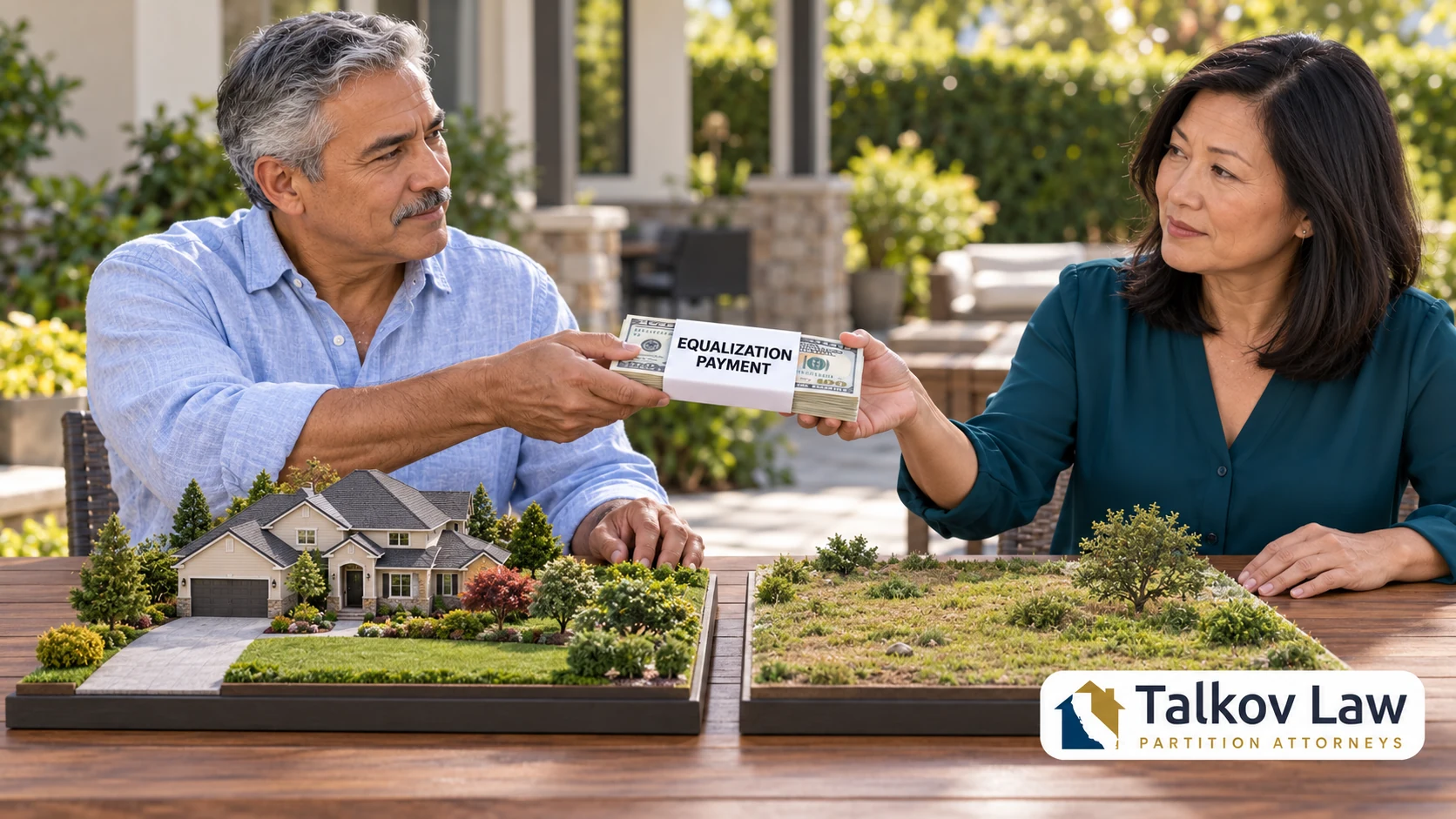
When a property can’t be divided into equal-value parts, the court can order owelty, a payment from the co-owner who receives more to the one who receives less.

A tenants in common agreement lets unrelated co-owners share one property, often divided into separate units. Long popular in San Francisco, these agreements are spreading to Los Angeles.

Agricultural land brings its own challenges in a partition action. Here is what co-owners of California farmland should know.

Code of Civil Procedure section 873.080 gives the partition referee authority to set aside part of the property for roads or other ways, or to close them, when selling or dividing the property.

Code of Civil Procedure section 873.280 sets what a partition referee’s report must contain and who must receive written notice of it.

Code of Civil Procedure section 873.230 explains what happens in a partition in kind when a co-owner transferred part of the property to a buyer before the partition action was filed.

Code of Civil Procedure section 873.250 lets the court order owelty, a compensating payment between co-owners, when a partition in kind can’t divide the property equally.

Code of Civil Procedure section 873.290 lets a party move to confirm, modify, or set aside the referee’s report in a partition in kind.

Code of Civil Procedure section 873.240 explains how property made up of more than one lot or parcel can be divided in a partition in kind.

Code of Civil Procedure section 873.210 explains how a partition referee physically divides the property and distributes it according to each party’s interest.

Code of Civil Procedure section 874.319 lists the factors a court considers in deciding whether a partition in kind would cause great prejudice to the co-owners.

A partition in kind physically divides the property so each co-owner receives a portion of the land. Here are the rules that decide when it is allowed.

Code of Civil Procedure section 873.220 lets a partition in kind allot to a party the portion of the property that includes improvements that party made.

California law provides three types of partition: partition by sale, partition in kind, and partition by appraisal. By far the most common is partition by sale.

Code of Civil Procedure section 872.830 allows a rare type of partition where part of the property is sold and the rest is divided in kind.

Code of Civil Procedure section 872.810 requires the property to be divided according to the parties’ interests as set in the interlocutory judgment.

Code of Civil Procedure section 872.820 allows the court to order a partition by sale when a sale would be more equitable than dividing the property.

Co-owners often disagree about whether to sell the property or divide it. Here is how California courts decide between partition by sale and partition in kind.

Representing co-owners statewide. Find your nearest Talkov Law office.
Practical guides from attorneys who focus exclusively on California partition actions.
The information on this site, including the Talkov Law Blog, is intended for general information purposes only. By using this site, you agree that any information contained in the site does not constitute legal, financial or any other form of professional advice. Information on this site may be changed without notice and is not guaranteed to be complete, accurate, correct or up-to-date.







