

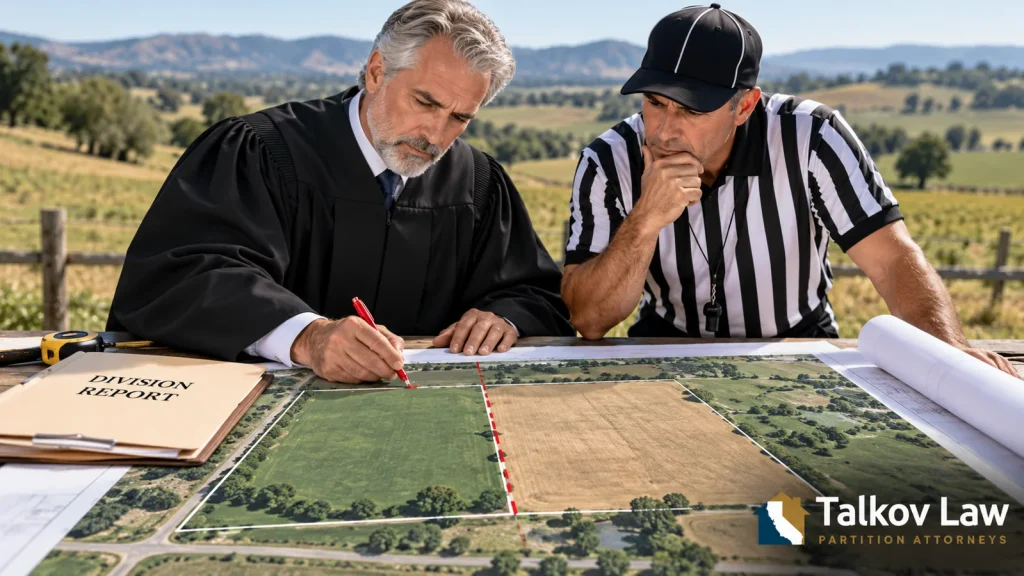

California Code of Civil Procedure section 873.290 (CCP 873.290) is the California partition statute that controls the final step of a partition in kind. After the partition referee files a report dividing the property, any party may ask the court to confirm, modify, or set aside that report. The division does not take effect, and no co-owner receives title to a parcel, until the court enters the judgment of partition.
Full Text of CCP 873.290
(a) Any party, upon notice to the other parties who have appeared, may move the court to confirm, modify, or set aside the report.
(b) At the hearing, the court may either confirm the report as filed or as the court may modify and enter judgment of partition accordingly or set aside the report and order preparation of a new report and, if necessary, appoint a new referee for this purpose.
(c) The division is effective and title vests in accordance therewith upon entry of judgment of partition.
California Code of Civil Procedure section 873.290
What CCP 873.290 Means in Plain Language
Section 873.290 picks up where CCP 873.280 leaves off. Once the referee files the report and gives notice of the filing, the case returns to the judge. The statute has three parts:
- Any party may bring a motion. Under subdivision (a), any party may move the court to confirm, modify, or set aside the report, after giving notice to the other parties who have appeared in the case. The Law Revision Commission comment below points to Code of Civil Procedure sections 1005 and 1010, which set the timing for motion notice and require the notice to be in writing.
- The court has three choices. Under subdivision (b), at the hearing the court may confirm the report as filed, modify it and enter judgment of partition on the modified terms, or set the report aside and order a new one. If necessary, the court may appoint a new referee to prepare it.
- Title passes at judgment. Under subdivision (c), the division takes effect, and title vests according to it, when the judgment of partition is entered. As the Law Revision Commission comment explains, it is the judgment, not the report, that gives the division its effect.
For example, suppose two brothers each own half of an 80-acre parcel, and the court has ordered it divided. The referee’s report gives the north 40 acres to one brother and the south 40 acres to the other, with a payment from one to the other to even out the values, called owelty. Either brother may move to confirm the report. If the judge agrees with the division, the court confirms the report and enters judgment, and each brother then holds title to his own 40 acres. If the judge finds the values were off, the court may adjust the payment and enter judgment on the modified terms, or set the report aside and order a new one.
Where CCP 873.290 Fits in a Partition in Kind
A partition in kind follows a set order, and section 873.290 is the last step before title changes hands:
- The court decides the parties’ interests and orders the partition in an interlocutory judgment under CCP 872.720.
- The court appoints a referee to divide the property under CCP 873.010.
- The referee divides the property and allots each party a share equal in value to that party’s interest under CCP 873.210, giving weight to any improvements a party made under CCP 873.220 and recommending any owelty under CCP 873.250.
- The referee files a report and gives notice of the filing under CCP 873.280.
- A party moves to confirm, modify, or set aside the report under section 873.290, and the court rules at the hearing.
- The court enters judgment of partition, and title vests. Chapter 9, beginning with CCP 874.210, governs who is bound by that judgment.
Section 873.290 applies only when the property is physically divided. When the court orders a partition by sale, the referee’s sale is confirmed under CCP 873.720 instead.
Richmond v. Dofflemyer: No Title Until Judgment Is Entered
In Richmond v. Dofflemyer (1980) 105 Cal.App.3d 745, the trial court awarded specific parcels of a family ranch to some of the co-owners in an interlocutory judgment and sent the rest of the ranch to a referee. The co-owners who appealed argued that the interlocutory judgment was really a final award of title to those parcels. The Court of Appeal disagreed. The judgment said those co-owners “shall receive” their parcels, which pointed to vesting in the future, and section 873.290, subdivision (c), provides that title vests upon entry of the judgment of partition, which had not yet been entered. (Richmond, at pp. 765–766.) Our article on Richmond v. Dofflemyer covers the rest of the decision.
The Law Revision Commission Comments on CCP 873.290
In 1976, the California Law Revision Commission explained CCP 873.290 as follows:
Subdivision (a) of Section 873.290 continues the substance of the last sentence of former Section 765. See Sections 1005 (time for service of notice) and 1010 (notice must be in writing).
Subdivision (b) supersedes the first sentence of former Section 766.
Subdivision (c) supersedes the second sentence of former Section 766. It makes clear that it is the judgment that gives effect to the referee’s report. For persons affected by the judgment, see Chapter 9 (commencing with Section 874.210).
Frequently Asked Questions About CCP 873.290
Who can ask the court to confirm the referee’s report?
Any party may. Under subdivision (a), the party must give notice of the motion to the other parties who have appeared in the action.
Can the court change the referee’s report?
Yes. Under subdivision (b), the court may confirm the report as filed or as the court modifies it, and then enter judgment of partition. It may also set the report aside and order a new one, appointing a new referee if necessary.
When does each co-owner actually own their parcel?
When the judgment of partition is entered. Subdivision (c) provides that the division is effective and title vests at that point, as the Court of Appeal confirmed in Richmond v. Dofflemyer.
Does CCP 873.290 apply when the property is sold?
No. It applies to a partition in kind. A referee’s sale is confirmed under CCP 873.720. Our article on whether a partition referee is necessary explains how referees fit into a case.
Talkov Law's Partition Attorneys Can Help
If your co-owner won’t agree to sell or buy you out, a partition action ends the co-ownership for good. Talkov Law can help. With 12 full-time partition attorneys and experience in over 650 partition actions throughout California, Talkov Law is California’s #1 partition law firm. Our team handles every step of the process, from filing the partition action through the sale or buyout and the final division of the proceeds. Not a single court has denied our clients the right to partition.
Call (877) PARTITION (727-8484) today or contact us online for a free consultation with a partition attorney.







