

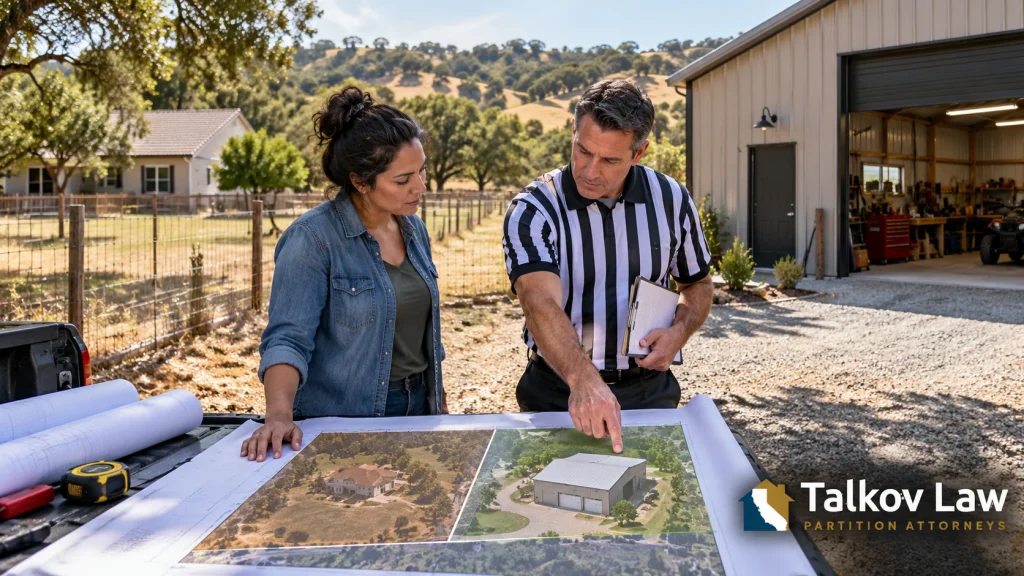
California Code of Civil Procedure section 873.220 (CCP 873.220) tells a court that is dividing co-owned land to give each co-owner, where it can, the portion that holds the improvements that co-owner made, and to leave the value of those improvements out when the shares are measured. Section 873.220 is the California partition statute that protects an improving co-owner in a partition in kind.
Full Text of CCP 873.220
As far as practical, and to the extent it can be done without material injury to the rights of the other parties, the property shall be so divided as to allot to a party any portion that embraces improvements made by that party or that party’s predecessor in interest. In such division and allotment, the value of such improvements shall be excluded.
California Code of Civil Procedure section 873.220
In plain terms, the co-owner who made the improvements will generally receive the portion of the property that includes them when the referee divides the property under section 873.210.
What CCP 873.220 Means in Plain Language
When a court orders co-owned land divided rather than sold, a referee draws the new boundary lines. Section 873.220 tells the referee how to treat a house, barn, well, orchard or other improvement that one co-owner paid for. It has three working parts:
- The improver keeps the improvement. As far as practical, the land is divided so that the portion containing an improvement goes to the co-owner who made it, or to the co-owner who acquired the share from the person who made it (the statute calls that person a “predecessor in interest”).
- The improvement’s value is left out. When the shares are measured, the value of the improvement is excluded. The improving co-owner is not charged for their own work, and the other co-owners do not share in it.
- Fairness to the other owners comes first. All of this applies only “to the extent it can be done without material injury to the rights of the other parties.”
For example, a brother and sister each own half of a 20-acre parcel. The sister spent her own money planting an orchard on the north 10 acres. A referee values the bare land, without the orchard, at $800,000, so each half share is worth $400,000 of bare land. Under section 873.220, the referee would draw the line so the sister receives the north 10 acres with her orchard and the brother receives the south 10 acres. Because the orchard’s value is excluded, the two halves are compared as bare land. The sister does not pay her brother anything for the orchard, and her brother does not receive extra acreage because the orchard made the north half worth more.
If the bare land itself is not equal, the court can even things out with a cash payment called owelty under CCP 873.250. Suppose the north 10 acres are worth $350,000 as bare land and the south 10 acres are worth $450,000. Each sibling is entitled to $400,000 ($800,000 ÷ 2), so the brother, who received $50,000 more than his share ($450,000 − $400,000), would pay his sister $50,000. The orchard still plays no part in that math.
CCP 873.220 Applies When the Property Is Divided
Section 873.220 is written for a division of the property. Its words, “the property shall be so divided,” describe the manner of partition in which the land itself is split, not one in which it is sold.
Its place in the Code of Civil Procedure confirms this. Section 873.220 sits in Chapter 5, titled “Division of the Property,” alongside the other statutes that govern a partition in kind:
- Chapter 5. Division of the Property
- Section 873.210. Division by Referee
- Section 873.220. Allotment of Improvements (this page)
- Section 873.230. Allotment of Property Previously Conveyed to Purchaser
- Section 873.240. Division by Lots or Parcels
- Section 873.250. Owelty
- Section 873.260. Lien on Undivided Interest; Charge on Allotted Share
- Section 873.270. Combined Interests of Unknown Parties; Property Remains Undivided
- Section 873.280. Proceedings of Referee; Report; Notice; Contents
- Section 873.290. Confirmation, Modification or Setting Aside Report; Hearing; Entry of Judgment
Credit for Improvements When the Property Is Sold Instead
Most co-owned California homes cannot be split, so courts usually order a sale under section 872.820 rather than a division under section 872.810. A sale does not erase an improving co-owner’s claim. California case law has long credited a co-owner for improvements made in good faith whether the court divides or sells the property. (Wallace v. Daley (1990) 220 Cal.App.3d 1028, 1038.)
Wallace v. Daley extended that rule to the successor’s side of section 873.220. The Court of Appeal held that a co-owner is entitled to the same credit for improvements made by the person she acquired her share from whether the property is sold or divided, as long as it can be done without material injury to the other co-owners. (Id. at p. 1038.)
In a sale, the credit is handled in the final accounting under CCP 872.140, which lets the court order “allowance, accounting, contribution, or other compensatory adjustment among the parties according to the principles of equity.” Our articles on reimbursement for improvements and partition offsets explain how courts measure it.
Limits on Credit for Improvements
Credit for improvements is not automatic. The courts have recognized these limits:
- Good faith and added value. The rule covers improvements a co-owner placed on the property at their own cost and in good faith that increased its value, even if the other co-owners never consented. (Mercola v. Chester (1950) 97 Cal.App.2d 140, 143.)
- No material injury. The credit applies only where it can be given without material injury to the other co-owners. Wallace explained that this protects people such as a buyer of a co-owner’s share, who may have trouble tracing improvements made by an earlier owner. (Wallace v. Daley, supra, 220 Cal.App.3d at p. 1037.)
- Improvements made as a renter. A co-owner who made improvements while renting the property under a lease that put those costs on the tenant could not claim credit for them. (Id. at pp. 1039–1040; see Ventre v. Tiscornia (1913) 23 Cal.App. 598, 606.)
The Law Revision Commission Comments on CCP 873.220
In 1976, the California Law Revision Commission explained CCP 873.220 as follows:
Section 873.220 continues the substance of the last sentence of former Section 764.
This codifies the common law doctrine. See, e.g., Seale v. Soto, 35 Cal. 102 (1868). In the case of sale rather than division of the property, California case law applies a comparable rule. See, e.g., Ventre v. Tiscornia, 23 Cal.App. 598, 138 P. 954 (1913); Mercola v. Chester, 97 Cal.App.2d 140, 217 P.2d 32 (1950).
The Court of Appeal later explained that this comment understates what the Legislature did. Former section 764 said nothing about improvements made by a co-owner’s predecessor in interest, so section 873.220 added that protection rather than simply carrying the old rule forward. (Wallace v. Daley, supra, 220 Cal.App.3d at pp. 1036–1037 & fn. 9.) The case the comment calls Ventre v. Tiscornia is reported as Ventre v. Tiscornia.
Frequently Asked Questions About CCP 873.220
Does CCP 873.220 apply if the house is sold instead of divided?
The statute itself governs a division. When the property is sold, the courts give a comparable credit for good-faith improvements through the partition accounting, and Wallace v. Daley held that credit for a predecessor’s improvements applies in a sale as well.
Can a co-owner get credit for improvements the other owners never agreed to?
Yes, in many cases. Consent is not required if the improvements were made in good faith, at the co-owner’s own cost, and increased the property’s value. The credit still must not materially injure the other co-owners.
Section 873.220 covers improvements made by a party’s “predecessor in interest,” meaning the person the share came from. The court can still weigh whether giving that credit would materially injure the other co-owners.
No. The value of the improvements is excluded, so the shares are compared as if the improvements were not there. If the bare land is uneven, the court can order an owelty payment under section 873.250.
Talkov Law's Partition Attorneys Can Help
If your co-owner won’t agree to sell or buy you out, a partition action ends the co-ownership for good. Talkov Law can help. With 12 full-time partition attorneys and experience in over 650 partition actions throughout California, Talkov Law is California’s #1 partition law firm. Our team handles every step of the process, from filing the partition action through the sale or buyout and the final division of the proceeds. Not a single court has denied our clients the right to partition.
Call (877) PARTITION (727-8484) today or contact us online for a free consultation with a partition attorney.








