

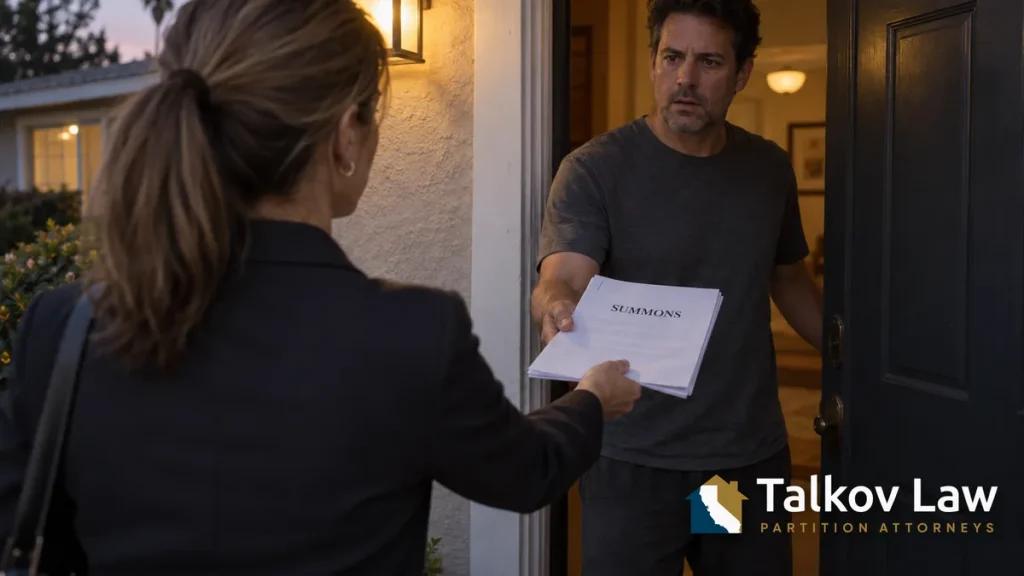
A co-owner cannot personally serve the partition lawsuit on the other co-owner. In Braugh v. Dow (2023) 93 Cal.App.5th 76, a co-owner handed the summons and complaint to her former partner herself, obtained a default judgment awarding her the entire home in Sun Valley in the San Fernando Valley, and recorded a deed. Nearly two years later, the trial court set the judgment aside as void, and the Court of Appeal affirmed. A partition action that looked finished in 2018 had to start over.
Why Braugh v. Dow Matters
- A party cannot serve the summons. Code of Civil Procedure section 414.10 allows service by “any person who is at least 18 years of age and not a party to the action.”
- It does not matter that the co-owner actually received the papers. Service by a party is void even when the defendant had the lawsuit in hand.
- A judgment that is void on its face has no six-month deadline. The other co-owner can attack it years later, even after a deed is recorded.
- A default judgment is only as strong as the service behind it. Proper service at the start protects the judgment at the end.
The Facts: A Family Home, a Breakup and Do-It-Yourself Service
Jane Braugh and Roy Dow, a former unmarried couple, owned a family home in Sun Valley in Los Angeles County as joint tenants with the right of survivorship. Their relationship ended in 2013. Braugh is an attorney licensed in California.
In April 2018, Braugh filed a partition complaint seeking partition, an accounting and an injunction. She alleged that Dow had not paid on the mortgage since 2004 and refused to pay for necessary repairs. She asked the court to quiet title and decide that Dow “is owed nothing,” or else to order the property sold. (Braugh, at p. 81.)
On May 2, 2018, Braugh personally handed Dow the summons and complaint at the property. She then signed a proof of service stating, under penalty of perjury, that she was “not a party to this action.” (Braugh, at p. 81.) Dow did not file an answer. The court entered his default in June 2018. In September 2018, it quieted title and ordered Dow’s interest transferred to Braugh, and a grant deed was recorded that October. (Braugh, at p. 82.)
In July 2020, one year and nine months later, Dow moved to set aside the default and the judgment as void. The trial court granted the motion, and Braugh appealed.
How the Court of Appeal Decided the Case
Service by a Party Is Not a Technicality
Braugh argued that she had “substantially complied” with the service rules because Dow actually received the papers, so that who served him was a mere technicality. The Court of Appeal disagreed:
“This is not a ‘mere technicality’ as Braugh would like us to hold; this is an issue of fundamental jurisdiction.”
Braugh v. Dow (2023) 93 Cal.App.5th 76, 88
A court gains power over a defendant only through service made the way the statutes require. Here the defect was visible in the court file itself: Braugh’s own proof of service showed that a party to the case had served the summons. The trial court therefore never had jurisdiction over Dow.
Actual Notice Did Not Save the Judgment
The court made the rule plain: “We therefore hold that ‘substantial compliance’ does not apply where a party personally serves its own summons and complaint.” (Braugh, at p. 89.) The ban on service by a party is strictly enforced because it discourages fraudulent service by someone with a stake in the case.
The Six-Month Deadline Did Not Apply
A defendant usually has six months to ask for relief from a default under Code of Civil Procedure section 473, subdivision (b). That limit does not apply to a judgment that is void on its face, which a court may set aside under subdivision (d). An email from a lawyer who had seen a draft of the complaint did not cure the problem, and Dow was “under no duty to act upon a defectively served summons.” (Braugh, at p. 90.)
The court affirmed the order setting aside the default and the judgment, and awarded Dow his costs on appeal.
How to Serve a Partition Action the Right Way
Under Code of Civil Procedure section 872.310 (CCP 872.310), the summons in a partition action is served “as in civil actions generally.” In practice:
- Have someone who is not a party serve the papers. A registered process server is the safest choice. A co-owner who is a plaintiff can never be the server.
- Read the proof of service before asking for a default. The proof of service is part of the record a court reviews years later.
- If a co-owner cannot be found, ask the court for another method. Service by publication in a partition action is available under CCP 872.320’s rule on publication and CCP 872.330.
- Name and serve everyone with an interest. CCP 872.510’s rule on joining defendants requires the plaintiff to join everyone with a recorded or known interest in the property, and a lis pendens gives notice of the case.
- A properly served default holds. In Crittenden v. Crittenden (1963) 221 Cal.App.2d 299, a brother who was properly served and did not answer could not undo his default.
What Braugh v. Dow Means for Co-Owners
The shortcut cost years. The complaint was filed in April 2018, and when the Court of Appeal ruled in July 2023, the case was back at the answer stage. A partition handled correctly usually takes far less time, as explained in how long a partition action takes.
The case also shows why a partition should end with a judgment that lasts. Co-owners who file a partition action have the right to partition, and whether or not you tell your co-owner before suing, the lawsuit must reach them through proper service. A buyer, a title company and a lender will all rely on that judgment when the property is sold in a partition by sale.
End the Co-Ownership With a Judgment That Holds
Braugh v. Dow is a reminder that small procedural mistakes can undo a partition judgment, even for a lawyer representing herself. If your former partner or another co-owner refuses to sell, the case should be filed and served so the result cannot be attacked later.
Talkov Law can help. With 12 full-time partition attorneys and experience in over 650 partition actions throughout California, our team handles every step, from the complaint and service of the summons through the referee’s sale and the final distribution of proceeds. Call (877) PARTITION (727-8484) today or contact us online to get started. No fees until you win.








