

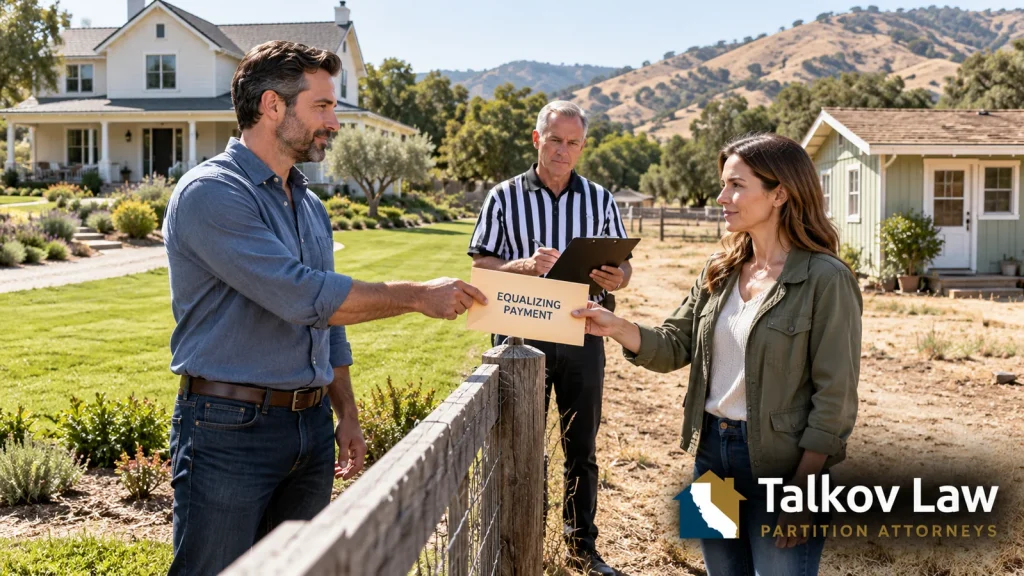

California Code of Civil Procedure section 873.250 (CCP 873.250) lets a court order one co-owner to pay another, a payment called owelty, when property cannot be divided equally among the co-owners in a partition in kind. Section 873.250 is the California partition statute that sets the rule, and it protects unknown owners and minors from being ordered to pay.
Full Text of CCP 873.250
(a) Where division cannot be made equally among the parties according to their interests without prejudice to the rights of some, compensation may be required to be made by one party to another to correct the inequality.
(b) No compensation shall be required to be made to others by unknown owners or by minors unless it appears that a minor has personal property sufficient for that purpose and the minor’s interest will be promoted thereby.
California Code of Civil Procedure section 873.250
What CCP 873.250 Means in Plain Language
“Owelty” is a sum of money paid by one former joint tenant to another after a partition results in the unequal division of property, in order to equalize the disproportionate division of the property. Owelty is ordered by a court as part of a judgment of partition in order to compensate a prejudiced party for the inequality of partition. The term is usually, if not universally, applied to the partition of lands (i.e., partition in kind). See 48 Cal. Jur. 3d Partition § 80.
In everyday terms, land rarely divides into pieces of exactly equal value. Section 873.250 lets the court fix the difference with money. It has two subdivisions:
- Subdivision (a): the equalizing payment. Where the division “cannot be made equally among the parties according to their interests without prejudice to the rights of some,” the court may require compensation from one party to another “to correct the inequality.”
- Subdivision (b): who is protected. No compensation may be required of unknown owners or of minors, unless a minor “has personal property sufficient for that purpose” and the minor’s interest “will be promoted thereby.” The Law Revision Commission comment adds that this bar covers a lien on the minor’s share as well as direct payment.
For example, two siblings inherit 10 acres and the court divides it in kind. One half has road frontage and a well, and the other half is steep and dry. If the court allots the better half to one sibling, owelty can require that sibling to pay the other the difference. The referee may recommend an owelty amount in the report under CCP 873.280, and the court decides at the confirmation hearing under CCP 873.290. The referee divides the property under CCP 873.210.
A recent decision discussing this topic is Jamison v. Jamison (2008) 164 Cal.App.4th 714, which found that, “to make the owelty award, the trial court was required to determine the property values of the various parcels.”
It is important to understand that the provision for owelty of partition, however, should be distinguished from compensatory adjustments under CCP 872.140 made under the ordinary principles of equity as for accountings and allowances in a partition by sale of real property. See 48 Cal. Jur. 3d Partition § 80.
Law Revision Commission Comments to CCP 873.250
In 1976, the California Law Revision Commission explained CCP 873.250 as follows:
Section 873.250 continues the substance of the first sentence of former Section 792. The bar on requiring owelty of a minor applies to imposition of a lien on the share of the minor as well as to direct payment. The provision in this section for owelty of partition should be distinguished from compensatory adjustments made under the ordinary principles of equity, as for accountings, allowances, and the like, pursuant to Section 872.140.
Frequently Asked Questions About Owelty in a Partition
What is owelty in a California partition?
Owelty is a payment one co-owner makes to another to equalize an unequal division of property. Our article on owelty gives more background.
When can a court order owelty?
When the property cannot be divided equally among the parties according to their interests without prejudice to the rights of some. Under subdivision (a), the court may then require compensation to be made by one party to another to correct the inequality.
Does owelty apply when the property is sold?
No. The Law Revision Commission comment distinguishes owelty from the compensatory adjustments the court makes under the ordinary principles of equity, such as accountings and allowances, under CCP 872.140. Our article on partition offsets and accounting covers those adjustments in a sale.
Who decides the amount of owelty?
The referee may recommend it in the report required by CCP 873.280, and the court decides when it confirms the report under CCP 873.290. In Jamison v. Jamison (2008) 164 Cal.App.4th 714, the court said that to make the owelty award, the trial court was required to determine the property values of the various parcels.
Can a minor or an unknown owner be ordered to pay owelty?
Generally no. Subdivision (b) bars compensation from unknown owners or minors, unless a minor has personal property sufficient for that purpose and the minor’s interest will be promoted by the payment.
Talkov Law's Partition Attorneys Can Help
If your co-owner won’t agree to sell or buy you out, a partition action ends the co-ownership for good. Talkov Law can help. With 12 full-time partition attorneys and experience in over 650 partition actions throughout California, Talkov Law is California’s #1 partition law firm. Our team handles every step of the process, from filing the partition action through the sale or buyout and the final division of the proceeds. Not a single court has denied our clients the right to partition.
Call (877) PARTITION (727-8484) today or contact us online for a free consultation with a partition attorney.







