

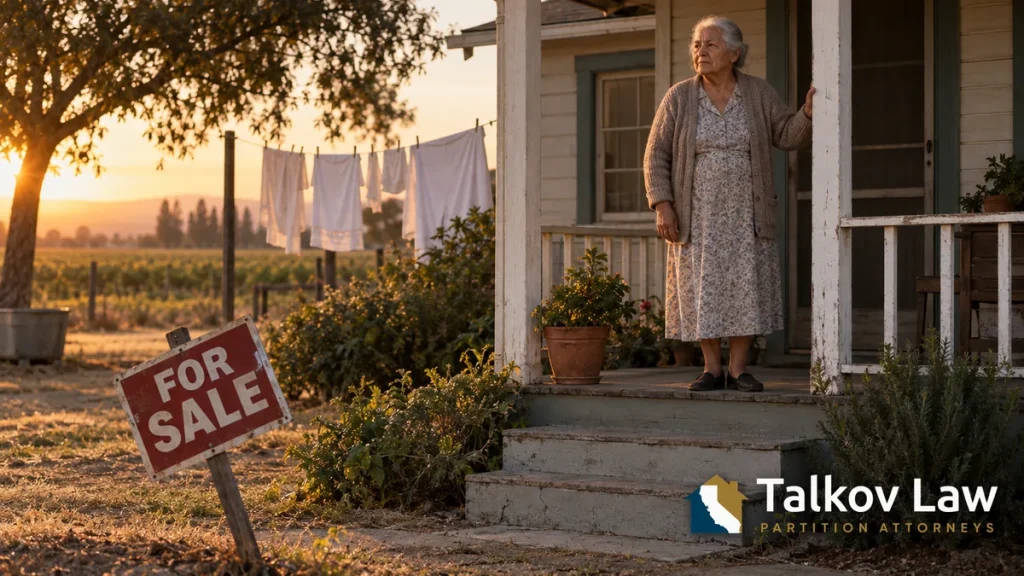
A co-owner who paid nothing for a house may hold title subject to the rights of the co-owner who paid for all of it. In Rowland v. Clark (1949) 91 Cal.App.2d 880, a grandmother bought a small Kern County house with her own earnings and put her teenage granddaughter on the deed as a joint tenant. When the granddaughter later sued for partition, the Court of Appeal held that a resulting trust protected the grandmother’s right to live in her home for life. The case turned on who paid for the house, so it does not help a co-owner who only claims a spoken promise.
Why Rowland v. Clark Matters
- Who paid for the property matters. When one person pays the whole price and title goes into another person’s name, the law presumes a resulting trust in favor of the person who paid.
- The proof must be clear and convincing. The deed controls unless the co-owner who says otherwise meets that high standard.
- A spoken promise was not the reason the grandmother won. She won because she paid every dollar of the price, and a resulting trust arises from the payment itself. A bare claim of “I was promised the house for life” is a different case.
- The right to partition remains the rule. A co-owner has the right to partition unless there is a valid waiver of the right to partition.
The Facts: A Grandmother’s Home and a Granddaughter on the Deed
Pearl Clark, a widow, took in her orphaned granddaughter Thelma, along with Thelma’s two sisters and brother, when Thelma was nine. She brought the children to California in 1942 and supported them by doing laundry, caring for children and working odd jobs. In 1944, she bought the house in this case. She paid the $750 initial payment and the balance of about $300 from her own earnings. (Rowland, at p. 881.)
She had the deed name herself and Thelma, then 13 or 14 years old, as joint tenants. At trial, she explained why:
“I told her I would put her name on the deed so she could get the property at my death; it would be hers.”
Rowland v. Clark (1949) 91 Cal.App.2d 880, 882
She also told Thelma that she meant to keep living there: “It was my home.” (Rowland, at p. 882.)
Thelma lived in the house until August 1946. She paid nothing toward the purchase price, the improvements, the property taxes or the upkeep. At 19 and married, she filed a partition action to force the sale of what the court called “the four room frame house acquired by defendant as her home.” (Rowland, at p. 882.) The trial court ruled for the grandmother, and Thelma appealed.
How the Court of Appeal Decided the Case
Thelma argued that the partition statute then in effect gave her an absolute right to partition. The court answered that “the right to partition property is not always absolute” and can be defeated by an agreement between the co-owners. (Rowland, at p. 882.) The trial court had found such an agreement: the grandmother would keep the property for her lifetime, and Thelma would take it afterward.
The Person Who Paid Is Presumed to Hold the Benefit
The Court of Appeal rested its decision on the law of resulting trusts:
“We conclude that where, as here, the title to the property was taken in the name of one party and the consideration for the transfer furnished by the other, a trust is presumed to result in favor of the latter.”
Rowland v. Clark (1949) 91 Cal.App.2d 880, 882-883
A resulting trust requires clear and convincing proof, but the proof may be indirect, “consisting of acts, conduct and circumstances.” (Rowland, at p. 883.) Here the evidence pointed one way. The house was the grandmother’s “only home during her declining years, purchased and improved from her limited earnings over a period of several years.” (Rowland, at p. 883.)
Being a Minor Did Not Change the Result
Thelma also argued that, as a minor, she could cancel any agreement, and that filing the lawsuit did so. The court held that even if that were true, she was still bound by the rules of equity, and “the resulting trust is not affected.” (Rowland, at p. 884.) The judgment for the grandmother was affirmed.
The Law Today
Rowland was decided under the former partition statutes. Since 1976, Code of Civil Procedure section 872.710 (CCP 872.710) has provided that partition between co-owners “shall be as of right unless barred by a valid waiver.” The California Supreme Court cited Rowland for that same rule in Lazzarevich v. Lazzarevich (1952) 39 Cal.2d 48, 50, holding that without a waiver a joint tenant is entitled to partition as a matter of right.
Three rules keep Rowland narrow:
- The deed is presumed correct. Under Evidence Code section 662, the owners on title are presumed to own the full beneficial title, and only clear and convincing proof overcomes that presumption.
- Who paid does not, by itself, undo a joint tenancy deed. In Gudelj v. Gudelj (1953) 41 Cal.2d 202, the California Supreme Court held that a joint tenancy deed is not overcome just by showing who paid for the property. In Rowland, the trial court found an actual agreement in addition to the payment.
- A life estate must be in writing unless the law itself creates it. Under the statute of frauds, an oral life estate is not legally recognized. A resulting trust is different because it arises from the payment of the price. One year after Rowland, the Court of Appeal described it as a case that “involves a discussion of a resulting trust.” (Wilson v. Peterson (1950) 96 Cal.App.2d 84, 86.)
Rowland belongs to the same family of older waiver cases as Pine v. Tiedt (1965) 232 Cal.App.2d 733 and American Medical International, Inc. v. Feller (1976) 59 Cal.App.3d 1008. None of them creates a general fairness defense, because fairness is not a defense to partition.
What Rowland v. Clark Means for Co-Owners
- If you paid for the whole house, you can prove it. A partition court decides each owner’s share before it orders a sale, and equitable title can differ from the deed. See what happens when a parent funds a house and a child is on title.
- A claimed promise is not a waiver. If a sibling says Mom promised them the house for life, the written deed, will or trust controls, and the other owners can still force the sale.
- Unequal payments are usually settled with money, not by blocking the sale. A co-owner who paid more of the down payment, the mortgage or the taxes is repaid through partition offsets when the property is sold.
- Put family arrangements in writing. A parent who adds a child to title should say in the deed or in a written co-ownership agreement who may live there and for how long. See our guide to joint tenancy between a parent and child.
Does Your Co-Owner Say the House Can’t Be Sold?
Rowland v. Clark protected a grandmother who paid the entire price of her only home. It does not let a co-owner who shared the cost, or who only recalls a conversation, stop a partition. In intra-family partition actions, the deed and the written record decide who owns what, and the court can order a partition by sale or a buyout.
Talkov Law can help. With 12 full-time partition attorneys and experience in over 650 partition actions throughout California, our team handles every step, from filing the partition action through the referee’s sale and the final distribution of proceeds. Call (877) PARTITION (727-8484) today or contact us online to get started. No fees until you win.








