

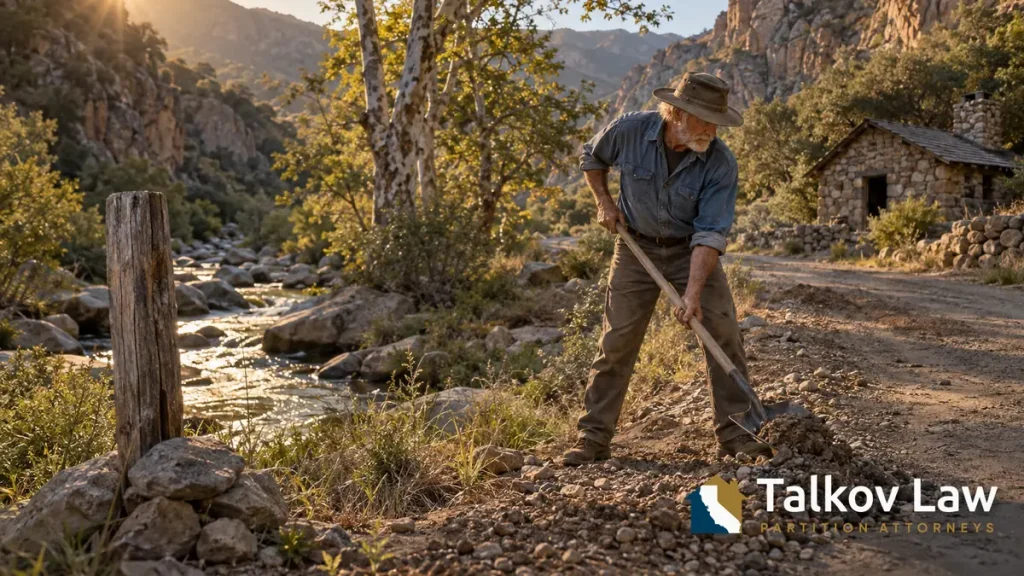
A California co-owner who never visits the property, never lives there, and lets the taxes go unpaid still owns their share. In Wood v. Henley (1928) 88 Cal.App. 441, the Court of Appeal held that a co-owner’s family could not take an absent owner’s half interest in 160 acres in Ventura County by working the land, building on it, and renting cabins to campers. Because co-owners “hold the common land by unity of possession,” no co-owner can claim a particular piece as their own, and “the possession of one cotenant is possession for all.” (Wood, at p. 452.)
This comes up when a sibling has lived in an inherited house for years, when one owner has paid all the property taxes and claims that makes the house theirs, or when a co-owner who moved out of state wonders whether they still have any rights. Our guides to adverse possession between co-owners and whether paying property taxes gives ownership cover the day-to-day rules. This post covers the case behind them.
Why Wood v. Henley Matters
- Every co-owner has the right to the whole property. “Each of such tenants has the right to enter upon and occupy the whole and every part of the common lands.” (Wood, at p. 452.)
- No co-owner can carve out a piece as their own. A co-owner “cannot put his finger on a particular portion of the common property” and claim it as their share. (Wood, at p. 456.)
- Living there and paying the taxes is not enough. Exclusive possession, paying the taxes, or both, even for five years, do not give a co-owner title to the others’ shares. (Wood, at p. 453.) Our summary of Preciado v. Wilde applies the same rule.
- An ouster has to be open and communicated. The co-owner in possession must do something that clearly tells the others they are being shut out. (Wood, at pp. 453–454.)
- Adverse possession takes the clearest proof. No one should lose their property on a claim of adverse possession “unless such plea is sustained by the clearest and most satisfactory proof.” (Wood, at p. 460, quoting Pyramid Land etc. Co. v. Scott (1921) 51 Cal.App. 634, 646.)
The Facts: A Rock Quarry, a Tax Sale, and an Owner Who Never Saw the Land
The property was 160 acres in Sespe Canyon, in the mountains of Ventura County. It was rock, useless for farming but valuable as a stone quarry. Frances Wood owned a one-half interest, which she got from her husband, Ira. Melita Henley owned one-fourth, and a man named Mason Bradfield owned the other fourth. Mrs. Wood had never been on the property or even seen it. (Wood, at pp. 444, 446.)
The taxes on Mrs. Wood’s half went unpaid for 1911, 1912, and 1913, and her interest was sold to the state. In June 1917, the state sold it to the Ventura Abstract Company, which quitclaimed it to Melita’s husband, George Henley, in July 1917. Ira Wood had warned the company that the sale was invalid, and everyone later admitted it was void, because the county never gave the required notice. (Wood, at pp. 446–448.)
George Henley had been on the land for years. He built and kept up the only road into the canyon, quarried and sold stone, built cabins, and charged campers a small fee to stay and fish in the stream. He started living there off and on in 1916, built a stone house in 1918 that he believed was on his own neighboring 40 acres, and said he paid the taxes on the Wood half from 1918 to 1921. (Wood, at pp. 448–451.) The Woods sued to quiet title on May 28, 1921. The Henleys claimed the half interest by adverse possession, and the trial court ruled for Mrs. Wood. (Wood, at pp. 444–445.)
How the Court of Appeal Decided the Case
Possession by One Co-Owner Is Possession by All
The court began with the basic feature of a tenancy in common: the owners share possession of the whole, so no one can say which part is theirs. From that, the court drew the rule that protects every co-owner who is not living on the property:
“It follows, therefore, that a tenant in common of an undivided interest in the common property is entitled to the possession of the whole thereof as against all persons except his cotenants.”
Wood v. Henley (1928) 88 Cal.App. 441, 452
Each co-owner may occupy all of the property and has no right to exclude the others from any part of it, so “the possession of one cotenant is possession for all.” (Wood, at p. 452, citing Civil Code section 685 and Civil Code section 686.) That is also why you cannot evict a co-owner.
A Co-Owner Cannot Claim a Specific Piece
The Henleys were never in exclusive possession of the land. Melita Henley could not, without the other owners’ agreement, pick out a portion and claim it as her share, and George Henley could not do it either. The court held that a co-owner or an outsider “cannot put his finger on a particular portion of the common property itself” and, by occupying, improving, and paying taxes on it, claim that portion as the share they are trying to take. (Wood, at pp. 455–456.) Informal deals in which each owner uses a different part of the property run into the same rule, as our guide to tenancy in common agreements explains.
An Ouster Must Be Open and Communicated
A co-owner can take the others’ shares by adverse possession, but only after an ouster or a clear repudiation of the co-ownership. (Wood, at p. 453.) The court explained what that requires:
“It is the intent which determines the character of the possession; but it is essential that this intent be in some mode, either by actual or presumptive notice, directly or indirectly communicated to the other cotenant.”
Wood v. Henley (1928) 88 Cal.App. 441, 454
The court listed examples of ouster, including refusing a co-owner’s proper demand to be let into possession. (Wood, at p. 454.) Today, Civil Code section 843 lets a co-owner prove an ouster with a written demand. Our summaries of Estate of Hughes and Hacienda Ranch Homes v. Superior Court show what an ouster looks like.
The Henleys did none of that. There was no evidence they ever refused to let Mrs. Wood in, told her they claimed her half, or paid the taxes on her half for any definite period before 1917. George Henley’s use of the land was intermittent, and the other owners could assume his work was for the benefit of his wife and all of the co-owners. (Wood, at pp. 456–458.) His first open claim to Mrs. Wood’s half was taking the void quitclaim deed in July 1917, and the Woods sued less than four years later, so the five-year period never ran. (Wood, at pp. 456, 461.)
No Credit for Improvements That Were Never Claimed
The Henleys also argued they should be paid for the stone house, barn, cabins, pipeline, and road. The court rejected that, because they never asked for it in their pleadings, and a claim for improvements must be pleaded and proven to have been made in good faith and to have increased the property’s value. (Wood, at p. 462.) In a partition, by contrast, Code of Civil Procedure section 872.430 lets a defendant raise these claims in the answer, and good-faith improvements that add value can be credited, as in Mercola v. Chester and Ventre v. Tiscornia.
The Result
The Court of Appeal affirmed the judgment quieting Mrs. Wood’s title to her one-half interest. The Henleys’ claims of adverse possession and of the statute of limitations both failed. (Wood, at pp. 460, 464.)
Wood v. Henley Today
Nearly a century later, Wood is still the case California courts cite for what co-owners share. In Zaslow v. Kroenert (1946) 29 Cal.2d 541, 548, the California Supreme Court relied on Wood for the rule that each tenant in common “equally is entitled to share in the possession of the entire property and neither may exclude the other from any part of it.” Zaslow then held that a co-owner who is shut out, demands to be let in, and is refused can recover common possession of the property. (Zaslow, at p. 548.)
The Courts of Appeal also cite Wood for the point that a tenancy in common needs only one thing in common: the right to possess. A tenancy in common “requires for its existence but one unity, namely, that of possession.” (Zolezzi v. Michelis (1948) 86 Cal.App.2d 827, 830, citing Wood.) “Only unity of possession is required to create a tenancy in common.” (Wilson v. S.L. Rey, Inc. (1993) 17 Cal.App.4th 234, 245, citing Wood.)
The rule runs through California co-ownership law today. Our guides to tenancy in common, the rights of a 50% owner, and leasing jointly owned property all rely on Wood‘s page 452 statement that no co-owner can claim a particular portion of the property as their own.
What Wood v. Henley Means for California Co-Owners
- Moving away does not cost you your share. A co-owner out of possession is still a co-owner and can still sue for partition, as in Martin v. Walker.
- The co-owner living there is not earning your share. Living on the property, paying the taxes, and making improvements are presumed to be for all of the owners. See our guide to a co-owner who is not paying the property taxes.
- Want rent? Ask to be let in, in writing. A written demand under Civil Code section 843 sets up a claim for the value of your share’s use. Our guide to collecting rental value from a co-owner explains how.
- Act on a real ouster. Once a co-owner openly claims the whole property, the adverse possession clock can start. Our summary of Adams v. Hopkins explains why time never bars a partition until that happens.
- Ownership fights can be decided in the partition. The Woods filed a quiet title action. Today, a dispute over who owns what is usually decided inside the partition action itself.
Co-Owner Acting Like It’s All Theirs? End It With a Partition Action
A co-owner who uses the property as their own does not gain your share by doing it. A partition action lets any co-owner, including one who has never lived there, force a sale, with the taxes, improvements, and rental value settled in the final accounting.
Talkov Law can help. With 12 full-time partition attorneys and experience in over 650 partition actions throughout California, our team handles every step, from the complaint through the partition sale and the final distribution of proceeds. Call (877) PARTITION (727-8484) today or contact us online to get started.







