
California Civil Code section 685 defines an “interest in common,” the legal term for a tenancy in common: property “owned by several persons, not in joint ownership or partnership.” It is the most common way California co-owners hold title. Tenants in common can own unequal shares, each can use the whole property, there is no right of survivorship, and any one of them, from Riverside to San Francisco, can end the co-ownership through a partition action.
Full Text of Civil Code 685
An interest in common is one owned by several persons, not in joint ownership or partnership.
California Civil Code section 685 (enacted 1872)
Civil Code 685 Defines Tenancy in Common by What It Is Not
Section 685 does not list requirements. It defines an interest in common by excluding the other forms of co-ownership. If several people own property and it is not a joint tenancy and not partnership property, it is an interest in common. Two neighboring sections complete the picture:
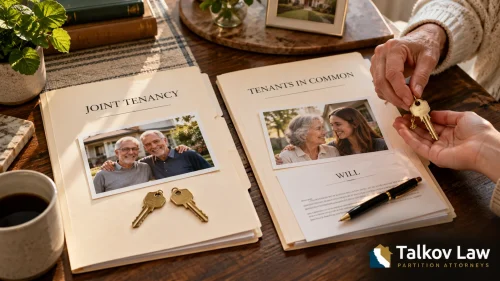
- Civil Code section 682 lists the four forms of co-ownership: joint interest, partnership interests, interests in common, and the community interest of spouses.
- Civil Code 686 makes tenancy in common the default whenever a deed or will does not expressly declare a joint tenancy and the property was not acquired by a partnership or as community property.
Because so little is required, a tenancy in common is easy to create. “Tenancy in common merely requires, for creation, equal right of possession or unity of possession.” (Wilson v. S.L. Rey, Inc. (1993) 17 Cal.App.4th 234, 242.) A joint tenancy, by contrast, requires equal shares taken under a single deed or will that expressly declares it, as Civil Code 683 on how a joint tenancy is created explains.
The Rights of a Tenant in Common in California
An interest in common carries these rights:
- The right to use the whole property. “Each tenant in common equally is entitled to share in the possession of the entire property and neither may exclude the other from any part of it.” (Zaslow v. Kroenert (1946) 29 Cal.2d 541, 548.) That is true even for an owner with a small share.
- Compensation if locked out. A tenant in common who is shut out by another can recover damages, which ordinarily equal the excluded owner’s share of the value of the use and occupation of the property from the time of the ouster. (Zaslow v. Kroenert, supra, 29 Cal.2d at p. 548.) Our summary of Zaslow v. Kroenert and our page on Civil Code 843 on ouster explain how.
- Unequal shares are allowed. Tenants in common can own 70 and 30 percent, or any other split. A joint tenancy requires equal shares.
- Each owner controls their own share. A tenant in common can sell, give away, or borrow against their share without the others’ consent. See our post on whether you can sell your half of a jointly owned property.
- No right of survivorship. When a tenant in common dies, the share passes under their will or trust, or to their heirs, not to the other co-owners. Compare the right of survivorship that comes with a joint tenancy.
Every Tenant in Common Has the Right to Partition
An interest in common is a concurrent interest, and under Code of Civil Procedure section 872.710, “partition as to concurrent interests in the property shall be as of right unless barred by a valid waiver.” A tenant in common does not need the other owners’ agreement, a majority share, or a reason. The court usually orders the property sold and divides the proceeds, as our guide to partition by sale explains.
The deed is not the last word on how the money is divided. In a partition, “all parties’ interests in the property may be put in issue regardless of the record title.” (Milian v. De Leon (1986) 181 Cal.App.3d 1185, 1195–1196.) And when the court finds a tenancy in common, it “may either order reimbursement … or determine the ownership interests in the property in proportion to the amounts contributed.” (Id. at p. 1196.) That helps the co-owner who paid more, as our guide to unequal down payments explains.
Common Questions About Civil Code 685
Is an “Interest in Common” the Same as a Tenancy in Common?
Yes. The Civil Code uses “interest in common,” while deeds and courts usually say “tenants in common.” They mean the same thing.
Yes. The right to partition does not depend on the size of the share. A 10 percent owner has the same right to file as a 90 percent owner.
My Siblings and I Inherited a House. Are We Tenants in Common?
Almost always, unless the will or trust declared a joint tenancy. That means any of you can ask a court to sell the house. See our page on inherited property partition, or our post on a co-owner buyout if one of you wants to keep it.
An Interest in Common Comes With a Way Out
Civil Code section 685 describes the form of ownership most California co-owners have. It gives each of them an equal right to use the property, control over their own share, and the right to end the co-ownership through partition.
Talkov Law can help. With 12 full-time partition attorneys and experience in over 650 partition actions throughout California, our team handles every step of the process, from proving your share of the property through the partition sale and the final distribution of proceeds. No fees until you win. Call (877) PARTITION (727-8484) today or contact us online for a free 30-minute consultation.