

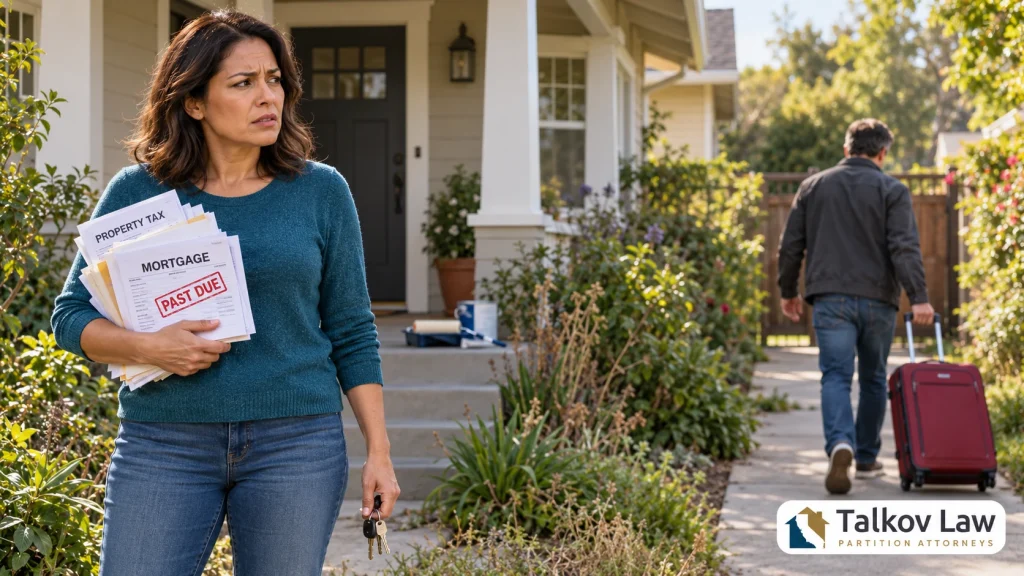
A co-owner who abandons a property in California does not lose their ownership rights, but their absence often creates financial strain that can be resolved through a partition action.
Did your co-owner walk away and leave you paying? You can force a sale and recover what you paid. Get a free 30-minute consultation or call (877) PARTITION (727-8484). No fees until you win.
When one co-owner stops contributing, the remaining co-owner is often left covering the mortgage and upkeep alone. This situation is common among unmarried couples, family members, and investment partners, and it is often a clear sign that a partition action is the most effective way to move forward.
But does abandonment mean the remaining co-owner gets full ownership? Not quite.
Does Abandonment Mean Loss of Ownership?
No. In California, simply leaving a property does not terminate ownership rights. A co-owner who abandons the property still retains their legal interest unless:
- They voluntarily transfer their interest, or
- A court orders a change in ownership (such as through a partition action)
This means the absent co-owner may still technically own part of the property, even if the co-owner has not paid the taxes, maintenance, or mortgage for months or years.
Financial Burden on the Remaining Co-Owner of Abandoned Property
When one co-owner abandons the property, the remaining co-owner often ends up covering:
Under California law, these contributions can become critical in a partition action.
Courts have the authority under Code of Civil Procedure section 872.140 to allocate property related expenses among the co-owners based on what is equitable. As a result, a co-owner who pays more than their fair share may be entitled to reimbursement or credits when the property is divided or sold.
If a Co-Owner Abandons House, Can You Force Them Off Title?
You generally cannot remove a co-owner from title without their consent. However, California law provides a powerful solution: a partition action.
Under California Code of Civil Procedure section 872.210 (CCP 872.210), any co-owner has the right to file a partition action to divide or sell the property.
In most cases, the court will order a partition by sale, meaning:
- The property is sold
- The proceeds are divided among the co-owners
- Adjustments are made for unequal contributions
What If the Co-Owner Cannot Be Reached at All?
When a co-owner goes missing, courts have ways to ensure that the missing defendant can still be served to allow for the partition of the property. California partition statues provide that partitions can be served by publication in a newspaper, with certain conditions and with specific information. Indeed, service by publication is also proper under the Partition of Real Property Act. After a missing co-owner is served by publication or by ordinary service of process, but fails to respond, a default partition judgment can be entered by the court.
A co-owner’s disappearance does not block a partition action. This comes up more than people expect: a sibling who disappears after inheriting a share, an investment partner who walks away, or an ex who moved and left no address. Code of Civil Procedure section 872.710(b) states that “partition as to concurrent interests in the property shall be as of right unless barred by a valid waiver.” Going missing is not a waiver. The court will not deny partition just because one party cannot be located. A missing co-owner is a procedural hurdle, not a legal barrier.
How Service by Publication Works
Code of Civil Procedure section 872.310(b) provides that unknown or missing defendants “shall be [served] by publication pursuant to Section 415.50 and the provisions of this article.” To obtain a court order for publication, the plaintiff must submit an affidavit showing the co-owner cannot be located through reasonable diligence, documented attempts at personal service, public records searches, and similar efforts.
Once ordered, three conditions apply under Code of Civil Procedure section 872.320:
- Post the summons and complaint on the property within 10 days.
- Record a lis pendens if not already done.
- The publication must describe the property, including its street address.
If the missing co-owner is served and fails to respond, default means the co-owner has given up the right to contest the partition. The case then moves forward. A partition referee can be appointed to manage the sale, and the court oversees the distribution of proceeds. The missing co-owner’s share is preserved and they do not lose their equity, but they lose any say in how the case proceeds.
Can Abandonment of Co-Owned Property Strengthen Your Partition Case?
Yes. While abandonment does not eliminate ownership rights, it can significantly impact the financial outcome of a partition case.
Courts may consider:
- Who paid the mortgage and expenses
- How long the property was abandoned
- Whether one party benefited from exclusive use
Default partition judgments are generally faster than litigated partition judgments, thereby speeding up the process. This can result in one co-owner receiving a larger share of the sale proceeds.
Common Scenarios of Why Co-Owners Abandon Property
Abandonment issues frequently arise in:
- Unmarried couples who purchased a first home together
- Inherited property between family members that have stopped contributing
- Investment partners where one party walks away from the deal
- Co-owners who have been incarcerated
In all of these scenarios, the remaining co-owner is often left searching for a way to resolve the situation and recover their financial contributions.
Partition Actions for Abandoned Co-Owned Property in California
If a co-owner has abandoned your property, you don’t have to stay stuck in limbo. Talkov Law’s team of 12 partition attorneys has handled over 650 partition actions, helping clients force a sale, recover contributions, and move forward.
Call (877) PARTITION (727-8484) or contact us online to speak with an experienced California partition attorney today.








