

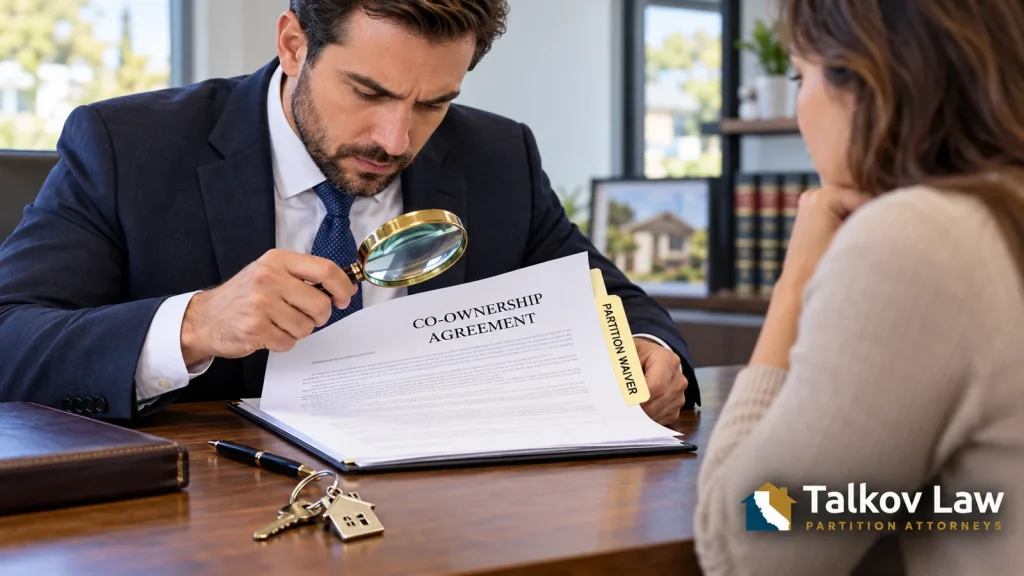
A waiver of the right to partition is an agreement in which co-owners give up their right to force a sale or division of the property they own together. California allows these waivers, but they are rare. Most co-owners never signed anything giving up the right, and the co-owner who claims a waiver has to prove it by clear and convincing evidence.
Is your co-owner claiming you waived your right to partition? A valid waiver is extremely rare. Get a free 30-minute consultation or call (877) PARTITION (727-8484). No fees until you win.
That matters if you want out of a co-owned property and your co-owner insists you agreed to stay. In most cases the claim does not hold up, and the partition action moves forward.
What Is a Waiver of the Right to Partition?
Every co-owner of California real estate can end the co-ownership through a partition action. Courts call this an absolute right to partition. The statute names only one way to lose it, a waiver:
“partition as to concurrent interests in the property shall be as of right unless barred by a valid waiver.”
California Code of Civil Procedure section 872.710(b)
The Court of Appeal said the same thing in Orien v. Lutz (2017) 16 Cal.App.5th 957, 962: “A co-owner of property has an absolute right to partition unless barred by a valid waiver.”
A waiver means giving up a known right on purpose. In partition cases, it comes from an agreement between the co-owners: “[T]he right of partition may be waived by contract, either express or implied.” (LEG Investments v. Boxler (2010) 183 Cal.App.4th 484, 493, quoting American Medical International, Inc. v. Feller (1976) 59 Cal.App.3d 1008, 1014.) An express waiver says so in words. An implied waiver is one a court reads into an agreement because a partition would defeat the agreement’s purpose.
Does a Co-Ownership Agreement Waive the Right to Partition?
Only if it says so, or if its terms clearly cannot work alongside a partition. Most co-owners never sign a co-ownership agreement at all. Siblings who inherit a house, couples who buy together, and parents who go on title to help a child usually just take title on a deed, so there is no agreement to point to.
Written agreements are more common when unrelated buyers share one building under a tenancy in common agreement, often with each owner living in a separate unit. Some of those agreements limit partition. Even then, the court reads the actual words of the agreement.
An agreement about running the property is not enough. In Heber v. Yaeger (1967) 251 Cal.App.2d 258, 263, one agreement let both owners possess and operate the land, and a later letter gave up one owner’s income from a citrus ranch while the other ran it. Neither waived partition, because neither clearly showed an intent to restrict the property to a use that ruled partition out.
The Court of Appeal has told drafters to be clear: “the wise drafter of an agreement among co-owners of property will include language making clear no such waiver is intended.” (Orien v. Lutz (2017) 16 Cal.App.5th 957, 962–963.) We agree. A tenancy in common agreement should state plainly that the right to partition is not waived.
Does a Right of First Refusal Waive Partition?
No. A right of first refusal requires a co-owner who wants to sell to offer their share to the other co-owners first. In LEG Investments v. Boxler (2010) 183 Cal.App.4th 484, two families held a Lake Tahoe vacation home under a tenancy in common agreement with a right of first refusal. The trial court treated that clause as a waiver of partition. The Court of Appeal reversed.
The clause added a step but did not take away the right. The co-owner who wanted out first had to offer its share to the other side on the agreement’s terms. It did, the other side declined, and the partition could go forward. As the court explained, “The policy behind a partition action is to permanently end all disputes about property and to remove all obstructions to its free enjoyment.” (LEG Investments v. Boxler (2010) 183 Cal.App.4th 484, 497.)
For more, see the right of first refusal in a California partition action.
Who Has to Prove a Waiver of Partition?
The co-owner who claims it. Waiver is the intentional giving up of a known right after learning the facts. The California Supreme Court set a high bar for anyone claiming a waiver of a right:
“The burden … is on the party claiming a waiver of a right to prove it by clear and convincing evidence that does not leave the matter to speculation, and ‘doubtful cases will be decided against a waiver’ [citation].”
Waller v. Truck Ins. Exchange, Inc. (1995) 11 Cal.4th 1, 31
The court in Waller v. Truck Ins. Exchange, Inc. (1995) 11 Cal.4th 1 was quoting City of Ukiah v. Fones (1966) 64 Cal.2d 104, 107–108, and it later modified its opinion on denial of rehearing (Oct. 26, 1995). Later courts have repeated the same rule, including Rosenberg-Wohl v. State Farm Fire and Casualty Company (2023) 93 Cal.App.5th 436, 455, and Quach v. California Commerce Club, Inc. (2024) 16 Cal.5th 562, 584, both quoting Waller v. Truck Ins. Exchange, Inc. (1995) 11 Cal.4th 1, 31.
Clear and convincing evidence is a higher standard than the usual rule in civil cases, which asks only what is more likely true. A vague memory of a conversation, a family understanding, or the fact that one co-owner has lived in the house for years falls well short of it.
The standard matters even more when the right at stake is one the law favors. The clear and convincing evidence standard “is particularly apropos in cases in which the right in question is one that is ‘favored’ in the law….” City of Ukiah v. Fones (1966) 64 Cal.2d 104, 107–108. Partition is such a right: “Partition is a remedy much favored by the law.” LEG Investments v. Boxler (2010) 183 Cal.App.4th 484, 493.
Courts apply this standard in partition cases. In Yang v. Li, an unpublished 2026 opinion, the co-owners of a Ventura County home had signed a written agreement for one to buy the other’s half for $420,000, but the purchase never closed. The co-owner living in the house argued that the agreement, and an earlier oral understanding that either owner could buy the other out at the original price, waived partition. The trial court found he had not proved a waiver by clear and convincing evidence, and the Court of Appeal affirmed the partition by sale. It explained that the written agreement did not prohibit partition, and that the oral understanding was superseded by the later written agreement and, as an option to buy real property, was unenforceable under the statute of frauds. (Yang v. Li (Aug. 17, 2026, B346169) 2026 WL 2388063, at pp. *1, *3–*4 [nonpub. opn.].)
Another unpublished 2026 opinion shows how hard a waiver is to prove. In Bel Air K.A., LLC v. 5 Sites, Inc., the majority owners of a 10-story office building in downtown Los Angeles claimed the minority owner had waived partition in a partnership agreement and through an oral understanding that major decisions needed the consent of two of the three owners. At trial they could produce only an unsigned copy of the agreement, and the trial court rejected the oral understanding under the statute of frauds. The Court of Appeal affirmed the partition. It said it was “inclined to agree” with the trial court that a waiver must be proved by clear and convincing evidence, but did not need to decide the point because the owners claiming a waiver had not proved it even by a preponderance of the evidence. (Bel Air K.A., LLC v. 5 Sites, Inc. (Feb. 17, 2026, B339859) 2026 WL 452397, at pp. *1, *5 [nonpub. opn.].)
Can You Accidentally Waive the Right to Partition?
No. A waiver cannot happen by accident, because it requires intent. The California Supreme Court explained what a waiver takes:
“‘Waiver’ means the intentional relinquishment or abandonment of a known right. Waiver requires an existing right, the waiving party’s knowledge of that right, and the party’s actual intention to relinquish the right. Waiver always rests upon intent. The intention may be express, based on the waiving party’s words, or implied, based on conduct that is so inconsistent with an intent to enforce the right as to induce a reasonable belief that such right has been relinquished.”
Lynch v. California Coastal Com. (2017) 3 Cal.5th 470, 475 (citations and quotations omitted)
So a co-owner who never knew they had a right to partition, or never meant to give it up, has not waived it. An offhand remark, a promise to “keep the house in the family,” or years of letting a sibling live there does not add up to an intentional surrender of a known right, and the co-owner claiming waiver still has to prove it by clear and convincing evidence.
In the more than 650 partition actions Talkov Law has handled, a claimed oral waiver almost never comes up, and claims that a co-owner gave up partition by moving out, by abandoning the house, or through a general plan to buy a home together are almost always rejected. When a waiver does exist, it is usually a written, unambiguous term in an agreement among the co-owners, such as a tenancy in common agreement.
When Have Courts Found an Implied Waiver of Partition?
Rarely, and only in a few kinds of arrangements. The published cases share a pattern: a specific agreement between the co-owners, tied to a defined period or condition.
- Pine v. Tiedt (1965) 232 Cal.App.2d 733, 739–740: investors bought shares of land leased long term to a company that ran a sanitarium. Partition was barred until the existing leases ended.
- Penasquitos, Inc. v. Holladay (1972) 27 Cal.App.3d 356, 359: two brothers gave a developer a 99-year lease and an option to buy their San Diego land, with rent and the purchase price shared by each brother’s interest. Partition was denied because it would substantially impair those contract rights.
- Thomas v. Witte (1963) 214 Cal.App.2d 322, 331: co-owners signed operating agreements to develop their oil leases as a unit. Partition was barred while those agreements were in effect.
- Miranda v. Miranda (1947) 81 Cal.App.2d 61, 68: a divorce settlement kept the family home in both names while the former wife lived there with the children and did not remarry. The court held that this arrangement “constitutes a waiver of the right of either party to a partition during the prescribed period.”
Each waiver grew out of a deliberate agreement, and most were temporary. None involved co-owners who simply bought or inherited a home together. In LEG Investments v. Boxler (2010) 183 Cal.App.4th 484, 497, the court refused to read an implied waiver into an ordinary right of first refusal because that reading would defeat the policy of ending co-ownership disputes.
Does the Partition of Real Property Act Change the Rules on Waiver?
The Partition of Real Property Act applies to partition actions filed on or after January 1, 2023, for real property held as tenants in common. Under California Code of Civil Procedure section 874.311(b) (CCP 874.311(b)), the Act applies where “there is no agreement in a record binding all the cotenants which governs the partition of the property.” A record means a written or electronic document, so when no such document governs partition, the Act’s appraisal and buyout procedures apply. The Act defines a record in Code of Civil Procedure section 874.312(d) as “information that is inscribed on a tangible medium or that is stored in an electronic or other medium and is retrievable in perceivable form.”
That matters when a co-owner claims you gave up partition by a handshake, a family understanding, or years of living with the arrangement, with nothing in writing. Without a written or electronic agreement that binds every co-owner and governs partition, the Act applies, and its procedures lead to a court-set buyout or a sale, not to keeping the co-ownership in place. A waiver claim with no writing behind it runs against the structure of the statute.
Pleading Requirements for Waiver of Partition
Waiver is an affirmative defense, so the co-owner who raises it must plead it in their answer, with facts. As the Court of Appeal put it, “[t]he facts showing the affirmative defense of waiver must be pleaded.” (Aetna Casualty & Surety Co. v. Richmond (1977) 76 Cal.App.3d 645, 653.)
A one-line defense is not enough. In one case, the answer alleged only that the plaintiff’s claims were “barred in whole or in part by the doctrine of waiver,” and the Court of Appeal held that such an “affirmative defense consist[s] of legal conclusions that could survive neither a demurrer nor a motion for judgment on the pleadings.” (Westly v. California Public Employees’ Retirement System Bd. of Administration (2003) 105 Cal.App.4th 1095, 1118.)
To plead a waiver of partition, the co-owner must allege the facts that make up the waiver, including how it happened: in a writing, orally, or by conduct. For example, a waiver was sufficiently shown by a “written agreement that provided that one party would not sell his one-half interest without giving the other coowner the right to purchase it at a price not in excess of the original purchase price.” (American Medical International, Inc. v. Feller (1976) 59 Cal.App.3d 1008, 1014.) Few co-owners can point to facts like these.
What If Your Co-Owner Says You Waived Partition?
Start with one question: where is the agreement? If your co-owner cannot point to a signed document that gives up partition, or a specific arrangement like the ones above, the claim is unlikely to stop the case.
Some defendants list waiver as a boilerplate defense with no facts behind it, and those defenses can be challenged early in the case. Courts have also rejected the argument that a partition should be denied because a sale seems unfair to the co-owner who wants to stay. If you are worried about something you said or signed, see whether you can waive partition by accident above.
Talk to a California Partition Attorney
If your co-owner is holding up a sale by claiming you waived partition, Talkov Law can help. With 12 full-time partition attorneys and experience in over 650 partition actions throughout California, our team handles every step, from filing through the sale and the division of the proceeds. Call (877) PARTITION (727-8484) today or contact us online to get started.








