

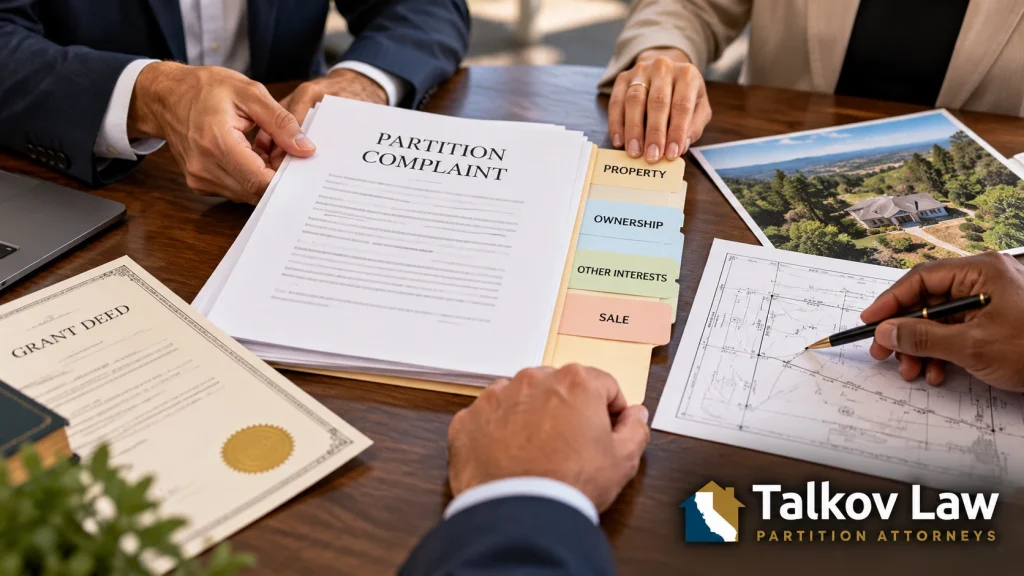
California Code of Civil Procedure section 872.230 (CCP 872.230) lists what the complaint in a partition action must contain: a description of the property, the plaintiff’s own interests, the other interests the case will affect, the estate to be partitioned, and, when the plaintiff wants the property sold, the facts that justify a sale. The section is part of the California partition statutes that govern starting the case, and our sample partition complaint shows how each item is pleaded.
Full Text of CCP 872.230
The statute provides:
The complaint shall set forth:
California Code of Civil Procedure section 872.230 (added by Statutes 1976, chapter 73)
(a) A description of the property that is the subject of the action. In the case of tangible personal property, the description shall include its usual location. In the case of real property, the description shall include both its legal description and its street address or common designation, if any.
(b) All interests the plaintiff has or claims in the property.
(c) All interests of record or actually known to the plaintiff that persons other than the plaintiff have or claim in the property and that the plaintiff reasonably believes will be materially affected by the action, whether the names of such persons are known or unknown to the plaintiff.
(d) The estate as to which partition is sought and a prayer for partition of the interests therein.
(e) Where the plaintiff seeks sale of the property, an allegation of the facts justifying such relief in ordinary and concise language.
What CCP 872.230 Requires in a Partition Complaint
The complaint tells the court and every other party what property is at stake, who holds what, and what the plaintiff wants done with it. Section 872.230 requires five things:
- The property. Real property is described by both its legal description and its street address or common designation, if it has one. Tangible personal property, such as a vehicle or equipment, is described with its usual location. Real and personal property may be joined in one action under CCP 872.240.
- The plaintiff’s interests. Every interest the plaintiff has or claims, including a lien the plaintiff holds in addition to an ownership interest. CCP 872.210 sets out which interests allow a person to file.
- Other people’s interests. Every interest of record, or actually known to the plaintiff, that the plaintiff reasonably believes the case will materially affect, whether or not the plaintiff knows the holders’ names. CCP 872.510 governs who must be joined as defendants, and CCP 872.520 covers what the complaint says when a name or interest is unknown.
- The estate and the request. Which estate is to be partitioned, such as full ownership or a life estate, and a request that the court partition the interests in it.
- Facts justifying a sale. If the plaintiff asks for a partition by sale rather than a physical division, the facts that justify a sale, stated in ordinary and concise language.
A title report under CCP 872.220 is the usual way to find the recorded interests, and the court later ascertains the state of the title before it rules.
The Law Revision Commission Comment on CCP 872.230
The California Law Revision Commission recommended the partition statutes the Legislature enacted in 1976. Its comment on section 872.230 reads:
Section 872.230 is new. In addition to the information required by this section, other information may be necessary. See, e.g., Section 872.220 (information relating to title report).
Subdivision (a) requires a description of the property that is the subject of the action. It should be noted that several properties may be joined in one complaint even though located in different counties. See, e.g., Murphy v. Superior Court, 138 Cal. 69, 70 P. 1070 (1902). And, real and personal property may be joined in one action. Section 872.240. As to joinder of property under varying ownership, see Middlecoff v. Cronise, 155 Cal. 185, 100 P. 232 (1909).
Subdivision (b) requires an allegation of all the plaintiff’s interest in the property. For interests sufficient to maintain the action, see Section 872.210. Where the plaintiff has a lien on the property as well as an interest sufficient to maintain the action, he must allege his lien as well as his other interest.
Subdivision (c) supersedes the first portion of former Section 753. Unlike the former provision that required all interests to be set out regardless of whether the interests would be affected, subdivision (c) limits the requirement to only those interests the plaintiff reasonably believes will be materially affected by the partition action. Incorporation of a title report should be sufficient to satisfy this requirement as to recorded interests but not as to unrecorded interests known to the plaintiff. It should be noted that there may be interests of record in personal property filed to perfect a security interest under the Commercial Code. Partition of some or all of the interests in the property may be obtained.
Subdivision (d) requires the plaintiff to indicate which estate or estates are intended to be affected by the action. The estates in real property include estates of inheritance, for life, and for years. Civil Code § 761. For provisions relating to parties defendant, see Article 4 (commencing with Section 872.510).
Subdivision (e) requires an allegation of facts justifying a sale of the property where the plaintiff seeks sale. Should the plaintiff fail to seek sale at the time of filing the complaint, he may do so thereafter by amending the complaint subject to the general rules governing amendment. See Sections 471.5, 472, and 473. The defendant may request sale by appropriate pleading in the answer. See Section 872.410.
California Law Revision Commission Comment to Code of Civil Procedure section 872.230 (1976)
Common Questions About CCP 872.230
Does the Complaint Have to Specify the Manner of Partition?
No. The California Supreme Court held in De Uprey v. De Uprey (1865) 27 Cal. 329, 331, that “the manner in which the partition is to be made constitutes no part of the cause of action, but is merely a part of the relief.” The court added that while it is proper to ask for a particular mode of partition, “this is not indispensable, and a complaint which is silent upon the subject is good.”
The current statute keeps that structure. Subdivision (d) requires the estate to be partitioned and “a prayer for partition,” not a choice between a division and a sale, and the court sets the manner of partition in the interlocutory judgment under CCP 872.720. The one addition since 1865 is subdivision (e): a plaintiff who wants the property sold must allege the facts that justify a sale.
Does the Complaint Have to Ask for a Sale?
No. Every complaint must include a prayer for partition under subdivision (d), but it does not have to ask for a sale. A plaintiff may ask only for a partition in kind, a physical division of the property. A plaintiff who wants a sale must allege the facts that justify one under subdivision (e), and a plaintiff who did not ask at first may add the request later by amending the complaint, following the general rules for amending pleadings in sections 471.5, 472, and 473. Amendment is not automatic: before the defendant responds, a plaintiff can usually amend once without the court’s permission, but after that the plaintiff generally needs the other side’s agreement or the court’s permission. A defendant may also request a sale in the answer, by alleging the facts that justify it, under CCP 872.410. Either way, the pleadings only make the request. The court decides the manner of partition and states it in the interlocutory judgment under CCP 872.720.
Who Has to Be Named in the Complaint?
Subdivision (c) reaches every interest of record or actually known to the plaintiff that the case will materially affect, so the co-owners, and often lienholders, belong in the complaint. Our post on whether to name a lender in a partition action covers mortgage holders, and CCP 872.550 allows the plaintiff to join all persons unknown who claim an interest in the property.
What If a Co-Owner Cannot Be Found?
The complaint still names that co-owner and describes the interest. Service of the summons then follows CCP 872.310 and the rules for service by publication in CCP 872.320. Our post on filing a partition action when a co-owner cannot be reached walks through the steps.
Where CCP 872.230 Fits in the California Partition Statutes
Section 872.230 is in the article on the complaint and notice of pending action. It follows CCP 872.210 on who may file and CCP 872.220 on the title report, and it comes before CCP 872.240 on joining real and personal property and CCP 872.250 on recording a notice of pending action. The defendant’s answer is governed by CCP 872.410. Once every party is before the court, it issues an interlocutory judgment under CCP 872.720 that determines each party’s interest and orders the partition.
Talkov Law Partition Attorneys Can Help
A complaint that names the right property, the right parties, and the right relief from the start keeps a partition from stalling over an amendment or a missed interest.
Talkov Law can help. With 12 full-time partition attorneys and experience in over 650 partition actions throughout California, our team handles every step of the process, from drafting the partition complaint through the partition sale and the final distribution of proceeds. Call (877) PARTITION (727-8484) today or contact us online to get started.








