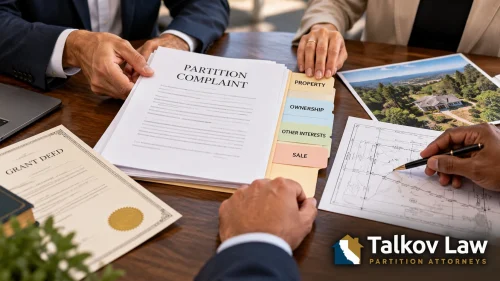
A co-owner who does not want to sell can file challenge after challenge, but that does not stop a partition. In De Uprey v. De Uprey (1865) 27 Cal. 329, 331–337, the California Supreme Court affirmed the sale of a small co-owned San Francisco lot after the defendants filed five demurrers, moved to dismiss the case without a trial, and disputed the plaintiff’s ownership at every step. Along the way, the court set out four rules that still shape every California partition action: the complaint does not have to explain why the property cannot be split, everyone claiming an interest belongs in the case, ownership disputes are decided inside the partition, and a plaintiff who guesses wrong about the other owners’ shares still gets a partition.
Why De Uprey v. De Uprey Matters
Many partition fights are not about whether the property should be sold. They are about paperwork: whether the complaint said enough, whether the right people were named, and whether an ownership dispute belongs in some other lawsuit. De Uprey is one of California’s earliest answers to those arguments, and the answer favored the co-owner who wanted out. The court treated the defendants’ objections as obstacles to the case rather than reasons to end it, and the plaintiff left with an order of sale.
The Facts: A 23-Foot Lot on a San Francisco Alley
Elizabeth De Uprey sued Samuel De Uprey for partition of a lot and its improvements in San Francisco. The lot fronted on an alley and measured, in the court’s words, “only twenty-three feet front and extending back sixty.” (De Uprey, at p. 332.) Samuel’s wife, Mary Ann De Uprey, was later added to the case. She claimed a homestead right and claimed to own the entire legal title. The trial court found that she held legal title to an undivided half. (De Uprey, at p. 332.)
The trial court ordered the property sold and the money divided, because it could not be divided “by metes and bounds,” meaning by drawing physical boundary lines, without prejudice to the owners. The defendants appealed. The California Supreme Court took up each of their arguments in turn and affirmed. (De Uprey, at pp. 331, 337.)
The Complaint Did Not Have to Explain Why the Lot Could Not Be Divided
Samuel first filed a demurrer, a request to throw out the complaint because it does not state a valid claim. (Our post on demurrers explains how they work.) He argued the complaint only said generally that the property could not be divided without prejudice, without stating the facts showing why.
The court rejected the argument. It held that “the manner in which the partition is to be made constitutes no part of the cause of action, but is merely a part of the relief.” Asking for a particular kind of partition is proper, the court said, but “this is not indispensable, and a complaint which is silent upon the subject is good.” (De Uprey, at p. 331.) The court added that whether property can be physically divided is the ultimate fact to be decided, so the background facts did not have to be pleaded. In any event, the lot’s size alone showed that dividing it would be difficult. (De Uprey, at p. 332.)
Today, Code of Civil Procedure section 872.230 (CCP 872.230) keeps that structure with one addition. Under CCP 872.230(d), the complaint must include a request for partition, not a choice between division and sale. But under CCP 872.230(e), a plaintiff who asks for a sale must allege the facts justifying a sale “in ordinary and concise language.” The court then decides the manner of partition in the interlocutory judgment under CCP 872.720’s rule on the interlocutory judgment of partition. Our sample partition complaint shows how those facts are pleaded.
The standard for a sale has also changed. In 1865, a sale required proof that division would cause great prejudice to the owners. Under CCP 872.820’s rule on sale of the property, the court orders a partition by sale when the parties agree or when a sale would be more equitable than physical division. Cases such as Sting v. Beckham and Butte Creek Island Ranch v. Crim explain the evidence that supports a sale.
Everyone Who Claims an Interest Belongs in the Case
After the first demurrer failed, the court allowed Elizabeth to bring Mary Ann into the case through a supplemental complaint. Samuel objected. The Supreme Court called the objection frivolous: Mary Ann claimed to own the property, so she was a necessary party. The court explained that “[a]ll persons having or claiming any interest in the land are not only proper but necessary parties to a suit for partition,” and that refusing to add her would have been error. (De Uprey, at pp. 332–333.)
The same principle runs through the current statutes. CCP 872.510’s rule on joinder of defendants governs who must be named, and our post on whether to name a lender in a partition action covers mortgage holders. Naming every claimant up front means the judgment binds everyone, and the property can be sold with clear title.
Five Demurrers and a Motion to Dismiss Did Not Stop the Case
Once Mary Ann was added, both defendants demurred again, arguing that she was wrongly joined, that separate claims had been improperly combined, and that the complaint still did not state a claim. The court found these demurrers frivolous as well, noting that the complaint stated only one claim and sought only one kind of relief. (De Uprey, at p. 333.)
The court observed that the case was “contested with a pertinacity worthy of a better cause.” After all five demurrers had been overruled and both defendants had answered, their lawyer asked the court to dismiss the case on the pleadings without a trial. The court rejected that request too, explaining that an answer, without evidence, deserves no more belief than a complaint. (De Uprey, at pp. 333–334.)
Samuel also argued that he had disclaimed any interest in the land, so the case against him should end. But he had disclaimed only his interest beyond a homestead right, while denying the plaintiff’s title and claiming his wife owned the property. The court held that only an absolute, unconditional disclaimer would do, and that “[i]t is a misnomer to call such an answer a disclaimer.” (De Uprey, at p. 334.) As for homesteads today, Priddel v. Shankie explains that a co-owner’s homestead on their own share cannot stop a court-ordered sale.
Ownership Disputes Are Decided Inside the Partition
Mary Ann’s answer raised six questions, including whether the plaintiff owned any interest, whether Mary Ann owned the whole property, and whether the plaintiff had been in possession. The defendants argued that those questions belonged in a separate lawsuit to recover possession or to quiet title, so the partition should be dismissed. The court disagreed: “Any question affecting the right of the plaintiff to a partition, or the rights of each and all of the parties in the land, may be put in issue, tried and determined in such action.” (De Uprey, at p. 335.)
That is still the law. Under CCP 872.610’s rule on trying the interests of all parties, every party’s interest may be put in issue and decided in the partition, and under CCP 872.620’s rule on the state of the title, the court determines the state of the title as needed to grant relief. A co-owner seeking a sale usually does not need to file a separate quiet title action first.
The complaint alleged that Samuel owned the other half, but the trial court found that Mary Ann did. The defendants argued that because the findings did not match the complaint, the judgment had to be reversed. The court noted that this was essentially the same argument it had already rejected twice.
The court held that a plaintiff does not lose the right to partition because the plaintiff was mistaken about how the co-owners hold title. What matters is that the parties are co-owners. Their exact shares are decided according to the evidence, and “[t]he partition follows all the same, and is to be made according to the finding.” (De Uprey, at pp. 335–336.) Under current law, each defendant’s answer states the interest it claims under CCP 872.410’s rule on the contents of the answer, and the court declares each party’s interest in the interlocutory judgment of partition.
What De Uprey Means for Co-Owners Today
- The complaint asks for partition; the court picks the method. A complaint does not have to choose between division and sale. If you want a sale, current law requires you to allege the facts that justify it.
- Name everyone who claims an interest. A co-owner’s spouse, a person claiming title, or a lender may need to be in the case so the sale can close with clear title.
- Ownership fights do not require a second lawsuit. The court decides who owns what as part of the partition.
- Getting the other shares wrong is not fatal. The court divides the property or the sale money according to the evidence, not according to the plaintiff’s first guess.
- Repeated technical objections do not end the case. In De Uprey, five demurrers and a motion to dismiss only delayed the sale the court ultimately affirmed.
Facing a Co-Owner Who Fights Every Step?
A well-drafted complaint that names every claimant and asks for the right relief keeps a partition moving, even against a co-owner who contests everything. The right to partition is the same today as it was for Elizabeth De Uprey in 1865.
Talkov Law can help. With 12 full-time partition attorneys and experience in over 650 partition actions throughout California, our team handles every step of the process, from drafting the complaint through the partition sale and the final distribution of proceeds. Call (877) PARTITION (727-8484) today or contact us online to get started.