

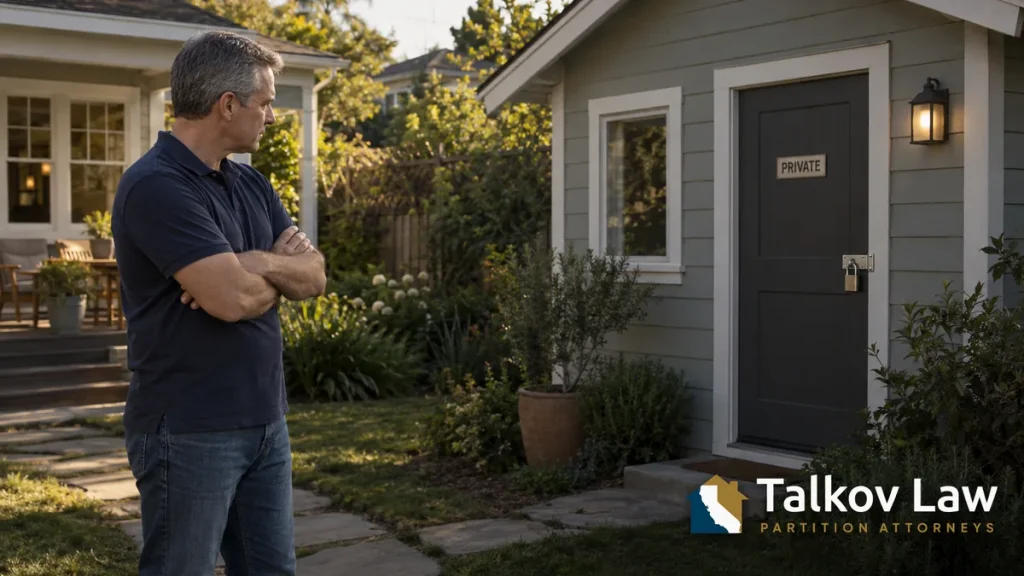
No, your co-owner does not get to claim part of the property as “their half.” In California, every co-owner has the right to use the whole property, so a co-owner who takes over the back house, one unit of the duplex, the garage or a fenced piece of the land and keeps you out of it may have committed an ouster. An ouster means they can owe you money for the use you lost. And a partition action lets you end the arrangement for good.
This is a common situation. Your sister lives in the main house and has put her own lock on the back unit. Your ex took the upstairs and told you to stay downstairs. Your brother fenced off the best part of the family land for his business. The explanation is always the same: “I own half, and I’m only using my half.”
You Own Half of Everything, Not Everything in One Half
Co-owners hold an undivided interest. A 50 percent owner owns half of every room, every unit and every square foot, not a particular side of the property. As the California Supreme Court put it:
“Each tenant in common equally is entitled to share in the possession of the entire property and neither may exclude the other from any part of it.”
Zaslow v. Kroenert (1946) 29 Cal.2d 541, 548
The rule is as old as California. In Carpentier v. Webster (1865) 27 Cal. 524, a co-owner fenced 60 acres of a shared rancho and refused to let another owner in, arguing that 60 acres was less than his share. The Supreme Court held that the refusal was an ouster, because before partition “a tenant in common has no share, except one which is undivided.” (Id. at p. 546.) The same rule protects every co-owner’s right to occupy the whole property today.
Courts still apply it. In two unpublished decisions from the last two decades, the California Court of Appeal reached the same result. In Mesbah v. Fallahi, an unpublished 2010 opinion, co-owners who kept their horses in a fenced pasture argued that the pasture was less than their half of the land. The court upheld an award of rental value to the owner they had shut out. (Mesbah v. Fallahi (Cal. Ct. App., July 12, 2010, No. C060689) 2010 WL 2725587 [unpublished].) In Sandore v. Ferguson, an unpublished 2007 opinion, a co-owner ran his business in part of a commercial building and leased the rest to another business. When the other owner’s written demand for shared possession went unanswered, the court found an ouster and awarded her rental value. (Sandore v. Ferguson (Cal. Ct. App., Oct. 29, 2007, Nos. G037379, G037922) 2007 WL 3138615 [unpublished].) Unpublished opinions cannot be cited as precedent in California courts, but these two show how judges handle this situation today.
When Occupying Part of the Property Becomes an Ouster
A co-owner who simply lives in one part of the property, while you remain free to use it too, has not ousted you and generally does not owe you rent just for being there. The line is crossed when they keep you out. Common examples:
- Changing or adding locks on a unit, a back house, a garage or a gate, and not giving you a key.
- Fencing off part of the land.
- Telling you that part of the property is theirs alone, or refusing when you ask to use it.
You do not have to argue about what was said at the door. Under Civil Code section 843, you can serve a written demand for shared possession. If your co-owner does not offer and provide unconditional shared possession within 60 days after the demand is served, an ouster is established.
What Your Co-Owner Can Owe You
- Rental value for the part you were kept out of. An ousted co-owner recovers damages that ordinarily equal “his share of the value of the use and occupation of the land from the time of the ouster.” (Zaslow, at p. 548.) In plain terms, that is your percentage of the fair rent for the space, for as long as you were shut out. Our article on collecting rental value from a co-owner explains how it is measured.
- Your share of any rent they collected. If your co-owner rented the unit (for example, the other side of a duplex) or the land to someone else, you are entitled to your share of that rent, even if they never kept you out, See what to do when a co-owner is collecting the rent and not paying you half. A co-owner “may maintain an action requiring his cotenant to account for rents collected for the use of the property by third persons.” (Rutledge v. Rutledge (1953) 119 Cal.App.2d 114, 120.) Living in another part of the property yourself does not change this, because a co-owner generally owes no rent for their own use of the property. (McWhorter v. McWhorter (1929) 99 Cal.App. 293, 296.) Your share is based on the rent actually collected, after your co-owner is credited for what they paid toward property taxes and necessary repairs. See our guide to a co-owner’s right to lease the property.
- An offset against what they claim from you. If your co-owner asks to be repaid for the mortgage, taxes or repairs, the court can set the value of their use of the property against those claims, as in Hunter v. Schultz.
These amounts are added up in the partition accounting. Under Code of Civil Procedure section 872.140 (CCP 872.140), the court in a partition action can order whatever adjustments between the co-owners are fair, and the money comes out of your co-owner’s share of the sale proceeds. That is CCP 872.140’s rule on compensatory adjustments.
Why You Should End the Co-Ownership
You could keep demanding access, or agree to live with “your side” and “their side.” Neither one solves the problem:
- An informal split is not ownership. Legally dividing one lot into two requires approval from the city or county under California’s Subdivision Map Act. An understanding between co-owners about who uses which part is not that approval, and it does not create two properties. You are still on title, and often on the loan, for the whole property, including the part you can’t use.
- You can’t sell “your part.” Because there is still only one property, neither of you can sell or refinance a side of it. All either of you can sell is an undivided share of the whole, and almost no one buys half a house at full value. The property has the same problems it had before you split it up.
- The damages keep running, and so does the fight. Every month adds to what you are owed and to what you will have to prove later.
- Waiting carries risk. An ouster can start the clock on a claim of adverse possession by the co-owner who shut you out. Don’t let one sit for years.
- You have the right to get out. Under Code of Civil Procedure section 872.710 (CCP 872.710), a co-owner is entitled to partition as a matter of right unless that right was waived. Your co-owner’s preference for their corner of the property does not change CCP 872.710’s right to partition.
A partition gives each owner something that is theirs alone. For a house, a duplex or a small lot, that almost always means a partition by sale, with the proceeds divided after the accounting. Larger land can sometimes be physically divided through a partition in kind. Either way, your co-owner can also buy you out at a fair price to avoid the sale.
Example: The Locked Back House in Long Beach
Say you and your sister inherited a house with a rentable back unit in Long Beach, half each. She lives in the main house, has put her own lock on the back unit, and uses it as a studio. When you ask for a key, she says the back unit is part of her half. You serve a written demand under Civil Code section 843. Sixty days pass with no key, so an ouster is established, and you file a partition action.
The property sells 18 months after the ouster for $1,000,000. About 5 percent ($50,000) goes to costs of sale, leaving $950,000, or $475,000 for each half. The back unit would rent for $2,000 a month, so your half of its rental value is $1,000 a month, or $18,000 for 18 months. That amount comes out of your sister’s share and goes to you: you receive $493,000, and she receives $457,000. These are illustrative numbers before attorney’s fees.
Stop Sharing a Property You Can’t Fully Use
Talkov Law can help. With 12 full-time partition attorneys and experience in over 650 partition actions throughout California, our team helps co-owners who have been shut out of part of their own property collect what they are owed and end the co-ownership. No fees until you win. Call (877) PARTITION (727-8484) or contact us online for a free 30-minute consultation.







