

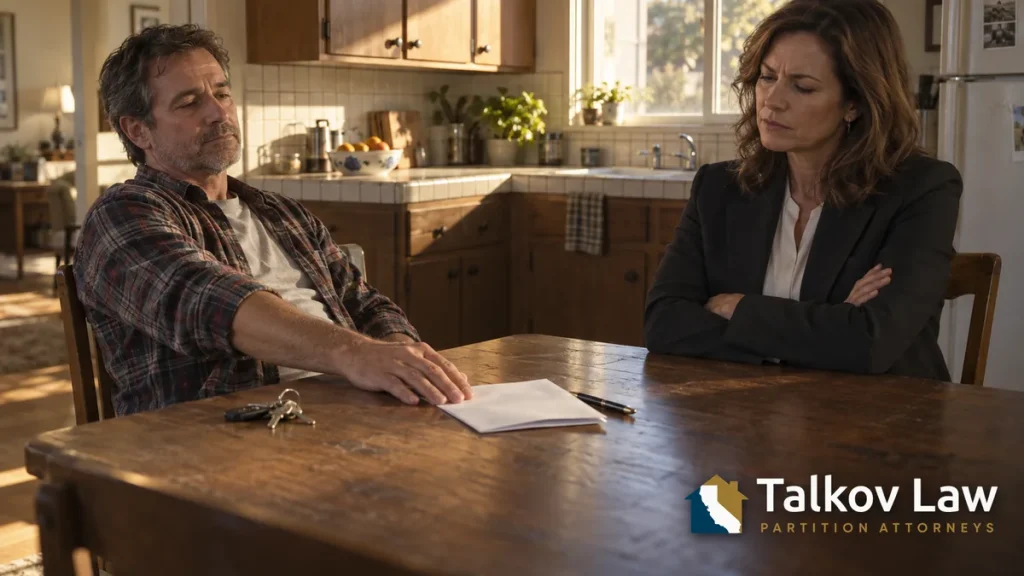
You do not have to accept a co-owner’s lowball buyout offer, and you do not have to sign over your share while they pay you over time. If you can’t agree on a fair price, a partition action puts a sale of the house on the table. Once that happens, most co-owners stop lowballing, and the buyout is negotiated at a fair price after the case is filed, without a trial. In California, “the right to partition is absolute.” Priddel v. Shankie (1945) 69 Cal.App.2d 319, 325.
Broken buyouts are one of the most common reasons people call us. A brother offers what the house was worth when Mom died. Your ex or partner wants to buy you out of the house for only what you spent on renovations. A business partner offers monthly payments for two years, as long as you sign the deed over now. The pattern is the same: the co-owner who wants to keep the property names a price and dares you to do better.
Your Co-Owner Can Buy You Out, but Not at Their Price
Your co-owner does not get to set the price just because they want to keep the property. Without your agreement, the only way for them to end up owning the whole house is to pay you a price you accept. If they won’t, any co-owner can ask the court to order the property sold and the money divided through a partition by sale. That is the real alternative to their offer, and it is the number a fair buyout should be measured against.
In some cases the law also gives a co-owner the option of a court-ordered buyout under the Partition of Real Property Act. That option is not available in every case, and in practice it sits in the background. Most buyouts are simply agreed between the co-owners once the case is underway.
Before you answer any offer, calculate what buying you out of the house should cost. The math has four steps:
- Start with the fair market value of the whole property today. Use an appraisal, not an online estimate, the purchase price, or the value when a parent died.
- Subtract the mortgage balance. What is left is the equity.
- Multiply the equity by your ownership share. See how to calculate your share in a partition if your shares are not equal.
- Add the credits your co-owner owes you, and subtract the credits you owe. If you paid more than your share of the mortgage, property taxes or insurance, your co-owner’s share of that money is added to your price.
Two things do not belong in the math. The first is a discount because you own “only half” of the house. In a partition sale the whole house is sold, so no one takes a discount for owning a share. The second is your co-owner’s own opinion of value. A co-owner who is keeping the house will also often try to subtract the costs of a sale that is never going to happen. Whether to accept any deduction like that is a negotiating point, not a rule.
The Co-Owner Buyout Appraisal: Who Decides What the House Is Worth?
Most lowball offers are really fights about value. No rule says your co-owner’s number wins. Co-owners usually agree on one licensed appraiser, or each hire one and average the two. If your co-owner refuses to do either, that tells you the offer was never meant to be fair.
Once a partition action is filed, the question gets easier. If no deal is reached, the house goes to a sale, often run by a court-appointed partition referee, and the open market decides the price. Because a partition sale usually brings fair market value, a co-owner who wants to keep the house has every reason to agree on a real appraisal instead.
An offer to pay you over time in exchange for the deed now is the most dangerous kind of lowball. Once you sign, you are no longer an owner. If the payments stop, you are an unsecured creditor chasing a relative or an ex, and you have lost the right to force a sale. Three rules protect you in any buyout:
- Get paid at closing. The deed and the money should change hands at the same moment, through an escrow for your co-owner buyout.
- Get off the loan. An offer that leaves your name on the mortgage is not a real buyout. See whether your co-owner can buy you out if you are on the mortgage.
- Get credit for what you paid. If you paid more than your share of the down payment, mortgage, taxes or repairs or improvements, that money comes back to you through partition offsets and credits under Code of Civil Procedure section 872.140 (CCP 872.140 on compensatory adjustments among co-owners). Your co-owner’s credits are decided the same way, not by subtracting them from their offer.
Example: Calculating a Fair Buyout Against a Lowball Offer
Say you and your brother each inherited half of your mother’s paid-off house in Orange County. He lives there and offers you $300,000, paid at $10,000 a month for 30 months, if you sign the deed over now. An appraiser values the house at $1,000,000 today. You have also paid $30,000 in property taxes and insurance by yourself since she died.
| Fair market value of the house | $1,000,000 |
| Mortgage balance | $0 |
| Your half of the equity | $500,000 |
| His half of the taxes and insurance you paid | $15,000 |
| Fair buyout of your share | $515,000, paid at closing |
| Your brother’s offer | $300,000, paid over 30 months |
These are illustrative numbers before attorney’s fees. Actual results depend on the facts of each case. The offer is $215,000 short, and it is not even paid up front. If the house were sold on the open market instead, about 5% in costs of sale would come off the top, and you would still receive about $490,000. A negotiated buyout usually lands somewhere in that range, because it saves both of you the costs of a sale.
Most Buyouts Are Negotiated After the Partition Action Is Filed
A lowball offer usually rests on one assumption: that you have no other option. Filing removes it. Once a partition action is on file, your co-owner knows the house will be sold if you can’t agree, so the negotiation starts from what a sale would bring instead of their number. In most of our cases, the buyout is worked out between the lawyers, out of court, after filing. There is nothing wrong with filing first and negotiating after, and you can settle a partition action at any point after filing. Learn more about how buying out a co-owner in California works, including what happens when a buyout falls apart.
Many co-owners think their co-owner is the only possible buyer for their share. Without a partition, that is nearly true, because almost no one else will buy half of a house. A partition action creates a market. The signature on the deed can now come from you, in a deal with your co-owner, or from the court, in a sale on the open market. That lets you ask two simple questions. Who is acting more reasonably, your co-owner or the judge? Where will you receive more money? If your co-owner’s offer beats what a sale would deliver, take it. If it does not, let the case go forward. We aim to keep the cost of a partition action low so that more of the outcome goes to you.
Based on Talkov Law’s completed-case data, the average partition action resolves in seven to nine months and costs about $20,000. See how long a partition action takes.
Turn Down the Lowball Offer and Negotiate From Strength
You do not have to choose between a bad offer and staying stuck. A partition action ends the co-ownership at full value, through a negotiated buyout or a sale, with credit for what each of you paid.
Talkov Law can help. With 12 full-time partition attorneys and over 650 partition actions handled throughout California, our team handles every step of the process, from responding to a lowball offer through negotiating the buyout or completing the sale and the final distribution of proceeds. There are no fees until you win. Call (877) PARTITION (727-8484) today or contact us online for a free consultation with a partition attorney.