

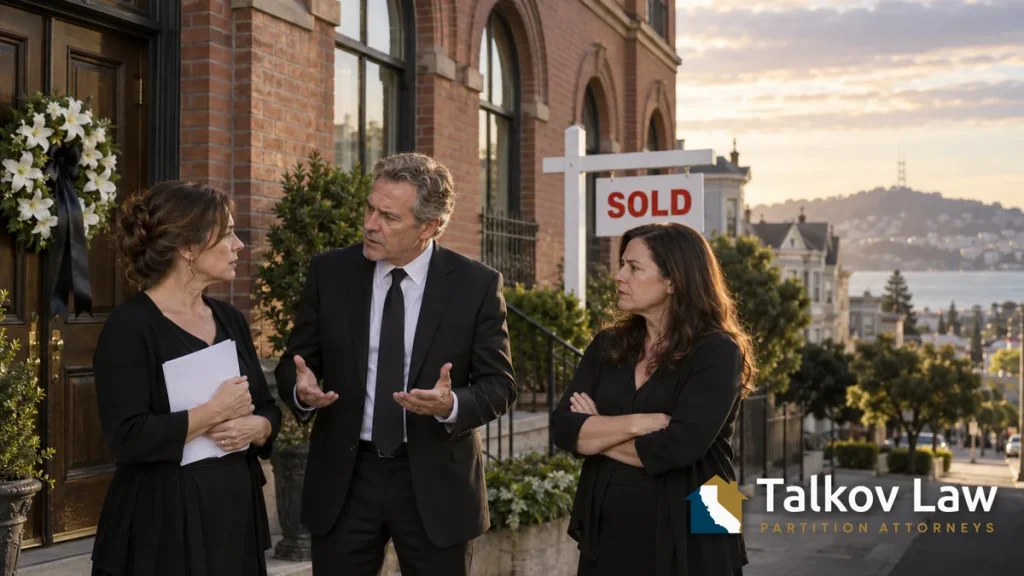

A co-owner’s death does not stop a California partition action, and neither does a fight among that co-owner’s heirs. In Grant v. Murphy (1897) 116 Cal. 427, the California Supreme Court affirmed a judgment ordering the sale of a San Francisco business building while the children of a deceased co-owner were still fighting over her will. The trial court set every owner’s share, including the one-fourth that belonged to the deceased co-owner’s estate, and left it to the probate court to decide which of her children would receive that one-fourth. The Supreme Court called that course “a proper and just one.” (Grant, at p. 433.)
This comes up whenever a co-owner dies and the family cannot agree on who inherits the share. Our guides on how to sell property after a co-owner dies and what happens if your co-owner dies during the case cover the steps. This post covers the case behind them and the statutes that apply today.
Why Grant v. Murphy Matters
- A co-owner’s death does not stop a partition. The surviving co-owner did not have to wait for the probate court before the property could be sold. (Grant, at p. 433.)
- The court sets the deceased co-owner’s share as a whole. The judgment fixed the estate’s share at one-fourth without deciding how the heirs would split it. (Grant, at p. 430.)
- The heirs’ fight stays in probate. While the estate is open and the contest is pending there, who inherits the share is a question for the probate court. (Grant, at p. 434.)
- Only the estate’s part of the money waits. The part of the sale proceeds that goes to the deceased co-owner’s successors waits for the probate court’s decision. (Grant, at p. 430.)
The Facts: A San Francisco Business Building and a Contested Will
Adam Grant and Daniel T. Murphy each owned an undivided half, as tenants in common, of a San Francisco city lot “upon which there is a large business building.” (Grant, at p. 428.) Murphy died on June 3, 1885. The probate court distributed his half under his will: six twenty-fourths of the whole property to his widow, Anna L. Murphy, and one twenty-fourth to each of six children. Two sons later conveyed their shares to Grant, making Grant the majority owner with fourteen twenty-fourths. (Grant, at pp. 428–429.)
Then the widow died. Three of her daughters claimed that her will left her one-fourth to them. Her sons and another daughter contested the will in Alameda County, where it had been admitted to probate. The contest had already been to the California Supreme Court once, and a second appeal was pending when the partition was decided. (Grant, at p. 429.)
In the partition, each of the three daughters claimed a third of the widow’s one-fourth, the children contesting the will each claimed a seventh, and the administrator claimed all of it for her estate. (Grant, at p. 429.) Everyone agreed on one thing: the building could not be divided and had to be sold. (Grant, at p. 428.)
The San Francisco Superior Court entered an interlocutory judgment (called an interlocutory decree at the time) that ordered a sale and set the shares as follows (Grant, at p. 430):
- Adam Grant: fourteen twenty-fourths
- Mary Helen Dominguez: one twenty-fourth
- Frances Josephine Murphy: one twenty-fourth
- Mary Margaret Isabella Murphy: one twenty-fourth
- The successors of Eugene K. L. Murphy, a son who had also died: one twenty-fourth
- The estate of Anna L. Murphy, deceased: six twenty-fourths
The judgment did not say which of the widow’s children owned her one-fourth. It left that “to the probate court, where the administration of said estate is pending, to determine how it should be distributed.” (Grant, at p. 430.) The three daughters and the administrator appealed, arguing that a partition judgment is invalid unless it determines exactly who is entitled to a deceased co-owner’s share, and in what proportions, before the property is sold. (Grant, at p. 430.)
How the Supreme Court Decided the Case
The court began with the rule behind the appeal: “a decree which does not adjudicate the interests of the respective parties is invalid.” (Grant, at p. 431.) That is still the law. In Summers v. Superior Court (2018) 24 Cal.App.5th 138, the Court of Appeal held that ownership shares must be decided before a partition sale is ordered. But none of the Supreme Court’s earlier cases, including De Uprey v. De Uprey (1865) 27 Cal. 329, involved a deceased co-owner whose heirs were fighting over the share in probate. (Grant, at p. 432.)
Here, every share had been “definitely settled” except the split among the people claiming the widow’s interest, and the size of her interest was itself “definitely determined.” (Grant, at pp. 431–432.) The other owners had no control over the probate case, and more owners could die while everyone waited. (Grant, at p. 433.) The court asked the question every surviving co-owner asks, and answered it:
“Must they wait until proceedings which they cannot hasten have terminated in the probate court, and which might remain there unsettled for many years? or may they proceed to a division, leaving the contestants to a particular interest to settle their claims among themselves in the proper court? We think that the latter course is a proper and just one, and within the general scope of the law and the jurisdiction of the court, at least where there is to be a sale of the entire premises and a deposit of the proceeds in court.”
Grant v. Murphy (1897) 116 Cal. 427, 433
The court limited that holding to a sale with the proceeds deposited in court. It did not decide whether the same rule applies when land is physically divided in a partition in kind. (Grant, at p. 433.)
The Heirs’ Dispute Belongs in the Probate Court
The partition court could not have decided the will contest anyway. While the estate was being administered and the contest was pending there, the power to decide who took the widow’s share was “in the probate court.” (Grant, at p. 434.) Because the trial court had decided everything within its power, the Supreme Court held that a judgment of sale “leaving the rights of said contesting claimants to be determined in the court having jurisdiction thereof, is proper; is warranted by the general law of partition, and is not violative of any provision of the code.” (Grant, at p. 434.)
The Result
The Supreme Court affirmed. (Grant, at p. 435.) The sale could go forward, and the estate’s part of the proceeds would wait for the probate court to decide which of the widow’s children took it.
The Statutes on Deceased Co-Owners in a Partition Today
Grant v. Murphy was decided under an earlier version of the law. The current California partition statutes, enacted in 1976, carry the same ideas forward and add a procedure for naming a deceased co-owner’s estate or heirs as defendants:
- Naming the estate or the heirs. Under Code of Civil Procedure section 872.530, when a co-owner has died, you name the personal representative (the executor or administrator) as a defendant. When you know of none, you file an affidavit and name “the testate and intestate successors” of the deceased co-owner.
- Suing the estate. Probate Code section 9823 provides that when a person dies owning an undivided interest in property, “an action for partition of the property may be brought against the personal representative.”
- Serving heirs you cannot identify. Successors named that way under CCP 872.530 are served by publication under CCP 872.310’s rule on serving the summons. See our guide to service by publication.
- Treating unknown owners as a group. Under CCP 872.640 on unknown parties’ interests, the court may consider the interests of two or more unknown parties “together in the action and not as between each other.” That section continues the exception in former section 759 that the court quoted in Grant. (Grant, at p. 433.)
- Setting shares in stages. Under CCP 872.720’s rule on the interlocutory judgment of partition, when it is “impracticable or highly inconvenient” to determine every party’s interest in one judgment, the court may first set the shares of the original co-owners, then turn to the people claiming under them.
- Holding the contested share of the proceeds. Under CCP 873.810 on disbursing sale proceeds, the court can order proceeds “deposited in court, placed in trust, or invested” for the persons entitled to them. CCP 873.850 on unallocated proceeds continues the former section 774 discussed in Grant: when proceeds have not been allocated among the parties, the case continues between those parties to decide their claims. See how the proceeds are divided.
What Grant v. Murphy Means for California Co-Owners
- You do not have to wait for probate. If your co-owner has died, you can file a partition action against the estate’s personal representative or, when you know of none, against the deceased co-owner’s successors. Our sample affidavit regarding the death of a co-owner shows the filing that CCP 872.530 requires.
- A will contest is not your problem. The Murphy children’s contest was on its second appeal, and the sale was ordered anyway. For the same reason, the answer to whether all heirs have to agree to sell is no.
- Name everyone at the start. Joining the personal representative, the known heirs, and any unknown successors means the judgment binds all of them under CCP 874.210 on who is bound by a partition judgment, and the property can be sold with clear title.
Co-Owner Died and the Heirs Are Fighting? You Can Still Force the Sale
Grant v. Murphy was decided in 1897, and the current statutes are built the same way: you do not have to sit on a property while a deceased co-owner’s family sorts out who inherits. If the property was inherited, our inherited property partition attorney page explains how these cases work.
Talkov Law can help. With 12 full-time partition attorneys and experience in over 650 partition actions throughout California, our team handles partitions involving deceased co-owners, from the affidavit and service by publication through the sale and the final distribution of proceeds. Call (877) PARTITION (727-8484) today or contact us online to get started.







