

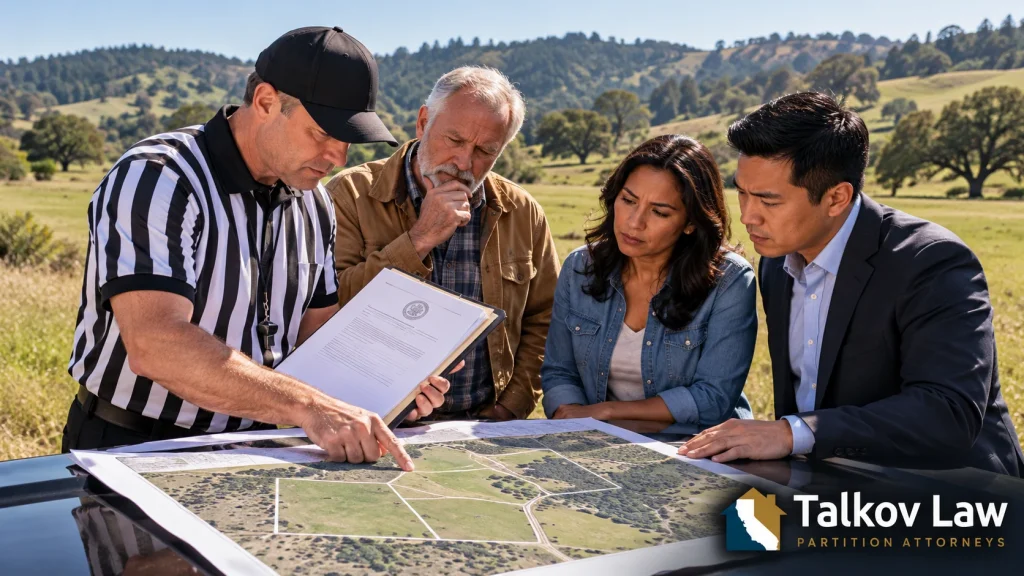
California Code of Civil Procedure section 872.810 (CCP 872.810) sets the starting rule for how a court divides co-owned property in a partition action: the property is divided among the co-owners according to the shares fixed in the interlocutory judgment of partition. This is the law’s preference for physical division, or partition in kind, and it is one of the California partition statutes on the manner of partition.
Full Text of CCP 872.810
The statute provides:
The court shall order that the property be divided among the parties in accordance with their interests in the property as determined in the interlocutory judgment.
California Code of Civil Procedure section 872.810 (added by Statutes 1976, chapter 73)
What CCP 872.810 Means in a Partition Action
- Division in kind is the default. Unless another statute applies, the court orders the property physically divided rather than sold.
- Shares come from the interlocutory judgment. Each co-owner receives a portion that matches the interest the court found in the interlocutory judgment under section 872.720.
- Sale is the main exception. Under CCP 872.820, the court orders a sale when the parties agree or when a sale would be more equitable than division.
- Other paths exist. The court may sell part and divide the rest under CCP 872.830, may sell property held in an express trust under CCP 872.840, and the parties may agree to partition by appraisal under CCP 873.910.
- A referee does the dividing. When division is ordered, the court appoints a partition referee under CCP 873.010 to divide the property.
In partition actions governed by the Partition of Real Property Act, the court also weighs the factors in CCP 874.319 when choosing between division and sale.
Law Revision Commission Comment
Section 872.810 continues the preference of prior law for partition by division in kind. See former Sections 763, 752 (real property), 752a (personal property). In an appropriate case, the court may order partition by sale (Section 872.820) or appraisal (Chapter 7 (commencing with Section 873.910) ).
It should be noted that the provision formerly found in Section 763 for division where the site of an incorporated town or city is included within the exterior boundaries of property has not been continued because it is obsolete.
Law Revision Commission Comment to California Code of Civil Procedure section 872.810 (1976)
Cases Applying CCP 872.810
Courts treat the preference for division as a presumption. In Butte Creek Island Ranch v. Crim (1982) 136 Cal.App.3d 360, 365, the Court of Appeal explained: “Partition in kind is favored in law and in the absence of proof to the contrary the presumption in favor of in kind division will prevail.” The co-owner asking for a sale must show that a sale would be more equitable.
Exception Swallows the Rule: Single-Family Homes Will Almost Always Result in Partition by Sale
However, Section 872.810 must be read in connection with CCP 872.820(b), which provides that:
Notwithstanding Section 872.810, the court shall order that the property be sold and the proceeds be divided among the parties in accordance with their interests in the property as determined in the interlocutory judgment in the following situations:…The court determines that, under the circumstances, sale and division of the proceeds would be more equitable than division of the property. For the purpose of making the determination, the court may appoint a referee and take into account his report.[1]
As a practical matter, this exception for partition by sale in CCP 872.820(b) swallows the general preference for partition in kind in 872.810 for most partitions. This is because it is “more equitable” to sell the single-family homes that form the property in most partitions since division of such a house into two parcels of equal value is usually not possible. As one secondary source explains, a “sale may be more equitable if, for example, the value of the whole would exceed that of the divided parcels, or zoning restrictions make physical division impracticable.”[2]
The same court, quoting the Law Revision Commission, explained why most partitions still end in a sale: “In many modern transactions, sale of the property is preferable to physical division since the value of the divided parcels frequently will not equal the value of the whole parcel before division. Moreover, physical division may be impossible due to zoning restrictions or may be highly impractical.”[3]
A rare exception would be a single-family home on a parcel with enough land to equal the value of the house, such as a farmhouse. Another might be two homes on one lot. Generally, though, this element of the manner of partition is almost always met as a matter of law for single-family homes, and the interlocutory judgment orders a sale.[4]
Common Questions About CCP 872.810
Does CCP 872.810 Mean the Court Will Divide Our House?
Usually not. Section 872.810 states the starting preference, but a single-family home rarely divides into parcels of equal value, so courts almost always find under CCP 872.820 that a sale would be more equitable.
Who Decides Where the Dividing Lines Go?
A court-appointed partition referee. Under CCP 873.010, the court appoints a referee to divide the property, and the referee’s report then goes back to the court for confirmation under section 873.290.
Can the Court Divide Part of the Property and Sell the Rest?
Yes. If selling part of the property would be more equitable than dividing the whole, CCP 872.830 lets the court order that part sold and the remainder divided.
Where CCP 872.810 Fits in the California Partition Statutes
Section 872.810 opens the article on the manner of partition. It follows CCP 872.710 on the right to partition and CCP 872.720 on the interlocutory judgment, and it is followed by CCP 872.820 on sale, CCP 872.830 on partial division and sale, and CCP 872.840 on property held in trust. For a fuller comparison, see our guide to partition in kind versus partition by sale.
Talkov Law Partition Attorneys Can Help
Whether co-owned property is divided or sold often decides how much each co-owner walks away with.
Talkov Law can help. With 12 full-time partition attorneys and experience in over 650 partition actions throughout California, our team handles every manner of partition, from partition in kind to the partition sale and the final distribution of proceeds. Call (877) PARTITION (727-8484) today or contact us online to get started.
References
| ↑1 | California Code of Civil Procedure 872.820(b) |
|---|---|
| ↑2 | Determination of Manner of Partition., 12 Witkin, Summary 11th Real Prop (2020) § 73 |
| ↑3 | Butte Creek Island Ranch v. Crim (1982) 136 Cal.App.3d 360, 365; accord Cummings v. Dessel (2017) 13 Cal.App.5th 589, 597 |
| ↑4 | CCP 872.720 |








