

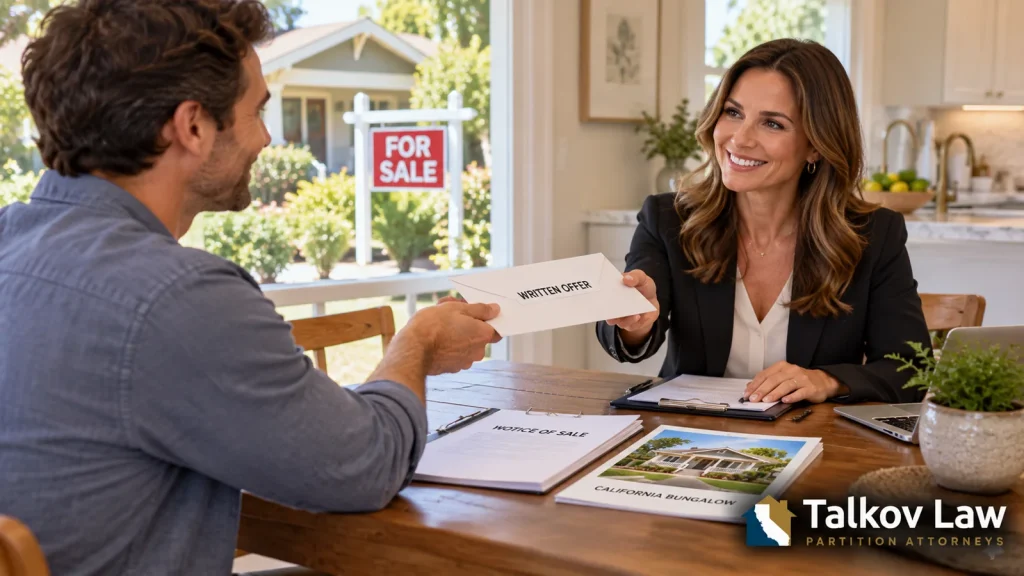

California Code of Civil Procedure section 873.680 (CCP 873.680) sets the timing and bidding rules for a private sale in a California partition action. It says when a partition referee may make a private sale and how buyers must submit their offers. It is one of the California partition statutes that govern a partition by sale, the way most co-owned houses and land are sold when the owners cannot agree.
Full Text of CCP 873.680
(a) A sale at private sale shall not be made before the day specified in the notice of sale but shall be made within one year thereafter.
(b) The bids or offers shall be in writing and left at the place designated in the notice at any time after the first publication or, if none, the posting of the notice.
California Code of Civil Procedure section 873.680 (added by Statutes 1976, chapter 73)
What CCP 873.680 Means for a Private Partition Sale
A “private sale” in a partition is not a secret sale, and it is not a sale limited to the co-owners. Under Cummings v. Dessel (2017) 13 Cal.App.5th 589, 599–600, a private sale must be publicly noticed and open to outside buyers. In practice, the referee lists the house or land on the open market through a licensed real estate agent, collects written offers, and asks the court to confirm the best one. Our article on what a notice of private sale means explains the notice that starts this process.
Section 873.680 adds four rules to that process:
- A start date. The referee cannot make the sale before the day named in the notice of sale.
- A one-year window. The sale must be made within one year after that day.
- Written offers only. Every bid or offer must be in writing and left at the place the notice names.
- When offers may come in. Buyers may submit offers any time after the notice is first published or, if the notice is not published, after it is posted.
The notice itself comes from neighboring sections. CCP 873.640 sets how and to whom notice of sale is given, and CCP 873.650 lets the court set what the notice says. For a private sale, the notice must state the place where offers will be received and the day on or after which the sale will be made.
Here is how the timing works. Say the referee for a three-bedroom house in Riverside first publishes the notice of sale on March 3, and the notice says the sale will be made on or after March 20:
- Buyers may leave written offers at the place named in the notice starting March 3, the day of first publication.
- The referee cannot make the sale before March 20, which is 17 days after first publication (20 − 3 = 17).
- The referee must make the sale by March 20 of the following year, one year after the day named in the notice.
If the referee signs a contract with a buyer at $650,000 on April 15, that sale falls inside the window. The referee then reports the sale to the court under CCP 873.710 and asks the court to confirm it under CCP 873.720.
Most partition sales happen this way. The referee usually hires a residential agent for a home or a commercial broker for commercial property, markets the property to the public, and brings the strongest offer to the court. Our guides on how a partition referee sells property and choosing the Realtor in a partition action cover the details.
The Law Revision Commission Comments on CCP 873.680
The California Law Revision Commission recommended the partition statutes the Legislature enacted in 1976. Its comment on section 873.680 reads:
Section 873.680 continues the substance of the last sentence of former Section 775, which provided for private sale in the manner required in private sales of real property of estates of decedents. Section 873.680 incorporates comparable provisions from Probate Code Sections 782 and 783.
California Law Revision Commission Comment to Code of Civil Procedure section 873.680 (1976)
In plain terms, the private sale rules in a partition were borrowed from the former probate rules for selling a deceased person’s real estate. That is why a private partition sale still looks much like a court-confirmed probate sale: public notice, written offers, and a hearing before the sale is final.
Common Questions About Private Partition Sales
Can a Co-Owner Make an Offer in a Private Partition Sale?
Yes. A co-owner may submit a written offer like any other buyer. CCP 873.690 bars only the referee, the attorney of a party, and a party’s guardian or conservator, unless the guardian or conservator buys for the benefit of the person they protect. Our article on whether a co-owner can buy the property in the partition action explains how that works.
Is the Sale Final When the Referee Accepts an Offer?
No. Under CCP 873.710, the referee must report the sale to the court, and the sale is not complete until the court confirms it after a hearing under CCP 873.720 and CCP 873.730. At that hearing, the court may consider a higher offer under CCP 873.740.
Does a Private Partition Sale Bring Fair Market Value?
Usually, yes. Because the property is marketed to the public through an agent and offers come in over weeks rather than at a single auction, a private sale typically draws open-market prices. Our article on whether a partition sale yields fair market value explains why.
Where CCP 873.680 Fits in the California Partition Statutes
Section 873.680 sits in article 2, “Sales Procedures,” of chapter 6 of the partition title, which governs the sale of the property. Before that article, CCP 873.510, CCP 873.520, and CCP 873.530 decide how the referee sells and whether the sale is by public auction, private sale, or both. Article 2 then covers CCP 873.600 (the sale order and the parties’ agreed terms), CCP 873.610 (the manner, terms, and conditions of sale and the referee’s recommendations), CCP 873.620 (selling in separate parcels or as a unit), CCP 873.630 (credit sales), CCP 873.640 (notice of sale), CCP 873.650 (contents of the notice of sale), CCP 873.660 (securities, perishable property, and passage of title), CCP 873.670 (public auctions), section 873.680 (timing and written bids for a private sale), and CCP 873.690 (who cannot buy).
After the referee makes a sale, article 3, “Consummation of Sale,” takes over: CCP 873.710 (the referee’s report of sale), CCP 873.720 (the motion to confirm or set aside the sale), CCP 873.730 (the confirmation hearing and a new sale), CCP 873.740 (increased offers at the hearing), CCP 873.745 (agent commissions), CCP 873.750 (the referee’s duties after confirmation), section 873.760 (a buyer who fails to pay), CCP 873.770 (a setoff when a party is the buyer), CCP 873.780 (closing the sale), and CCP 873.790 (the deed and its recording). The next article covers the money: CCP 873.810 (the court’s order of disbursement), CCP 873.820 (the order in which proceeds are applied), CCP 873.830 (a setoff for a tenant for life or for years), CCP 873.840 (successive estates), and CCP 873.850 (continuing the case to allocate proceeds). Our partition action timeline shows where the sale falls in the case as a whole.
Talkov Law Partition Attorneys Can Help
A private sale moves only as fast as its notice allows. Setting the notice dates correctly keeps the sale inside the one-year window and on track for a prompt confirmation.
Talkov Law can help. With 12 full-time partition attorneys and experience in over 650 partition actions throughout California, our team handles every step of the process, from the notice of sale and the written offers through the confirmation hearing and the final distribution of proceeds. Call (877) PARTITION (727-8484) today or contact us online to get started.







