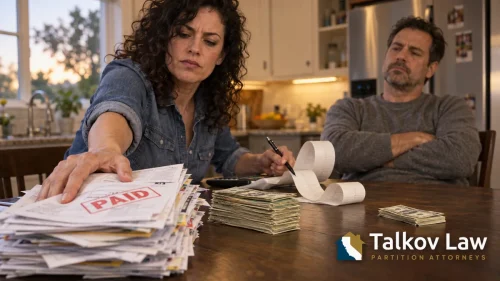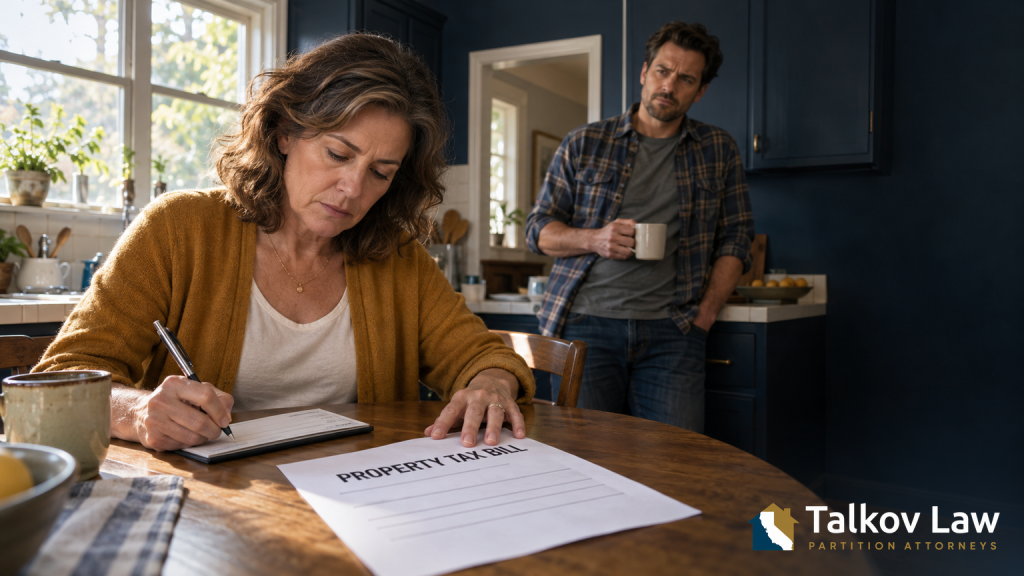
No. In California, paying someone else’s property taxes does not by itself give you ownership of the property. Tax payments matter only as one element of an adverse possession claim, and a co-owner who pays more than their share is repaid in a partition action rather than gaining the other owner’s title.
This comes up most often in families, where one relative quietly pays the taxes on a house titled to a parent, sibling, or former partner and assumes that doing so earns a bigger share.
If You Pay Someone’s Property Taxes, Do You Own the Property?
No. If you pay someone’s property taxes, you do not own the property. Ownership of California real estate changes hands through a recorded deed, an inheritance, or a court judgment. The person who pays the tax bill is not the owner unless the title and deed say so.
Without a written agreement, a court may treat the payments as a gift, a loan, or a contribution to be sorted out later. A promise to transfer real estate in exchange for the payments generally has to be in writing under the statute of frauds.
Where Tax Payments Matter: Adverse Possession
Paying property taxes is one of the requirements for adverse possession, which lets a non-owner acquire title after five years. Code of Civil Procedure section 325 (CCP 325) requires the claimant to have timely paid all taxes levied and assessed on the land during those five years, proven by certified records of the county tax collector. Taxes paid late do not count. Paying the taxes is necessary but never enough on its own. The claimant must also show:
- Actual occupation that gives the owner reasonable notice
- Possession that is hostile to the owner’s title
- A claim to the property under color of title or claim of right
- Continuous, uninterrupted possession for five years
Someone who pays the taxes but never lives on or uses the property cannot meet these requirements, so the payments alone transfer nothing.
A Co-Owner Cannot Take Title by Paying the Taxes
The rule is even stricter between co-owners. Every tenant in common has the right to possess the whole property, so one co-owner living there and paying the bills is not hostile to the others.
As the Court of Appeal put it in Hunter v. Schultz (1966) 240 Cal.App.2d 24, at page 28, “the rule is clear that one tenant in common cannot acquire the title of his cotenant by mere exclusive possession.” Adverse possession against a co-owner cannot even begin to run without an ouster, meaning clear notice to the other owners that they are being shut out.
The Court of Appeal applied that rule to tax payments in Hacienda Ranch Homes, Inc. v. Superior Court (2011) 198 Cal.App.4th 1122. A co-owner with a 24.5 percent interest paid all of the property taxes, maintained the land, and then claimed the whole parcel. The court held that none of this was an ouster, and the co-owner kept only 24.5 percent. Our article on what counts as ouster between co-owners covers the decision, and the same rule means a co-owner cannot take title by exclusive possession alone.
Paying the taxes for years, even with the other owners contributing nothing, does not change each owner’s percentage on title.
A Co-Owner Who Pays the Taxes Is Reimbursed in a Partition
What a paying co-owner earns is a credit, not more ownership. In a partition action, the court conducts an accounting under Code of Civil Procedure section 872.140 (CCP 872.140), and a co-owner who paid more than their share of the taxes is repaid from the other owners’ share of the proceeds.
Our guides to partition offsets and accounting and to a co-owner not paying property taxes explain how these credits work, and our article on calculating a co-owner’s reimbursement in a partition shows the math. The same principle applies when a co-owner paid the mortgage or the insurance.
Credits can be reduced, though. When the paying co-owner lived in the property alone, the court can offset the rental value against a co-owner in sole possession, reducing the credit for the taxes they paid. Our article on rental value explains when that applies.
Protect Your Interest If You Are Paying Someone Else’s Taxes
If you are paying taxes on property you do not own, or own only in part, take these steps:
- Keep proof of every payment. Save tax bills, receipts, and bank records, because the accounting depends on documentation.
- Put any deal in writing. A signed agreement can turn the payments into a loan, a lien, or a path to a share of title.
- Consider other claims. If you also paid toward the purchase price, a resulting trust may give you a share the deed does not show. If you paid because you were promised an interest, a constructive trust or a quiet title action may be available.
- Do not let the taxes go unpaid. Unpaid taxes become a lien and can lead to a tax sale, which is why a co-owner who refuses to pay the taxes is often a reason to act.
If you are already on title, a partition ends the arrangement. The property is sold or divided, and the accounting returns your extra tax payments before the proceeds are split, so filing a partition action is often the most direct way to get repaid.
Talkov Law can help. With 12 full-time partition attorneys and experience in over 650 partition actions throughout California, our team helps co-owners recover the taxes, mortgage payments, and other costs they carried alone. Call (877) PARTITION (727-8484) today or contact us online to get started.