

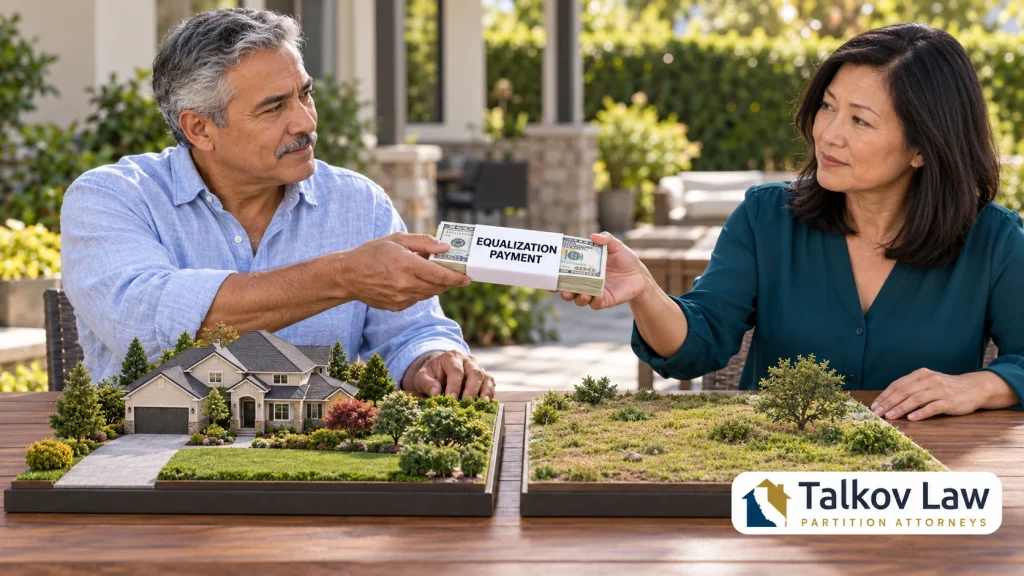
Owelty is money one co-owner pays another to even out a partition when the property is divided into pieces of unequal value. In California, partition actions often arise when co-owners, such as siblings who inherited land or former partners who bought together, decide to divide their property. Splitting land into pieces of exactly equal value is rarely possible, so California law lets the court order owelty: a cash payment that makes up the difference.
How Owelty Works
Owelty refers to a sum of money paid by one co-owner to another to equalize the distribution of property when the division results in unequal shares. It comes up in partition actions, particularly when a property cannot be divided into perfectly equal parcels. For instance, if one co-owner receives a portion of the property that is more valuable than the portion received by the other co-owner, the party with the more valuable share may be required to make an owelty payment to the other. The payment makes up the difference in value. [1]
Legal Foundation of Owelty in California
Owelty is authorized by Code of Civil Procedure section 873.250. One of the leading cases, Gonzalez v. Gonzalez, established that when it is impossible to divide property into equally valuable parcels, a court may order an owelty payment to ensure that each party receives a fair share of the property’s total value. [2]
The court in Gonzalez treated owelty as the way to make a physical division fair when the pieces cannot be made equal.[3]
Practical Application of Owelty
One court explained that, “to make the owelty award, the trial court was required to determine the property values of the various parcels.” [4]
Consider a scenario where two co-owners inherit a piece of land valued at $1 million. If the land cannot be divided into two equal parts—perhaps due to geographical features, existing structures, or zoning regulations—one co-owner might receive a portion worth $600,000 while the other receives a portion worth $400,000. To even it out, the court may order the co-owner who received the more valuable share to pay $100,000 to the other as owelty. Each owner then ends up with $500,000 in value. [5].
Owelty also comes up when co-owners hold several properties. This commonly occurs when inheritance results in each child obtaining equal fractional shares to each property and when romantic couples decide to amass multiple co-owned properties whether for personal use or for rental properties. By granting different properties to each co-owner as allowed by California law, the court can equalize the disparity in value through a payment of money, i.e. owelty.
Owelty is also relevant in cases where a property’s unique characteristics—such as differing access to roads, water sources, or views—make an equal division impossible. Owelty pays for those differences in cash. [6]
Owelty vs. Reimbursement Credits and Buyouts
Owelty is not the same as the credits co-owners claim for paying more than their share of the mortgage, taxes, or repairs. Those are compensatory adjustments under Code of Civil Procedure section 872.140, and they are settled in the partition accounting of offsets and credits. Owelty only evens out the value of the pieces each owner receives when the property itself is divided.
Owelty also rarely comes up with a single house. A house cannot be split into two equal homes, so most California partitions end in a partition by sale or a co-owner buyout. Owelty matters most with land that can be split, such as ranch land or acreage in Central California, or with several properties the court can award to different owners.
Ask for Owelty When the Pieces Are Not Equal
If you are dividing land or several properties with a co-owner and the pieces will not be worth the same, owelty is how you get paid the difference. The court can order it, or the co-owners can build it into a settlement. Either way, have the pieces appraised first, because the payment is only as accurate as the values behind it.
Talkov Law's Partition Attorneys Can Help
If your co-owner won’t agree to sell or buy you out, a partition action ends the co-ownership for good. Talkov Law can help. With 12 full-time partition attorneys and experience in over 650 partition actions throughout California, Talkov Law is California’s #1 partition law firm. Our team handles every step of the process, from filing the partition action through the sale or buyout and the final division of the proceeds. Not a single court has denied our clients the right to partition.
Call (877) PARTITION (727-8484) today or contact us online for a free consultation with a partition attorney.







