

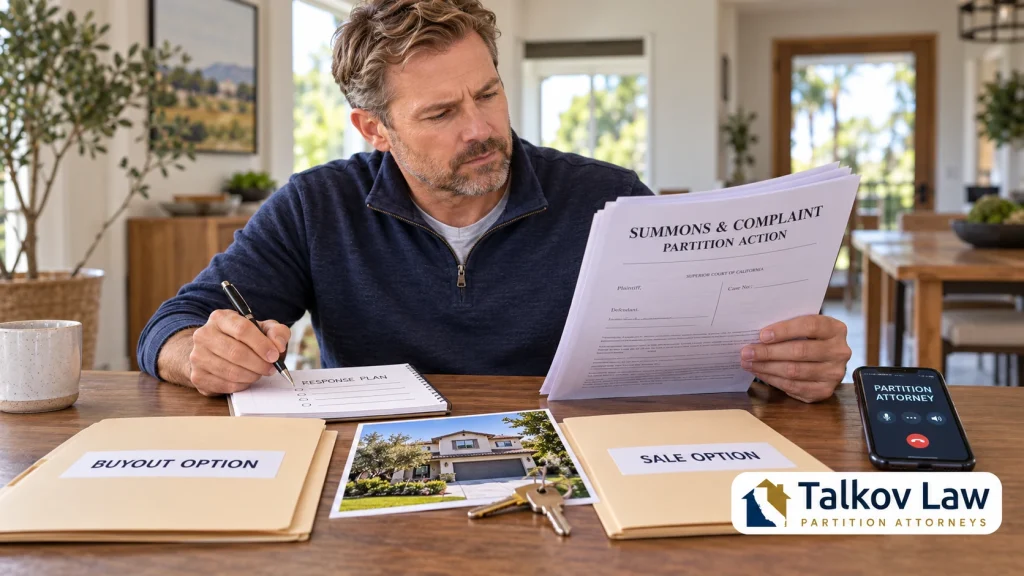
If you were served with a partition action, your co-owner has asked a California court to end your co-ownership by ordering the property sold or divided. Refusing to sell will not stop the case, but you still have real choices: buy out your co-owner, negotiate the sale on your terms, raise a defense such as a written waiver of partition, and claim credit for what you paid toward the property. Most of these cases are between heirs who inherited a house together, former couples, or friends who bought together. Your first deadline is your response: you generally have 30 days after being served to file one, and missing it can cost you most of these options.
Served with a partition action? There are steps you can take to protect your share. Get a free 30-minute consultation or call (877) PARTITION (727-8484). No fees until you win.
Immediate Steps to Take When Sued for Partition
Find the date you were served on the papers and put the response deadline on your calendar. Then speak with a partition attorney before that deadline, not after it. The start of the case is when resolving the partition through negotiation is cheapest, because neither side has spent much on fees yet. An attorney who works under the partition statutes every day can tell you quickly whether a buyout, a negotiated sale, or a defense is realistic for you.
Your main decision is whether you want to keep the property or be paid your share. A partition action forces the sale or division of the property, and the proceeds are divided among the co-owners. If you want to keep it, you will need to buy out the property in the partition, so check now what you can actually pay: cash on hand, whether you qualify for a loan large enough to cover your co-owner’s share, and whether a family member could co-sign.
Next, look at whether you have any affirmative defenses to partition, including waiver of partition. Your attorney can also help maximize your partition offsets, which credit you for paying more than your share, for example if you made the down payment or have paid the mortgage alone since your co-owner moved out.
Don’t Miss the Deadline to Respond to a Partition Lawsuit
The most damaging mistake a co-owner can make is not responding. If you do not file a response in time, your co-owner can ask the court to enter your default, and undoing a default is difficult and expensive. After a default, an interlocutory judgment of partition may be issued, a partition referee may be appointed, and getting yourself back on track to purchase the co-owner’s portion or offer your co-owner a buyout price becomes much more difficult.
Partition of Real Property Act
If your co-owner asked for partition by sale and you own the property as tenants in common, the Partition of Real Property Act, in effect since January 1, 2023, gives you the right to an appraised buyout of the property. Only the co-owners who did not ask for a sale have this right, and it comes with short deadlines once the court sends notice of the value, so plan your financing early. Our post Can My Co-Owner Buy Me Out If I File for Partition? explains how the buyout works. The statute provides:
If any cotenant requested partition by sale, the court shall, after the determination of value under Section 874.316, send notice to the parties that any cotenant except a cotenant that requested partition by sale may buy all the interests of the cotenants that requested partition by sale. Code of Civil Procedure section 874.317, subdivision (a)
Will the Property Be Sold or Divided?
Under Code of Civil Procedure section 874.318, the court can order a partition in kind, which physically divides the property, or a partition by sale. A single-family home almost always ends in a sale, because it cannot be split into two parcels that are each worth a fair share: the half with the house is worth far more than the half without it.
For some co-owners, the goal is keeping the home. For others, it is receiving the most money from the sale. If you are the co-owner who wants the property sold, see how to win a partition action instead. For the defenses that can work, such as a written agreement waiving partition, see our strategies for partition defendants.
Talkov Law’s Partition Attorneys Can Help
Being sued for partition does not mean forfeiting your ownership share. In most of these cases the real question is the price: who buys out whom, at what value, and how the sale proceeds are split after each owner’s credits. Those are the issues worth preparing for from the first week.
Talkov Law handles only partition actions, for co-owners on both sides of the case. For a free 30-minute consultation, call us at (877) PARTITION (727-8484) or contact us online today.








