

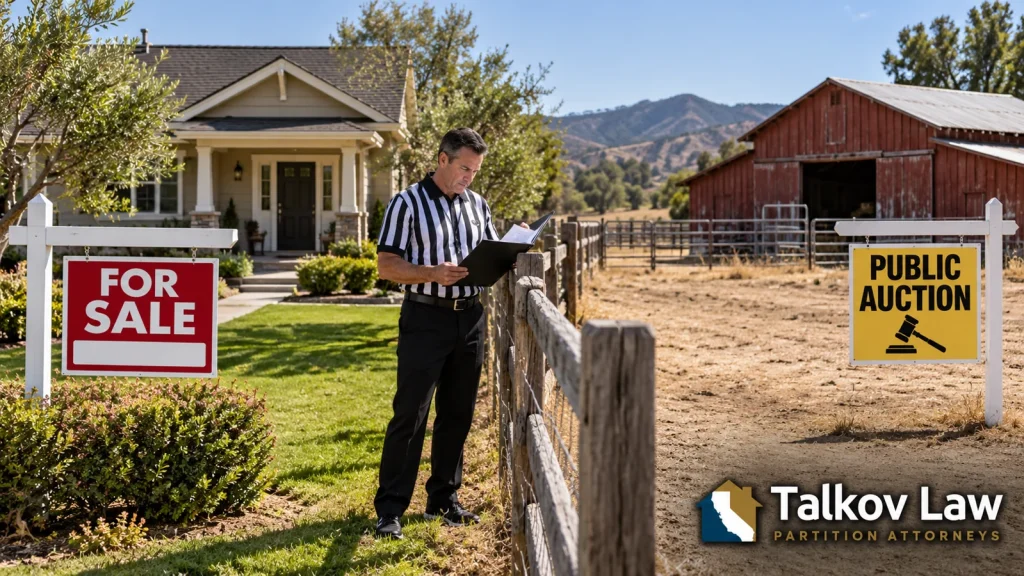
California Code of Civil Procedure section 873.530 (CCP 873.530) lets part of co-owned property be sold at public auction and part by private sale, if that will be more beneficial to the parties. Section 873.530 is the California partition statute that allows a split sale in a partition action.
Full Text of CCP 873.530
Part of the property may be sold at public auction and part at private sale if it appears that to do so will be more beneficial to the parties.
California Code of Civil Procedure section 873.530
What CCP 873.530 Means in Plain Language
In a partition by sale, the referee sells the property under CCP 873.510, and CCP 873.520 covers how the choice between a public auction and a private sale is determined and reported to the court. Section 873.530 adds a middle path: the court can use both methods in one case. It has one standard:
- Part at auction, part privately. “Part of the property may be sold at public auction and part at private sale.”
- Only if more beneficial. This is allowed “if it appears that to do so will be more beneficial to the parties.”
- No built-in preference. The statute does not favor private sales over public auctions, or the reverse.
For example, co-owners inherit a house and its contents. The house might be sold privately through a broker, while furniture and collectibles are sold at public auction. A private sale needs written offers delivered to the place named in the notice, and under CCP 873.680 it cannot be completed before the date stated in the notice or more than a year after it. A public auction follows CCP 873.670. The notice rules for either sale are in CCP 873.640, and CCP 873.620 addresses selling distinct lots separately and selling real and personal property as a unit. Our article How Does a Partition Referee Sell Property in California? walks through the whole process.
See Procedure., 12 Witkin, Summary 11th Real Prop § 78.
Law Revision Commission Comments to CCP 873.530
In 1976, the California Law Revision Commission explained CCP 873.530 as follows:
Section 873.530 continues the substance of a portion of the first sentence of former Section 775.
Frequently Asked Questions About Selling Part of a Property at Auction and Part Privately
Can part of a property be sold at auction and part sold privately in a partition?
Yes. Section 873.530 says part of the property may be sold at public auction and part at private sale if it appears that doing so will be more beneficial to the parties.
Who decides whether to use both methods?
The court does, based on whether it appears more beneficial to the parties. CCP 873.520 covers how the choice between a public auction and a private sale is determined and reported to the court.
Does California law prefer a private sale or a public auction?
No. The Law Revision Commission comment to CCP 873.520 says there is no preference for either a public or a private sale. Our article on partition sale and fair market value discusses how sales by a partition referee generally perform.
How does a private sale work?
Under CCP 873.680, offers must be in writing and delivered to the place named in the notice, and the sale cannot be completed before the day stated in the notice or later than one year after it. Our article on notice of a private sale explains more.
What notice is required when part of the property is sold each way?
CCP 873.640 sets who must receive notice of a partition sale, and CCP 873.650 sets what the notice must say. A notice of private sale must state a place where bids or offers will be received and a day on or after which the sale will be made. Both kinds of sale must be publicly noticed: in Cummings v. Dessel (2017) 13 Cal.App.5th 589, 599–600, the Court of Appeal held that the notice rules in section 873.640 contain no exception for private sales.
Talkov Law's Partition Attorneys Can Help
If your co-owner won’t agree to sell or buy you out, a partition action ends the co-ownership for good. Talkov Law can help. With 12 full-time partition attorneys and experience in over 650 partition actions throughout California, Talkov Law is California’s #1 partition law firm. Our team handles every step of the process, from filing the partition action through the sale or buyout and the final division of the proceeds. Not a single court has denied our clients the right to partition.
Call (877) PARTITION (727-8484) today or contact us online for a free consultation with a partition attorney.








