

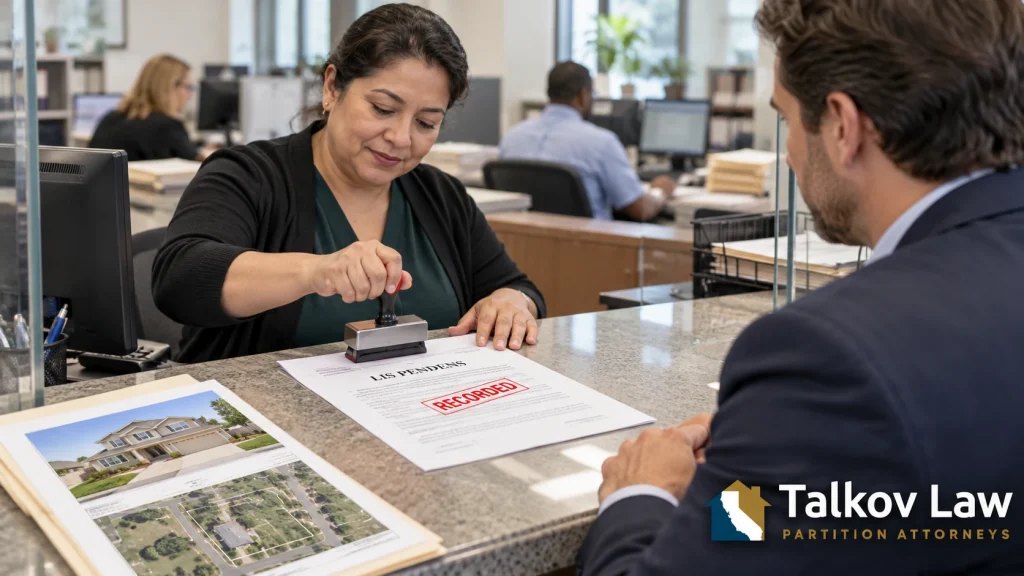
California Code of Civil Procedure section 872.250 (CCP 872.250) requires the plaintiff in a partition action to record a notice of pending action, often called a lis pendens, in every county where the real property is located, immediately upon filing the complaint. From the time it is recorded, anyone who later buys, lends against, or takes a lien on the property is treated as knowing the partition is pending. The section is one of the California partition statutes on starting the case.
Full Text of CCP 872.250
The statute provides:
(a) Immediately upon filing the complaint, the plaintiff shall record a notice of the pendency of the action in the office of the county recorder of each county in which any real property described in the complaint is located.
California Code of Civil Procedure section 872.250
(b) If, thereafter, partition of other real property is sought in the same action, the plaintiff or other person seeking such relief shall immediately record a supplemental notice.
(c) If the notice is not recorded, the court, upon its own motion or upon the motion of any party at any time, shall order the plaintiff or person seeking partition of the property, or another party on behalf of the plaintiff or other person, to record the notice and shall stay the action until the notice is recorded. The expense of recordation shall be allowed to the party incurring it.
(d) From the time of filing the notice for record, all persons shall be deemed to have notice of the pendency of the action as to the property described in the notice.
What CCP 872.250 Requires in a Partition Action
The section has four parts:
- Record at filing. Immediately upon filing the complaint, the plaintiff records the notice with the county recorder in each county where any of the real property described in the complaint is located.
- Supplemental notice. If partition of other real property is sought later in the same case, whoever seeks it records a supplemental notice right away. Real and personal property may be joined under CCP 872.240.
- Court-ordered recording. If no notice is recorded, the court must order it recorded, on its own motion or any party’s, and stay the case until it is. The party who pays for recording is allowed that expense.
- Notice to everyone. From the time the notice is filed for record, everyone is deemed to know the case is pending as to the property it describes.
Our lis pendens requirement checklist covers the form, mailing, and filing steps.
As the Court of Appeal put it: “The filing of the lis pendens constituted constructive notice to all the world in the manner expressly provided by statute that an action had been commenced which directly affected the title to the property described in the notice.”[1]
“A party who has no lien when the action is begun but obtains one later need not be made a party, but it is that party’s right and duty to intervene and set up the lien and have it adjudicated in the decree.”[2]
“Accordingly, a mortgagee who takes the mortgage after commencement of a partition action is not made a party and does not intervene has no rights as against the purchaser at the partition sale although the final decree is appealed and modified, and the buyer knows of the mortgage at the time of the sale.”[3]
Before recording, the notice must also be mailed by registered or certified mail to the adverse parties and to the owners of record, and immediately after recording, a copy must be filed with the court where the case is pending, under California Code of Civil Procedure section 405.22.
Common Questions About CCP 872.250
What Happens If the Plaintiff Does Not Record the Notice?
The case stops. Under subdivision (c), the court orders the notice recorded and stays the action until it is, so a plaintiff who skips this step only delays the partition.
Does a Lis Pendens Stop a Co-Owner From Selling?
Not by itself. The notice does not forbid a transfer, but anyone who buys or lends after it is recorded is treated as knowing about the case and takes subject to its outcome, as the authorities quoted above show. CCP 874.210 lists who is bound by the partition judgment. In practice, few buyers or lenders will close while the notice is on title.
Is a New Notice Needed If I Add Property Later?
Yes. Subdivision (b) requires a supplemental notice, recorded immediately, for any other real property brought into the same case.
The Law Revision Commission Comments on CCP 872.250
In 1976, the California Law Revision Commission explained CCP 872.250 as follows:
Subdivisions (a) and (d) of Section 872.250 continue provisions formerly found in Section 755. The detailed listing of the contents of the lis pendens formerly found in Section 755 is omitted since Section 409 covers this matter. The requirement of recording a lis pendens is not jurisdictional. Rutledge v. Rutledge, 119 Cal.App.2d 114, 120, 259 P.2d 79, 82 (1953). Failure to so file, however, may result in subsequent bona fide purchasers and encumbrancers of record at the time the judgment is recorded not being bound by the partition judgment. See Section 874.220 (persons not bound by judgment).
Subdivision (b) is new. The duty under subdivision (b) is upon the person seeking to join additional property to record the lis pendens; this might be either the plaintiff or a cross-complainant.
Subdivision (c) is new. The recording of the lis pendens is an important step in the partition action. Prompt recording enables the court to deal with the title with certainty. The person required to record might be either the plaintiff or a cross-complainant.
Where CCP 872.250 Fits in the California Partition Statutes
Section 872.250 closes the article on the complaint and notice of pending action, after CCP 872.210 on who may file, CCP 872.220 on the title report, CCP 872.230 on the complaint, and CCP 872.240 on joining property. The summons comes next under CCP 872.310, and when the court orders service by publication, CCP 872.320 again requires the notice to be recorded if it has not been.
Talkov Law Partition Attorneys Can Help
Recording the notice on day one protects the partition from a co-owner who tries to sell or borrow against the property while the case is pending.
Talkov Law can help. With 12 full-time partition attorneys and experience in over 650 partition actions throughout California, our team records the notice of pending action at filing and handles every step from the partition complaint through the partition sale and the final distribution of proceeds. Call (877) PARTITION (727-8484) today or contact us online to get started.
References
| ↑1 | Turner v. Bank of Am. Nat. Tr. & Sav. Ass’n (1933) 135 Cal.App. 314, 319–20 |
|---|---|
| ↑2 | 48 Cal. Jur. 3d Partition § 49 (citing Towle Bros. Co. v. Quinn (1903) 141 Cal. 382, 74 P. 1046). |
| ↑3 | 48 Cal. Jur. 3d Partition § 49 (citing Turner v. Bank of America Nat. Trust & Sav. Ass’n (1933) 135 Cal. App. 314. |








