

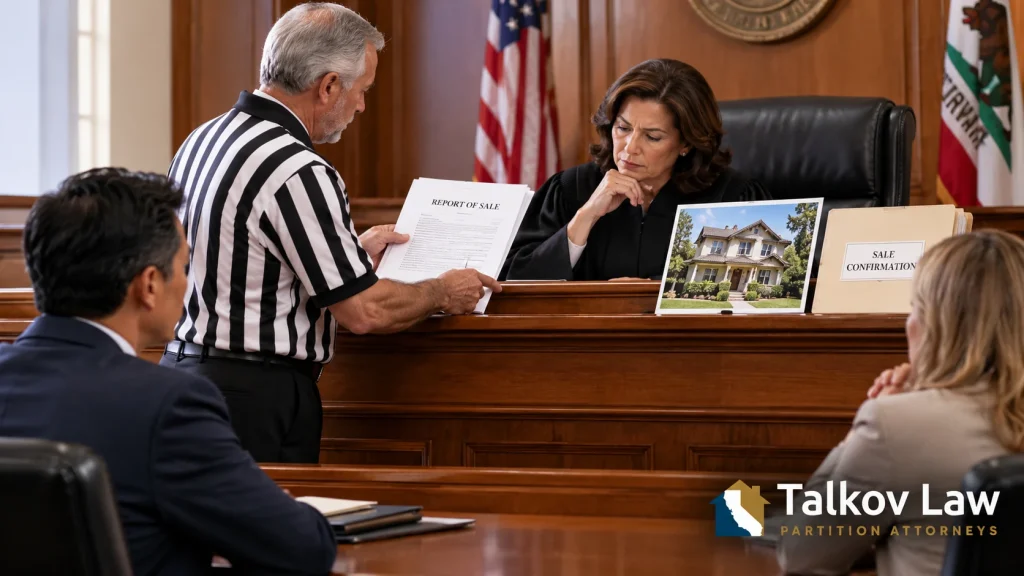

California Code of Civil Procedure section 873.730 (CCP 873.730), often cited as CCP 873.730, governs the partition sale confirmation hearing. At the hearing, the court reviews the referee’s report, may confirm the sale even if it departs from the set terms, and may vacate the sale and order a new one if it finds unfairness or improper notice, a price out of line with value, or that a new sale would bring enough more money. It is one of the California partition statutes that control a court-ordered sale in a partition action.
Full Text of CCP 873.730
(a) At the hearing, the court shall examine the report and witnesses in relation to the report.
California Code of Civil Procedure section 873.730 (added by Statutes 1976, chapter 73)
(b) The court may confirm the sale notwithstanding a variance from the prescribed terms of sale if to do so will be beneficial to the parties and will not result in substantial prejudice to persons interested in the sale.
(c) The court may vacate the sale and direct that a new sale be made if it determines any of the following:
(1) The proceedings were unfair or notice of sale was not properly given. If there is no finding at the hearing of unfairness or improper notice, the sale may thereafter not be attacked on such grounds.
(2) The sale price is disproportionate to the value of the property.
(3) It appears that a new sale will yield a sum that exceeds the sale price by at least 10 percent on the first ten thousand dollars ($10,000) and 5 percent on the amount in excess thereof, determined after a reasonable allowance for the expenses of a new sale.
What the Court Decides at a Partition Sale Confirmation Hearing
After a party moves to confirm under CCP 873.720, section 873.730 tells the judge what to do at the hearing. The court must examine the referee’s report of sale, prepared under section 873.710, and may hear witnesses about it. The court then has two paths:
- Confirm the sale. The court may confirm even if the sale varies from the terms the court set, as long as confirming “will be beneficial to the parties and will not result in substantial prejudice to persons interested in the sale.” For example, the buyer may have needed a longer escrow than the sale order allowed.
- Vacate the sale and order a new one. The court may do this if it determines that the proceedings were unfair or notice of sale was not properly given, that the price is disproportionate to the property’s value, or that a new sale will bring in enough more money to meet the statute’s formula.
Subdivision (c)(1) also protects a confirmed sale. If the court makes no finding of unfairness or improper notice at the hearing, the sale cannot be attacked on those grounds afterward. That gives the buyer, and the co-owner who asked for the sale, the finality needed to close.
When the referee has marketed the property properly, the price usually tracks the market, and confirmation is the normal result. Our post on whether a partition sale yields fair market value explains why. In Dunn v. Dunn (1902) 137 Cal. 51, the California Supreme Court reversed a refusal to confirm a fairly run sale that rested only on vague testimony that the property was worth more, and held that value is measured as of the sale date.
Worked Example: The 10 and 5 Percent New-Sale Test
Suppose the referee sells a duplex in Sacramento for $600,000. Subdivision (c)(3) works like this:
- 10 percent of the first $10,000 is $1,000.
- 5 percent of the remaining $590,000 is $29,500.
- Together, a new sale must beat the price by at least $30,500, so it must be expected to yield at least $630,500.
That yield is measured “after a reasonable allowance for the expenses of a new sale.” If the court allows $15,000 for the added cost of selling the duplex again, it would need to find that a new sale will likely bring about $645,500 or more before vacating on this ground. A quick way to find the threshold for any price over $10,000 is 5 percent of the price plus $500.
Subdivision (c)(3) asks whether a new sale will likely bring more. CCP 873.740 uses the same formula but requires an actual written increased offer at the hearing from a responsible bidder.
The Law Revision Commission Comments on CCP 873.730
The California Law Revision Commission recommended the partition statutes the Legislature enacted in 1976. Its comment on section 873.730 reads:
Section 873.730 continues the fourth sentence of former Section 784 with the exceptions noted below. Unlike the former section, subdivision (b) expressly authorizes confirmation of a sale that varies from the published terms. Subdivision (c) makes each ground for vacating a sale independently sufficient. The provision for notice of resale is found in Section 873.640. The 10-percent formula of former Section 784 is replaced by a 10-5 percent formula derived from Probate Code Section 785.
Where a credit sale is returned to the court for confirmation, the judge must determine whether the credit bidder is responsible before confirming the sale. See Section 873.740 (increased offers by “responsible” bidder). Agents’ commissions on the sale, if any, are fixed by the court. See Section 873.745.
California Law Revision Commission Comment to Code of Civil Procedure section 873.730 (1976)
Two points stand out. Each ground in subdivision (c) is enough on its own, and the new-sale test uses the same 10 and 5 percent formula as overbids under section 873.740. The reference to a credit bidder ties to section 873.630, which lets the court allow a sale on credit.
Common Questions About Partition Sale Confirmation Hearings
Will the Court Confirm a Partition Sale?
Usually, when the referee followed the sale order and gave proper notice. The court may confirm even with a variance from the terms of sale if confirming benefits the parties and does not substantially prejudice anyone interested in the sale. It may vacate the sale and order a new one if it finds one of the three grounds in subdivision (c).
Can a Confirmed Partition Sale Be Challenged Later for Unfairness?
Not on the grounds of unfairness or improper notice unless the court made that finding at the hearing. Section 873.730(c)(1) provides that without such a finding, “the sale may thereafter not be attacked on such grounds.”
What Happens if the Court Orders a New Sale?
The referee sells the property again, and notice of the resale is given under section 873.640, as the Law Revision Commission comment notes. If the new sale comes from a written overbid at the hearing, the court may instead confirm the sale to the overbidder under section 873.740.
Where CCP 873.730 Fits in the California Partition Statutes
Section 873.730 sits in article 3 of chapter 6 of the partition title, titled “Consummation of Sale,” which runs from section 873.710 through section 873.790. In order, section 873.710 requires the referee’s report of sale, section 873.720 lets a party move to confirm or set aside the sale, section 873.730 governs the confirmation hearing, and section 873.740 governs overbids at that hearing. After confirmation, section 873.745 covers agents’ commissions, section 873.750 the referee’s duties, section 873.760 a buyer who fails to pay, section 873.770 a buyer who is also a party, section 873.780 the closing, and section 873.790 the deed.
Before the sale reaches the court, article 2 sets the sale procedure, from section 873.600 on the court’s sale order and section 873.610 on the terms of sale, through section 873.630 on credit sales, section 873.640 on notice of sale, section 873.680 on private sales, and section 873.690 on who may not buy. After closing, article 4, section 873.810 through section 873.850, controls the money, with section 873.820 setting the order in which the proceeds are paid.
Talkov Law Partition Attorneys Can Help
The confirmation hearing decides whether the sale closes or starts over. A complete referee’s report and a clear record before the hearing are the best way to get the sale confirmed.
Talkov Law can help. With 12 full-time partition attorneys and experience in over 650 partition actions throughout California, our team handles every step of the process, from the referee’s sale and the confirmation hearing through closing and the distribution of proceeds. Call (877) PARTITION (727-8484) today or contact us online to get started.







