

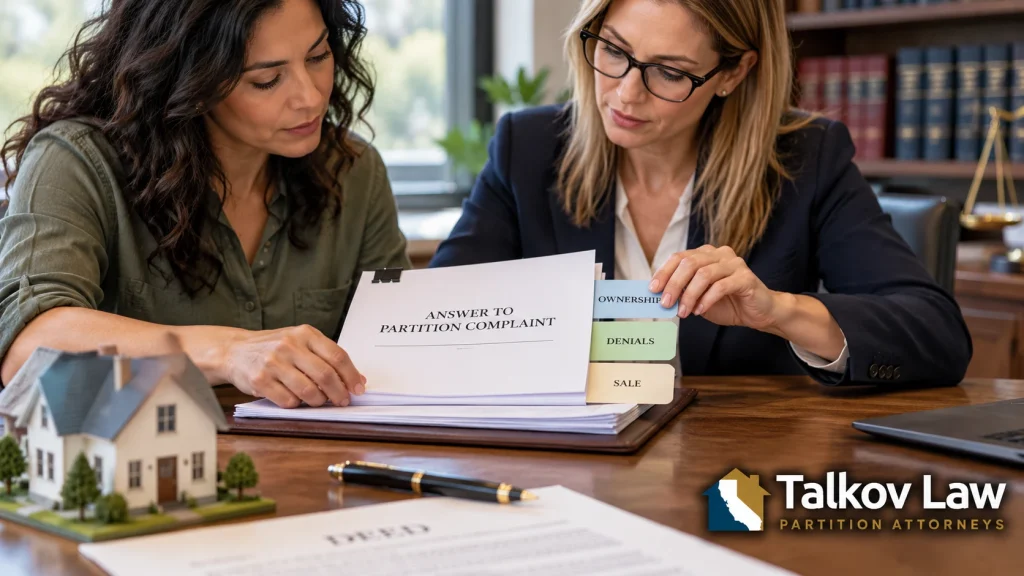

California Code of Civil Procedure section 872.410 (CCP 872.410) lists what a defendant must include in the answer to a complaint for partition: the defendant’s interest in the property, any denials of the complaint’s allegations, and, when the defendant wants the property sold, the facts that justify a sale. It applies in every partition action and opens the “Answer” article of the California partition statutes.
Full Text of CCP 872.410
The answer shall set forth:
(a) Any interest the defendant has or claims in the property.
(b) Any facts tending to controvert such material allegations of the complaint as the defendant does not wish to be taken as true.
(c) Where the defendant seeks sale of the property, an allegation of the facts justifying such relief in ordinary and concise language.
California Code of Civil Procedure section 872.410 (added by Statutes 1976, chapter 73)
What CCP 872.410 Requires in Plain English
Section 872.410 tells a co-owner who has been sued for partition what the answer must say. Each subdivision does a different job:
- Subdivision (a): the answer states every interest the defendant has or claims in the property, such as a one-half ownership share or a lien.
- Subdivision (b): the answer disputes each material allegation the defendant does not want treated as true, such as a claim that the co-owners hold equal shares.
- Subdivision (c): a defendant who wants the property sold rather than divided alleges, in ordinary and concise language, the facts that justify a sale.
Subdivision (b) matters because of California Code of Civil Procedure section 431.20, which provides that “Every material allegation of the complaint or cross-complaint, not controverted by the answer, shall, for the purposes of the action, be taken as true.” A co-owner who leaves a wrong ownership percentage unchallenged in the answer can be held to it.
Subdivision (c) connects to CCP 872.820, the statute under which the court orders a partition by sale instead of a partition in kind. A defendant who wants a sale should plead those facts in the answer. Our comparison of partition by sale versus partition in kind explains how courts choose.
The Law Revision Commission Comment on CCP 872.410
The California Law Revision Commission recommended the partition statutes that the Legislature enacted in 1976. Its comment on section 872.410 reads:
Section 872.410 continues portions of former Section 758; subdivision (c) is new. The provision of former Section 758 that the defendant’s failure to answer within the time allowed by law would result in the allegations of the complaint being taken as true is now contained in Section 431.20. It should be noted that the requirement in subdivision (a) that the defendant list his interest in the property includes liens as well as other interests claimed by the defendant.
California Law Revision Commission Comment to Code of Civil Procedure section 872.410 (1976)
The comment makes two practical points. First, a defendant who does not answer at all is bound by the complaint’s allegations, which is how a plaintiff obtains a default judgment in a partition action. Second, a lender or other lienholder named as a defendant answers under section 872.410 too, and CCP 872.420 requires that answer to set forth “the date and character of the lien and the amount remaining due thereon.”
How California Courts Have Applied CCP 872.410
In Ritzman v. Ritzman (1923) 190 Cal. 505, 506, the California Supreme Court held that the requirement of former section 758, the predecessor of section 872.410, that a defendant set forth his interest in the property “was intended by the legislature to be mandatory.” The defendant had disclaimed any interest in his amended answer, so he could not complain on appeal that the decree gave him only a 45 percent share.
In Stutz v. Davis (1981) 122 Cal.App.3d 1, 6, two lienholders were named as defendants in a partition action. The Court of Appeal held that section 872.410’s direction that they answer did not make their attorney’s fees a cost of partition under CCP 874.010, because their work was not for the common benefit of the parties. They were left to the fee clause in their deed of trust. Our guide to attorney’s fees in a partition action explains the common benefit rule.
Where CCP 872.410 Fits in the California Partition Statutes
Section 872.410 is the first of three sections in the “Answer” article. It responds to the complaint described in CCP 872.230 and is followed by CCP 872.420 on lien claims and CCP 872.430, under which “The answer may set forth any claim the defendant has for contribution or other compensatory adjustment.”
Once the pleadings are settled, the court decides the parties’ interests and the manner of partition in the interlocutory judgment under CCP 872.720. What each answer says about ownership and sale frames that ruling, and our guide on how to obtain an interlocutory judgment of partition covers the next step.
Common Questions About Answering a Partition Complaint
What Happens If a Co-Owner Does Not Answer?
The allegations of the complaint are taken as true under section 431.20, and the plaintiff can ask the court to enter a default. Our post on what a default judgment in a partition action means explains the consequences.
Can a Defendant Ask for a Sale When the Plaintiff Wants Division?
Yes. Subdivision (c) exists for that situation. The defendant pleads the facts that justify a sale, and the court weighs them under CCP 872.820.
Can the Answer Raise Claims for Reimbursement?
Yes, under CCP 872.430. Credits for mortgage payments, property taxes, and improvements are part of partition offsets and accounting and should be pleaded early. A dispute over who truly owns the property may also call for a cross-complaint, as discussed in our post on cross-complaints for declaratory relief in partition actions.
Get Help Answering a California Partition Complaint
An answer that leaves out an interest, a denial, or a request for sale can shape the rest of the case. Pleading each point correctly from the start protects your share of the property.
Talkov Law can help. With 12 full-time partition attorneys and experience in over 650 partition actions throughout California, our team handles every step of the process, from drafting your answer through the sale and the final distribution of proceeds. Call (877) PARTITION (727-8484) today or contact us online to get started.







