

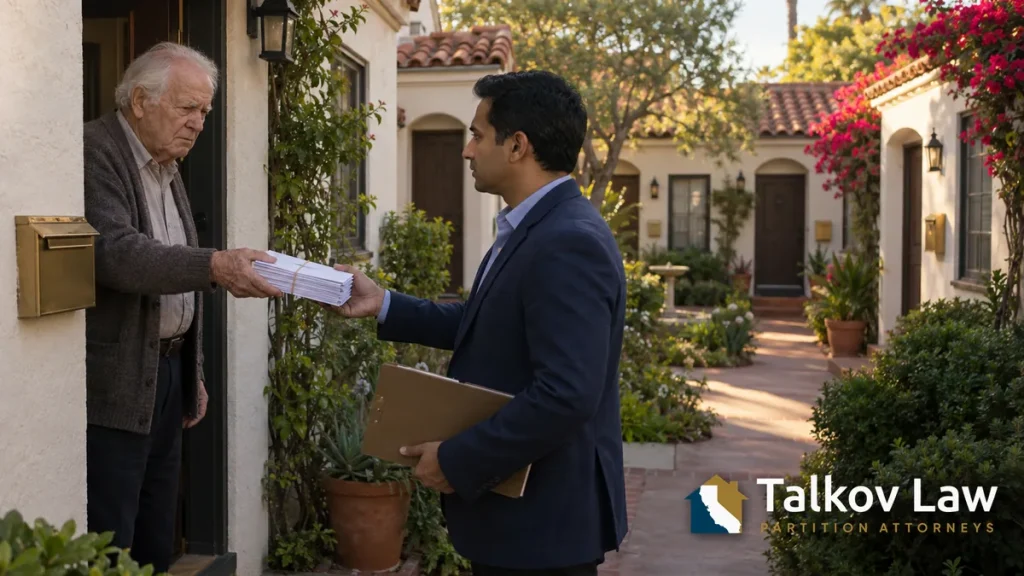

If someone who owns no part of your co-owned property is living there, collecting the rent, and claiming the place as their own, a California partition action can deal with that person, and the court can appoint a receiver to collect the rent while the case is pending. In Blodgett v. Haddock (1949) 95 Cal.App.2d 17, the Court of Appeal affirmed an order appointing a receiver over a four-unit Los Angeles County property. The widower of a woman who had only a lifetime interest in the property stayed on after her death, kept the rent from three tenants, and claimed an interest against the heirs who actually owned it.
The court held that the partition was the right case to decide his claim, and that a receiver was the right way to protect the rent until it was decided. Our guide to receivers in a partition action explains what a receiver does. This post covers the case behind it and the statutes that apply today.
Why Blodgett v. Haddock Matters
- A partition can reach an occupant who claims the property. The rights of a person in possession who claims against the owners can be tried and decided in the partition itself. (Blodgett, at p. 18.)
- The court can appoint a receiver in a partition. The court has the power to appoint one and “should do so when the circumstances require it.” (Blodgett, at p. 18.)
- Rent is protected while the case is pending. The property and its income must be conserved so the rightful owners receive them. (Blodgett, at p. 19.)
- An occupant who cannot pay a judgment is a reason for a receiver. The man collecting the rent had no assets and no other income, so a money judgment against him would have been worthless. (Blodgett, at pp. 18–19.)
The Facts: A Life Interest Ends, and the Husband Stays
Francis R. Fencil left ten-elevenths of the residue of his estate to ten of his children. He left the remaining one-eleventh in trust for his daughter, Anna M. Haddock, for as long as she lived. At her death, that share was to be divided equally among his other children or their descendants. (Blodgett, at p. 18.)
The trustees used the money, $7,000, to buy and improve a lot in Los Angeles County with four dwelling units. Anna died on October 2, 1945. Her husband, Frank D. Haddock, lived in one unit and collected the rent from the tenants in the other three, a total of $160 per month. (Blodgett, at p. 18.)
Frank had put no money into the property. The trial court found that he “is without means or assets to pay any judgment for rentals” and had no income other than from the property itself. (Blodgett, at p. 18.) About four months before the heirs filed for partition, he asserted an interest in the property against them. (Blodgett, at p. 19.) The trial court appointed a receiver, and Frank appealed.
How the Court of Appeal Decided the Case
The Partition Was the Right Case to Decide the Occupant’s Claim
The court started with a rule the California Supreme Court had already settled in Middlecoff v. Cronise (1909) 155 Cal. 185 and Adams v. Hopkins (1904) 144 Cal. 19: “the rights of adverse occupants of land which is the subject of an action in partition may be tried and determined in such action.” (Blodgett, at p. 18.) Because a partition is a case in equity, the court has the power “to hear and determine all the issues in order to do complete justice by deciding the whole case.” (Blodgett, at p. 18.)
Frank had nothing to back up his claim. Anna had only a lifetime interest, so she had nothing to leave him, and ownership passed to her father’s other descendants when she died. Frank had “invested no capital in the lot or its improvements and had acquired no interest by prescription.” (Blodgett, at p. 19.) But he was in possession and claiming an interest, and that was enough to bring him into the case: “As such adverse claimant an action in partition was appropriate to reach him as one in possession.” (Blodgett, at p. 19.)
A Receiver Was the Way to Protect the Rent
Citing Lent v. H.C. Morris Co. (1938) 25 Cal.App.2d 305, the court stated the rule on receivers:
“The superior court has jurisdiction to appoint a receiver as an ancillary remedy in an action for partition of real property among tenants in common and should do so when the circumstances require it.”
Blodgett v. Haddock (1949) 95 Cal.App.2d 17, 18
The circumstances required it here. Frank could not pay a judgment, so the court asked how the heirs could “have been made secure against loss otherwise than by the appointment of a receiver to collect and conserve the revenues earned by the properties pending the outcome of a trial?” (Blodgett, at p. 19.)
Calling the Case an Eviction Did Not Change the Answer
Frank argued that the heirs were really suing to put him out of possession, which is a different kind of lawsuit in which a receiver was not available. The court answered in one sentence: “Not one of his cited cases involved a partition.” (Blodgett, at p. 19.) A partition is a case in equity, and in such a case “the corpus and its income must be so conserved by the court as to enable the rightful owners to come into their own.” (Blodgett, at p. 19.)
The Result
The Court of Appeal affirmed the order appointing the receiver. (Blodgett, at p. 19.) The receiver would collect the rent and hold it until the trial court decided who owned the property. The court added that the appointment of a receiver “rests largely in the discretion of the trial court.” (Blodgett, at p. 19.)
The Statutes on Occupants and Receivers in a Partition Today
Blodgett v. Haddock was decided under the former partition law. The current California partition statutes, enacted in 1976, carry the same rules forward:
- Naming the occupant. Code of Civil Procedure section 872.510 (CCP 872.510) requires the plaintiff to name as defendants “all persons having or claiming interests of record or actually known to the plaintiff or reasonably apparent from an inspection of the property.” A person living in the property and claiming to own it fits that description. See CCP 872.510 on joining defendants.
- Deciding the occupant’s claim. Under CCP 872.610 on the interests of the parties, “The interests of the parties, plaintiff as well as defendant, may be put in issue, tried, and determined in the action.” Under CCP 872.620 on the state of the title, the court must “ascertain the state of the title to the property” to the extent needed to grant relief. That is why a partition is often paired with a claim to quiet title.
- Protecting the property during the case. CCP 872.120 on the court’s power to make orders allows “any decrees and orders necessary or incidental to carrying out the purposes of this title.” CCP 872.130 on restraining orders and injunctions adds orders to prevent waste and protect the property.
- Appointing a receiver. Code of Civil Procedure section 564 (CCP 564), the general receiver statute the court relied on in Blodgett, is still the statute courts use to appoint a receiver.
A receiver is different from a partition referee. The referee sells or divides the property after the court orders partition. A receiver manages the property and collects the income while the case is pending.
What Blodgett v. Haddock Means for California Co-Owners
- You do not need a separate lawsuit against the occupant. When you file a partition action, name the person living in the property and claiming it. The court decides that claim in the same case that ends the co-ownership.
- Ask for a receiver when the rent is disappearing. If the person collecting the rent has no assets, winning a judgment for unpaid rent later may not get you paid. A receiver collects the rent now. Our guide to partitioning a rental property with tenants covers how rent is handled during the case.
- Living there and collecting rent is not ownership. Frank Haddock lived in the property and kept all of its income, and he still had no interest in it. Even a true co-owner does not gain the other owners’ shares by possession alone, as the Court of Appeal held in Russell v. Lescalet (1967) 248 Cal.App.2d 310.
- A lifetime interest ends at death. Anna Haddock’s rights ended when she died, so her husband inherited nothing in the property from her. The heirs named in her father’s will owned it.
Someone Is Living in Your Co-Owned Property and Keeping the Rent? You Can Still Force the Sale
Blodgett v. Haddock was decided in 1949, and the current statutes work the same way: the partition court decides every claim to the property and can protect the rent until the case is over. If the property was inherited, our inherited property partition attorney page explains how these cases work.
Talkov Law can help. With 12 full-time partition attorneys and experience in over 650 partition actions throughout California, our team handles partitions involving occupants who claim the property, from the complaint and a motion for a receiver through the sale and the final distribution of proceeds. Call (877) PARTITION (727-8484) today or contact us online to get started.







