

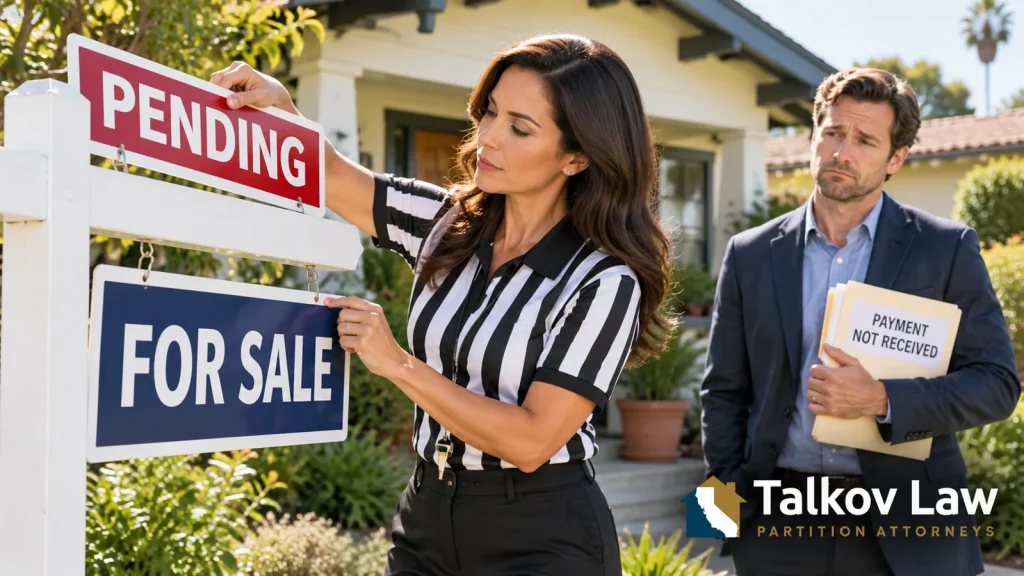
California Code of Civil Procedure section 873.760 (CCP 873.760) covers what happens when the buyer in a partition sale fails to pay after the court confirms the sale. A party or the partition referee can ask the court either to resell the property and make the buyer pay any loss, or to let the referee sue the buyer for the full price, with attorney’s fees in both cases. It is one of the California partition statutes that keep a partition action moving to a completed sale.
Full Text of CCP 873.760
If the purchaser, after the confirmation of the sale, fails to pay the sale price, the purchaser is subject to the court’s jurisdiction and to further proceedings in the action. Upon such failure, a party, or the referee, may upon notice move the court to order either of the following forms of relief:
(a) Resale of the property upon notice as provided in this chapter. If any loss is occasioned thereby, the referee may recover the amount of such loss and costs and expenses incurred, including a reasonable attorney’s fee, from the purchaser who failed to pay.
(b) Maintenance by the referee of an action against the purchaser for the amount of the sale price. If the referee recovers judgment, the referee shall be awarded a reasonable attorney’s fee against the purchaser.
California Code of Civil Procedure section 873.760 (added by Statutes 1976, chapter 73)
What Happens When a Partition Sale Buyer Fails to Pay
Once the court confirms a partition sale under CCP 873.730, the buyer is expected to close. The court’s confirmation order directs the referee to collect the price and sign the deed under CCP 873.750. Section 873.760 deals with the buyer who does not pay.
First, the buyer stays tied to the case. A buyer who fails to pay “is subject to the court’s jurisdiction and to further proceedings in the action,” so the buyer can be dealt with in the same partition case. Second, a party or the referee can bring a motion, on notice, asking the court to order one of two remedies:
- Resell the property. The referee sells again, with notice given the same way as for the first sale under CCP 873.640. If the second sale brings less, the referee can recover the shortfall, plus the costs and expenses of reselling and a reasonable attorney’s fee, from the buyer who failed to pay.
- Sue the buyer for the price. The referee brings an action against the buyer for the full sale price. If the referee wins a judgment, the court must also award the referee a reasonable attorney’s fee.
Either way, the co-owners who wanted the sale are protected. The case does not start over from the beginning, and the cost of the buyer’s default falls on the buyer rather than on the owners. For more on how the sale itself works, see our partition sale questions and answers.
Example: A Buyer Backs Out of a Confirmed House Sale
Suppose the court confirms the sale of a co-owned house for $900,000, and the buyer then fails to close. The referee moves for a resale, gives notice again, and sells the house for $860,000. The resale adds $6,000 in new marketing, notice, and escrow costs, and the court finds $8,000 in attorney’s fees reasonable:
- Loss on resale: $900,000 − $860,000 = $40,000
- Added costs and expenses of the resale: $6,000
- Reasonable attorney’s fee: $8,000
- Amount the referee may recover from the defaulting buyer: $40,000 + $6,000 + $8,000 = $54,000
The money the referee recovers goes back into the sale proceeds, so the co-owners end up close to where they would have been if the first buyer had paid. Our post on whether a partition sale yields fair market value explains why most sales close without this problem.
The Law Revision Commission Comments on CCP 873.760
The California Law Revision Commission recommended the partition statutes the Legislature enacted in 1976. Its comment on section 873.760 reads:
Section 873.760 continues the substance of the last sentence of former Section 785 with the added requirement of a court order on noticed motion of either a party or the referee and with the addition of express provisions for recovery of a reasonable attorney’s fee. To facilitate recovery under this section, the defaulting purchaser remains subject to the jurisdiction of the court.
California Law Revision Commission Comment to Code of Civil Procedure section 873.760 (1976)
In short, the 1976 law kept the old remedy but added two protections: a court order on a noticed motion before either remedy is used, and an express right to attorney’s fees against the buyer who defaulted.
Common Questions About a Buyer Who Fails to Pay
What Happens If the Buyer Backs Out of a Partition Sale?
If the court has already confirmed the sale, a party or the referee can move the court to order a resale or to let the referee sue the buyer for the price. The buyer remains subject to the court in the partition case and can be ordered to pay the loss, the added costs, and attorney’s fees.
Who Pays the Attorney’s Fees When a Partition Buyer Defaults?
The buyer who failed to pay. Section 873.760 makes a reasonable attorney’s fee recoverable from that buyer after a resale with a loss, and requires the court to award one if the referee wins a judgment for the price. Those fees are separate from the costs of partition the co-owners share under CCP 874.010. Our post on recovering partition attorney’s fees covers the co-owners’ side.
Does the Property Have to Be Marketed Again?
Only if the court orders a resale. A resale requires notice as provided in the partition chapter, which means the notice rules in CCP 873.640 and CCP 873.650 apply again, and the new sale is reported and confirmed under CCP 873.710 and CCP 873.720.
Where CCP 873.760 Fits in the California Partition Statutes
Section 873.760 sits in the article on reporting and confirming the sale. Before it, the referee sells under CCP 873.600 through CCP 873.690, including the private sale rules in CCP 873.680. The referee then reports the sale under CCP 873.710, a party moves to confirm under CCP 873.720, the court rules under CCP 873.730 and CCP 873.740, it fixes any commission under CCP 873.745, and it orders the referee to complete the sale under CCP 873.750.
After section 873.760, the article covers a co-owner or lienholder who buys in CCP 873.770, closing in CCP 873.780, and recording the deed in CCP 873.790. The money is then paid out under CCP 873.810 through CCP 873.850.
Talkov Law Partition Attorneys Can Help
A buyer’s default does not have to derail a partition sale. Moving quickly for a resale or a judgment for the price keeps the case on track and puts the cost on the buyer.
Talkov Law can help. With 12 full-time partition attorneys and experience in over 650 partition actions throughout California, our team handles every step of the process, from the referee’s sale and the confirmation hearing through closing, any resale, and the final distribution of proceeds. Call (877) PARTITION (727-8484) today or contact us online to get started.







